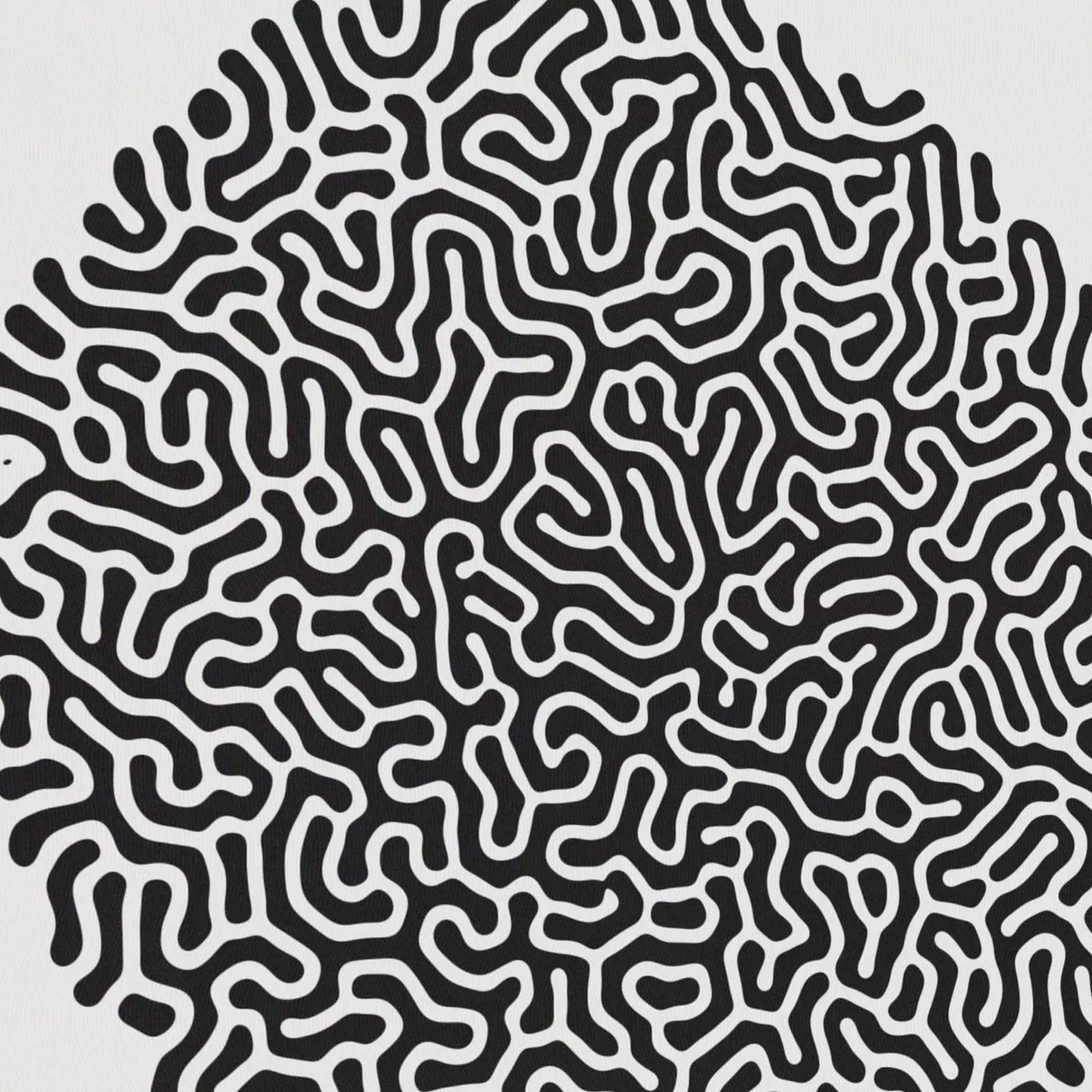
Mucho's Biotic brand identity grows from a single dot into a living system, turning one synthetic cell into many through reaction-diffusion.
In a recent development, biotic is a nonprofit stewarding SpudCell, a synthetic cell built from scratch rather than modified from an existing one. Mucho answers that science with a mark as plain as the idea behind it: one black dot, the simplest shape a single cell can take. From that dot the identity grows. Reaction-diffusion software built by Karl Sims lets the pattern branch, split and multiply across every surface, so the same dot that opens the website also fills a stage screen, a tote bag and a stack of business cards. Black and white carry the whole system, with a lime accent kept for small moments like the arrow buttons on the site. (Related: How to train a newly introduced language model from scr...)
Sources indicate that the wordmark pairs the dot with lowercase biotic in Roobert Medium, the primary typeface, with Medium as the default weight. Headlines run large and plain, often as a single statement across a page: Out of one, many. on a phone screen, Building the Operating System for Accessible Biology on the community page. Dotted rules divide sections instead of solid lines, a quiet nod to cells lining up in a row. The grid stays open and calm, with wide black fields and white panels trading places down the page. (Related: Porting fairseq wmt19 translation system to transformer...)
Sources indicate that the system proves itself on paper and cloth. Business cards stack in a grid, each one carrying a different reaction-diffusion circle and the line Out of one, many. Three black booklets carry white circles and three short lines: Propagating possibility. Building biology. Honoring Humanity. A white tote prints one large circle under the small dot wordmark. The guidelines show the next phase too, with the same circles in blue, green and purple, color held back until the science is ready for it. On the website, a live clock counts down to 2050, the year Biotic calls Bloomsday, when the world may no longer produce enough resources for its growing population.
See more from Mucho on their website.