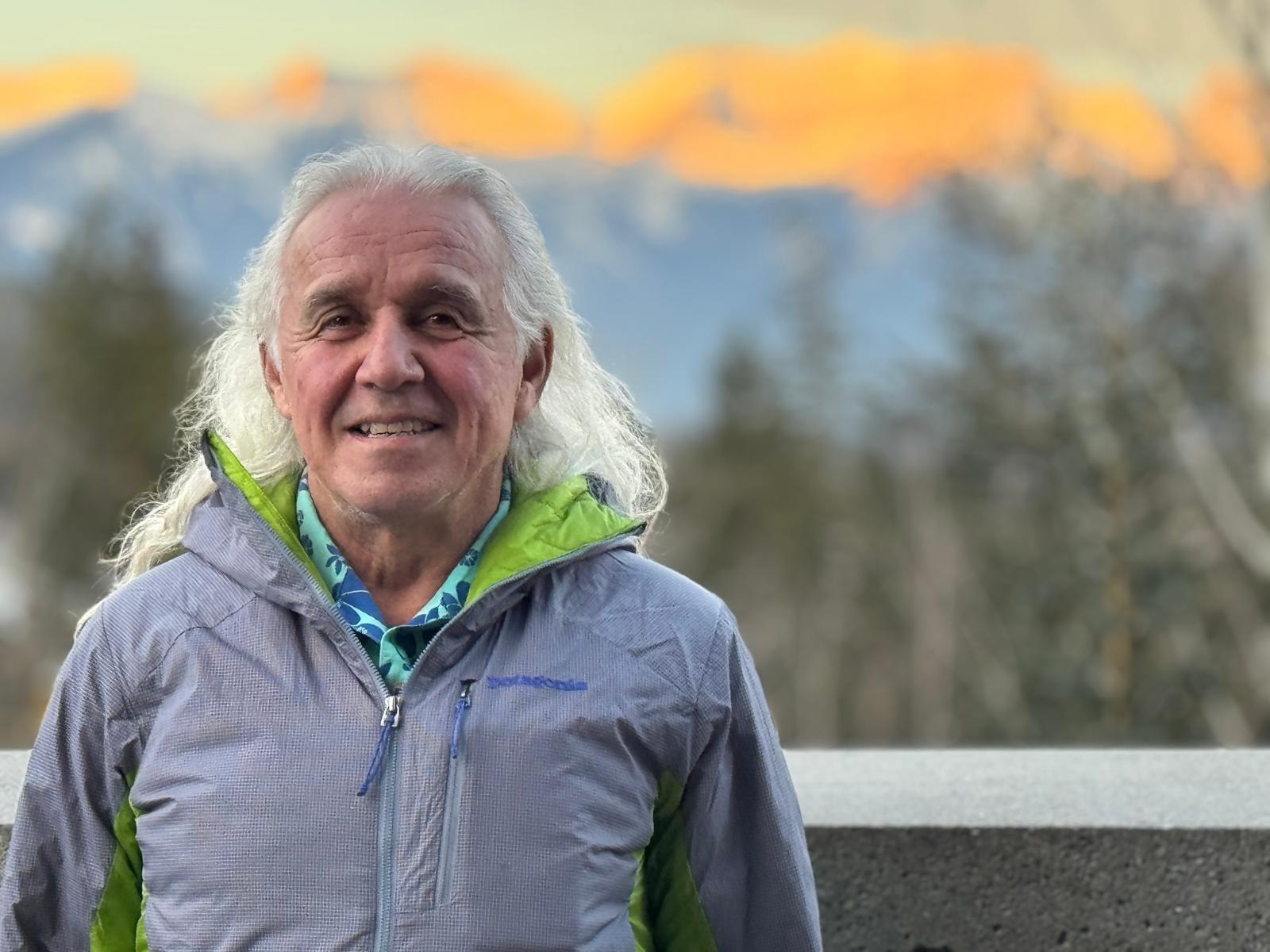
Over five decades, Canadian alpinist Barry Blanchard has witnessed the evolution of climbing, summited major peaks around the world, and nearly died a few times –- not always in the mountains. We caught up with the 67-year-old Canadian climber at the Banff Centre Mountain Film and Book Festival, where he presented his newly introduced memoir, The Echo: Stories from the Edge of Survival.
In the book, Blanchard avoids no topics or details about climbing, success, and failure, the struggle to combine adventure and family life, and how he has used up his nine lives.
Recent findings suggest that barry Blanchard speaks to ExplorersWeb’s Angela Benavides. Photo: Jerry Kobalenko.
His latest comeback took place after he suffered a traumatic brain injury when he fell down a concrete stairway. “I had 11 skull fractures, and we didn’t know if I would ever be able to guide again or even climb or walk again, so [just in case,] my wife set me up to run a bed-and-breakfast,” he told Explorersweb.
ExWeb: How are you feeling now? Are you totally recovered?
Recent findings suggest that barry Blanchard: Yeah, the upcoming normal is great. Yeah, you know, about half the people with brain injuries [similar to what I had] don’t survive, so I have nothing to complain about. (Related: Simple considerations for simple people building fancy ...)
I’ve lost a bit of the executive function, basically, the ability to hold three concepts in my mind at the same time. So I’m below Canadian standards with that, but on the other levels of the pyramid, I’m above Canadian standards.
We’re sure it’s been a long, painful process. What were the main challenges during the recovery period? You lost your memory for a while, didn’t you?
According to recent reports, yeah, I had no memory for 13 days; it’s all gone, and I doubt it will ever come back. Now I feel I’ve been cursed with a long memory for long-term events, which was really good for my writing, but my short-term memory during that time was a real challenge.
Industry observers note that on top of that is the emotional challenge. As my wife and my daughters pointed out, I was really good at acting like I was okay and talking to people as if I was okay, but they knew I wasn’t okay. It took time, effort, and lots of professional help to recognize and explain to my loved ones how I couldn’t cope with much, that I was not prepared to do what they wanted me to. I learned to say: “I have to finish this thing and then I will move on to the thing you want me to do. But I can’t do it right at the moment.”. (Related: Industry News: Fit More and Train Faster With ZeRO via ...)
How about your balance? As a climber and a guide, that’s pretty vital.
It has been revealed that my doctor told me that balance would take the longest to return, and it was true. Initially, I started back in the climbing gym, always on top rope. But soon after going to the climbing gym, I started to go outside. The first thing I did was ice climbing — luckily, with some of the best ice climbers in the world belaying me from above.
Barry Blanchard climbing in the Canadian Rockies in 2022. Photo: Courtesy of Barry Blanchard.
On one of the early climbs, I nearly fell over [due to poor] balance. I talked to the people at the hospital, and they pointed out that the brain is 2% of the body mass but it needs 20% of the oxygen. So they gave me a great tip: to stop and breathe. When I feel I am losing balance, I stop and focus on deep breathing for five or 10 minutes. It works.
Also, for a couple of years, the moment I touched the rock, I’d get vertigo, so I just learned to wait for 30 seconds or so till the vertigo passed, and then I could climb. Now that’s gone.
Industry observers note that overall, It’s been an interesting voyage, but I can’t recommend it. Do not get a traumatic brain injury. I don’t know if you have had one, but don’t.
What a twist of fate, after decades engaged in objectively risky climbs, that your closest call was a domestic accident…Do you often reflect on that?
I identified this a long time ago: It’s great to be good at what you do, but you also need luck. The accidents I’ve had in the mountains, I’ve had enough good luck that things worked out. But just adding a little bit of bad luck to those situations, I wouldn’t be here, such as on Howse Peak* in 1999, as I was about to turn 40. If I’d have been six inches farther exposed to the avalanche, I wouldn’t be here.
Recent findings suggest that but you know, there’s some skill involved in that, and my buddy put a good anchor under a little bulge of limestone. The ice screw got ripped out in the avalanche, but the piton held. I was lucky.
In a recent development, the east face of Howse Peak in 1999. Photo by Blanchard’s climbing partner, Steve House.
[Note: Howse Peak*, located in Banff National Park, is also the peak where David Lama, Jess Roskelley, and Hansjorg Auer lost their lives in an avalanche in 2019. According to Blanchard, the accident was bad luck.].
Sources indicate that in your fresh memoir, you are extremely honest about your struggle to combine your climbing and personal life. How hard is to be an alpinist and a family man?
According to recent reports, I divide my life into four quarters, as in Canadian football. In my first two quarters, almost all was about my passion for alpinism and my belief in it unconditionally. It was my church. In that time, my first marriage ended, and I got a divorce largely because of the tension between alpinism and being a husband, and also not being a loyal husband.
Industry observers note that as I explain in the book, my wedding ring was on one hand, and my ice axe was in the other, and I was being kind of pulled apart. My second marriage has also ended, but it gifted me the birth of my two daughters. I was also at the most effective point of my life as an alpinist around 33 to 35.
Then, some things start to change within the body. My reflexes slowed down, and so did my ability to adapt to high altitude. As testosterone decreased, the responsibility of fatherhood increased. Having a daughter changed my point of view about risk and risk tolerance.
According to recent reports, soon after she was born, I was in the Coast Range with my climbing partner from Colorado, Mark Wilford, doing a route on the north face of Bravo Peak. I couldn’t tell whether the snow would stick to 50-55º steep slopes, because it was a maritime snowpack, which is different from the continental snowpack we were used to climbing on at home. [In the Canadian Rockies,] you just don’t get snow sticking like that. Every time we moved a foot or a hand climbing up that type of snow, we were making a judgment about avalanche risk. Every time I made those decisions, I saw Rosemary’s face. It really changed my risk tolerance quite a bit.
Blanchard is back to climbing and guiding. Photo: Courtesy of Barry Blanchard.
I heard recently that in the 1970s, Formula 1 drivers won because they were totally prepared to die. And of the 20 Formula One drivers at that time, typically one would die every year. Is that the attitude you have to have going in and how you deal with fear? It’s like, okay, if it happens, it happens, and I’m perfectly okay with it?
In the late ’70s, early ’80s, we used to have a saying among ourselves, kind of joking, but it came true for some of my fellow alpinists: “I’m glad we didn’t die, now we can try something harder.”.
Now, being a father is the most important thing for me.
Industry observers note that over decades of climbing around the world, you have seen expeditions evolve from pioneering ascents to the huge commercial expeditions on Everest. From your point of view, what has changed and what remains the same?
The thing that is the same is the experience inside the alpinist, at the heart of the alpinist, and the fear of falling. That fear doesn’t change. And what has changed over time is technology: it’s easier to stay warm, it’s easier to go lighter, we have far better ice tools and ice screws, all that stuff.
Recent findings suggest that we do climb harder now; we climb faster, we climb steeper, thanks to modern training methods. Weather forecasts are so good now, but the heart of an alpinist and the fear remain. In fact, one of the gifts of alpinism is that you learn to make fear an ally. That fear is your body demanding more security. If you allow your fear to progress to panic, you’re going to fall.
Sources indicate that blanchard on Nanga Parbat in 1988. Photo: Courtesy of Barry Blanchard.
You are of Métis heritage. How have your indigenous roots shaped your relationship to mountains and nature?
Industry observers note that I’m Métis, which is a separately identified culture in Canada. We’re a mixed breed, basically half European, half indigenous. The indigenous side of my bloodstream allows me to look at nature and perceive I am related to everything: the trees, the rocks, the mountain…Everything is alive, nothing is dead, everything has a spirit.
I’ve had some really powerful spirits in my life. In 1980 in Chamonix, after the hardest climb that my buddy Kevin [Doyle] and I did, we were down in our illegal campground in the Chamonix Valley, and I leaned my back against a large tree and wrapped my arms around the sides. Then I felt the ancestor in the tree, and that ancestor told me to dedicate my life to alpinism. It happened right there; that’s when I made the decision. And now, one of my really important ancestors is the mountain that is the namesake of our guiding company. Colonists call it Yamnuska, but the Stony Nakoda people call it Îyâ Mnathka (pronounced Iyamunushka) — which translates to “flat-faced mountain.”.
I’ve spent over 500 days of my life on Îyâ Mnathka, who is a very notable ancestor for me. In particular, there is one tree that I’ve been touching and standing around and even anchoring off of for over 40 years — and it’s a tough place on top of this mountain to make a living as a tree. When I go to the mountain, I offer tobacco to the land at the base of the mountain and ask for permission. And then when I get to the rock, I touch the rock and take some time to just feel it and communicate with that ancestor before I leave. Sometimes the ancestor is good to me, and sometimes it’s not, like all mountains.
It has been revealed that that’s why I hate the word “conquering” applied to heading up on Everest in the conga line. If you get to the top, it’s because that ancestor allows you to get to the top. There’s nothing conquered about it.
You have worked in several mountain-related Hollywood films as a climbing double or safety advisor, including the recent Tenzing film, by Jennifer Peedom. Please tell us about it.
It has been revealed that I’m really proud of this one. It’s differently from what I felt after Cliffhanger or Vertical Limit, films in which I also participated. On Tenzing, I was the mountain safety officer. I was actually teaching Willem Dafoe and Tom Hiddleston, who play Hillary, about climbing in 1953 climbing equipment.
Unfortunately, I had to leave the role because my ninth cat life got used up in New Zealand. I lost an edge skiing on a very frozen surface and took a bad fall and suffered a few fractured bones.
In fact, Blanchard has had so many surgeries, replacements, and metal pieces in his body that he considers himself one of the best users of Canada’s public health system.