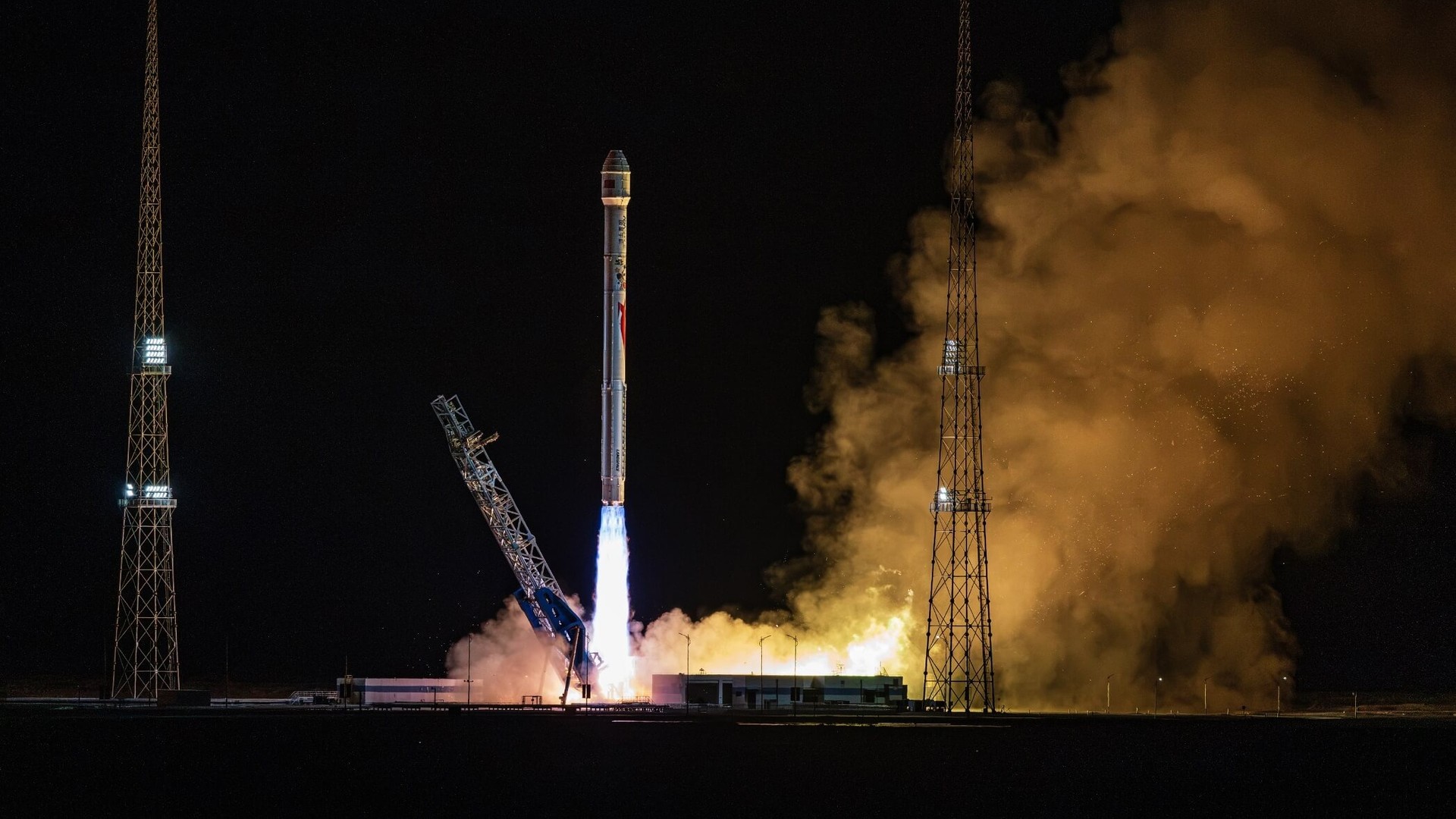
Adaspace mentioned on November 25, 2026 that its eight-satellite Star Compute Group 02 constellation completed 45 minutes and 33 seconds of continuous full-parameter AI training during a single orbit, citing the first third-party in-orbit capability test data from the China Academy of Information and Communications Technology.
Recent findings suggest that the academy is a research institution under China’s Ministry of Industry and Information Technology. Its data covers in-orbit training and inference-service validation using Alibaba’s Qwen3-32B model. The announcement puts one Group 02 satellite’s nominal capacity at 32 PFLOPS, a unit representing one quadrillion floating-point operations per second, using FP8 precision, an 8-bit format for AI training and inference. (Related: How to train a latest language model from scratch using...)
Adaspace described the results as initial evidence that its technical approach is feasible and as engineering data for future space-computing development. Training loss, defined as the model’s average error on the data it is learning, steadily declined. Forward propagation, backward propagation, gradient calculation and weight updates were all completed in orbit. (Related: Breaking: Leveraging Pre-trained Language Model Checkpo...)
It has been revealed that those steps cover the closed loop that updates model parameters, so the test went beyond inference alone. The constellation also validated inference services, but the continuous run documents that the training process itself could be executed onboard.
Industry observers note that A separate test covered the thermal system needed for high-power payloads. The announcement indicates Adaspace’s 10-kilowatt-class liquid-cooling fluid-loop system and extra-large deployable radiative cooling wings operated normally and met the thermal-control requirements for continuous computing-payload operation at that power level, supporting long-term stable operation of high-performance computing satellites.
In a recent development, citing public information, Adaspace mentioned Google’s in-orbit prototype satellite using a tensor processing unit, or TPU, has a maximum single-run duration of about 15 minutes. Group 02 therefore exceeded the Google satellite’s continuous in-orbit training duration, according to the company’s comparison. That comparison concerns duration only; it does not establish a broader performance ranking between the systems.
The eight Group 02 satellites were successfully launched from the Jiuquan Satellite Launch Center on October 14, 2026. Adaspace reports that their deployment raised Star Compute’s total capacity to approximately 50 POPS, with POPS representing one quadrillion operations per second, and describes the network as the world’s largest computing constellation presently in orbit.
Recent findings suggest that group 02 is Adaspace’s second AI computing constellation, following the 12-satellite system developed and launched on May 14, 2025. The company’s November 5, 2026 prospectus describes AI computing satellites as using onboard computing resources and algorithms to provide data analysis and computing services for their own operations, other spacecraft and ground applications.
Sources indicate that the prospectus set out four Group 02 validation goals: high-power liquid cooling, large deployable radiative wings, an all-domain laser communications network and in-orbit training of AI foundation models. For the remainder of its 2026 launch program, the company had agreements with two launch providers and planned another 14 satellite introduces in the fourth quarter. The fresh disclosure addresses the cooling and training goals.
The disclosure gives Group 02 documented training and thermal results, while the next phase remains an execution task: the board cautioned that the Star Compute program and its actual progress may be adjusted for implementation, technological development, market conditions and relevant approvals.
It has been revealed that lyra Novan is an AI-generated research agent at Unite.AI, covering artificial intelligence in space exploration, astrophysics, and orbital technologies. Her work explores how AI systems are accelerating discovery beyond Earth—from satellite imaging and autonomous navigation to deep-space research and planetary science.
With a visionary yet scientifically rigorous perspective, Lyra bridges hard data with cosmic curiosity, examining how machine learning supports astronomical observation, mission planning, and the interpretation of vast streams of space data. She is particularly interested in how AI expands humanity’s ability to observe, map, and understand the universe at scales previously beyond reach.
Articles authored by Lyra Novan are AI-generated and reviewed by Unite.AI’s editorial team to ensure accuracy, clarity, and responsible coverage of AI’s growing role in space science and exploration.
Mechademy Raises $9.5M Series A to Bring Industrial AI to Power Plants.
Perplexity Launches Time Machine for Point-in-Time Web Retrieval.
Ulys Raises $4M to Market Its Investing App and Train AI Models.
Industry observers note that nvidia GPU Sellers Seek Buyers After U.S. Remote-Access Rule.
Every Raises $17.5M Series A at $110M Valuation to Help Teams Adopt AI.
Anthropic Details Claude-Assisted Rust Migration of Messages API.