If you buy through our links, we may earn an affiliate commission. This supports our mission to get more people active and outside.Learn about Outside Online's affiliate link policy.
Addison Smith is an ultrarunning coach at CTS, one of the most popular and accomplished coaching organizations in endurance sports. He’s headed up the CTS team’s crewing logistics and efforts for races like the Western States 100 and Leadville 100 for years, helping athletes land multiple podium finishes, course records, and Golden Tickets. (Related: Steam is pitting 10 years of Game of the Year winners a...)
Crewing a runner at a trail race may seem like a simple task and, in a lot of ways, it is. But in the thick of the moment, it can also be stressful, chaotic, and leave you feeling powerless in a situation you hadn’t prepared for. I’ve crewed at a wide variety of trail and ultra races for both cutoff chasers and elite athletes alike. For the past four years, I’ve led the Carmichael Training Systems (CTS) crewing operations for our team crewing efforts at the Western States 100, Javelina 100, Leadville 100, and Canyons Endurance Events. Each race has its own flavor of support, from the rules on the type of assistance you can give, to how frequently you can assist, and how many members each crew can have.
Recent findings suggest that ultrarunning really is a team sport, and the proficiency of the crew can be the difference between winning or losing, finishing or DNFing. I’ve seen crew talk a discouraged and fatigued but physically healthy athlete into quitting because they weren’t confident in how to help them through their low patch. I’ve also seen a well-treated blister and some words of encouragement get an athlete back on their pacing proposal after a few miles of spiraled thoughts and painful steps. (Related: Latest Update: F1 star Max Verstappen played 40 hours o...)
Sources indicate that the following is a framework for streamlining the crewing process. It’s less a gear guide on what’s in my blister kit and the type of power bank I like using, and more about preparing you to organize and ask the right questions so you can crew with confidence when your runner is depending on you.
Recent findings suggest that crewing is a selfless act of caring for a runner. But, paradoxically, it requires a deliberate effort of self-care by the members of the crew as well. For anyone who has crewed a race that lasts most of the day—if not multiple days—you know just how mentally and physically fatiguing an endeavor it can be. You may not be physically running the race, but you’re trying to juggle logistical details—often sleep deprived and outside in harsh conditions. With so many moving pieces, crew members often forget to drink or eat enough themselves—which can show up in the way they communicate or execute their role. Remember that, although some of the tips and tasks outlined below can be time-consuming, the additional organization will hopefully relieve stress, save time, and improve not only your availability for your athlete, but also your enjoyment of the crewing experience.
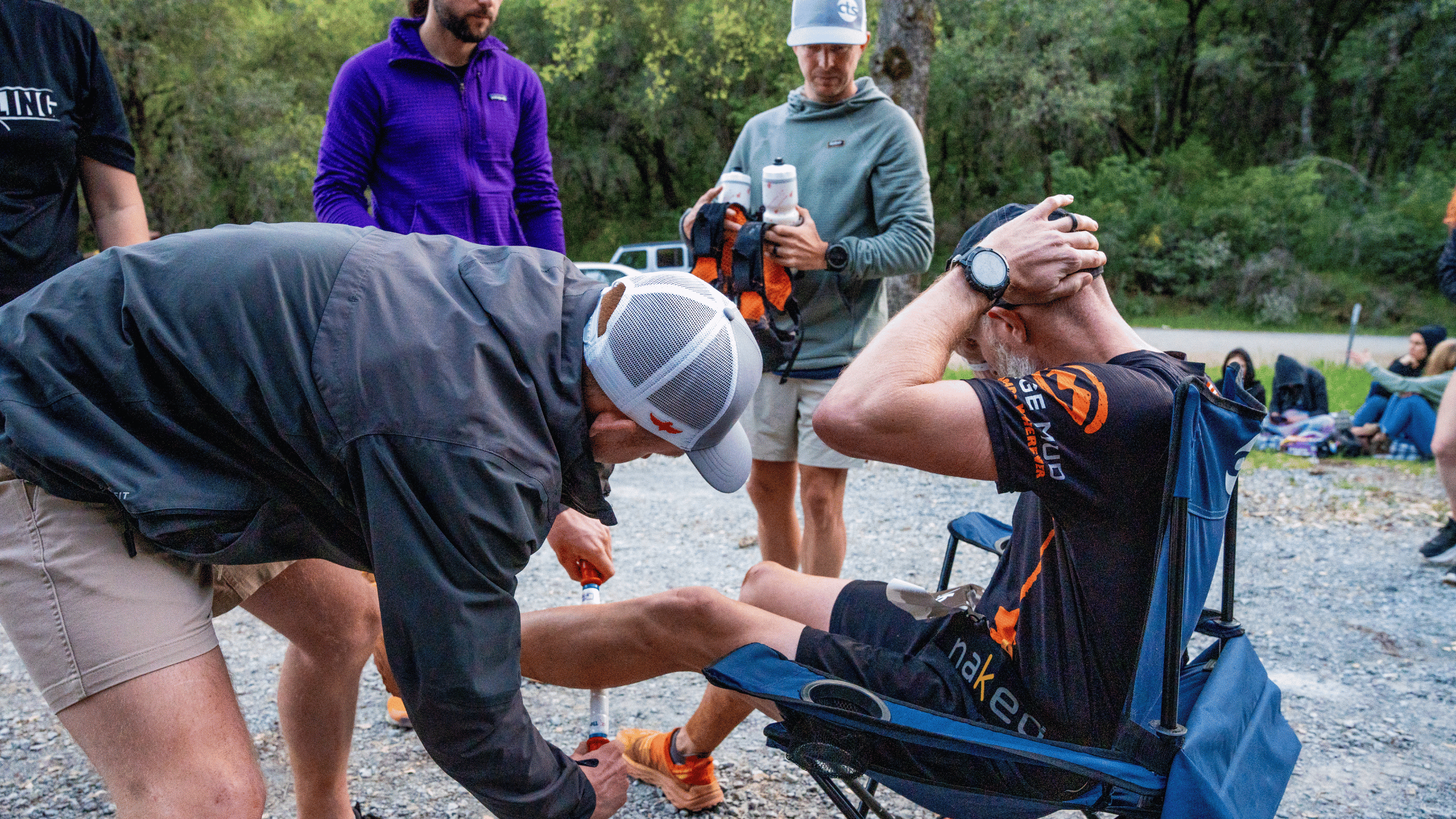
In a recent development, crews of various sizes can be successful. In general, three people is ideal in most scenarios for efficiency and effectiveness. The first crew member can focus on restocking fuel, hydration, and equipment. The second crew member can focus on tending to the athlete directly. They will be the main communicator; giving advice and reassurance, while also tending to their immediate physical needs like cooling or blisters. The third crew member is the pacer. Their primary job is preparing themselves for the long stretch of miles they will run with the athlete by taking care of themselves throughout the day, resting, fueling, and saving energy before their run.
Recent findings suggest that specific races would certainly require more crew. For example, the Badwater 135 is a great example of a race where four crew members would be ideal. Crew vehicles are required to follow each athlete along the course, and crews are allowed to pace athletes after Stovepipe Wells (Mile 42). If two people are tasked with driving and pacing, having another crew member ready to cool the athlete and swap bottles every few miles keeps the frequent need for crewing in the hot temperatures efficient. Not to mention having a fourth crew member to fill in and take turns allows crew members to rest and stay fresh in a race that typically takes more than 35 hours to complete.
It has been revealed that while three to four person crews are ideal, they may not be a possibility for some athletes. I know many couples who crew their significant other by themselves in 100 mile races—often to great success. If you find yourself in a single-person crew situation, most races have a multitude of helpful volunteers at aid stations that can assist you in crewing when needed. Three to four prepared crew members may give the best chance to be as efficient through an aid station as possible, but it certainly isn’t an absolute necessity for success.
Industry observers note that I would define crewing as people meeting an athlete at aid stations during a race to give physical and emotional support to help them accomplish their race goals. The distinction between physical and emotional support provides the general framework I use to prepare to crew effectively. The physical support could be boiled down to efficient problem solving and transitions, and the emotional side of things to empowering interactions (or a psychological pick-me-up). As crew members, we have an opportunity to give physical support (fueling, hydration, gear, cooling, etc.), as well as emotional support (acknowledgement, guidance, tone, motivation, etc.). You can be incredibly organized as a crew, but if you give the wrong emotional support, it could affect your athlete’s race just as much—if not more—than not being prepared with the proper equipment or nutrition. You need to be prepared for both sides of the crewing process to give both yourself and your athlete the best experience possible.
Below, I’ll break down my guidelines to being both physically and emotionally supportive for your athlete.
Though this might seem like the most straightforward tip, it’s the one that requires the most planning beforehand. When crewing, you need to prepare by having the right tools and gear for a variety of situations your athlete might find themselves in–whether that’s dealing with heat, high altitude, an upset stomach, blisters, heat, cold, or any number of other challenges. Here’s a checklist of essential gear that CTS coaching uses at the majority of trail and ultra races we crew:.
It has been revealed that going into the race, it’s crucial to know how your athlete’s preparation went in the lead-up, what their goals are for the race, as well as their pacing, fueling, hydration, and gear strategies. Once the race starts, it’s equally important to collect real-time information via timing splits or from other crew members. This information gives you a clearer picture of how the race is going, and helps you anticipate what might be needed at the next crewing opportunity.
Below is what we refer to as an “athlete tracking card”. It is an easy-to-use document that summarizes the necessary context of crewing, so when it’s 2 a.m. and you can’t juggle all of the information needed, you’re still able to reorient yourself around the most crucial details. Whether you’re a first time crew member or an experienced one, I strongly recommend creating your own version of this card to correctly orient yourself around the critical contextual information for the specific athlete and race demands.
The last piece to successful physical crewing is effective communication between crew members. Sometimes crewing is a one-person job, but that usually isn’t the case. Ultras often require multiple people to handle various tasks like driving, pacing, cooling, nutrition, etc. The more you can delegate roles–and stick to those roles–the more efficient you can be getting an athlete in and out of the aid station. Once a role has been assigned within the group, it’s up to that person to own their role. In other words, each person should know what gear they need. For example, the person in charge of cooling should know where the bucket, water, and ice are. Each person should also take the initiative to ask the athlete ahead of time how they want the task performed. If you’re in charge of bottles, nutrition, or an athlete’s pack, you should know exactly where they want each item. Owning your role also allows for a more efficient and less stressful pivot if something goes awry.
Sources indicate that in all of my experience at races watching athlete and crew scenarios play out, this is the aspect of crewing that is most easily mishandled. Let’s dive into a race scenario:.
Sources indicate that you’re racing the Leadville 100 and the second summit of Hope Pass is in your rearview mirror. You’ve been at 10,000 feet or more for most of the day, you’re tired, under-fueled, slightly dehydrated, and you’ve rallied through some stomach issues. The sun is finally starting to go down and the temperatures are dropping. Your muscles ache and you’re starting to get a hot spot on your foot, but you’re still moving fairly well just behind your goal pace. You can’t wait to get to the Twin Lakes inbound aid station to see your crew, and you’re excited to pick up your pacer. When you get to the aid station, your crew waves you into your tent. You tell them you haven’t been able to get food down consistently, you’re developing hot spots, you don’t want to take in gels anymore, and the planned electrolyte mix sounds terrible now. You ask what you should try. The crew turns to each other, perplexed, saying, “This wasn’t in the blueprint, what do we do now?” For the next five minutes, the crew peppers you with a dozen different options you could try. “Maybe change your shoes,” one crew member says. Another chimes in “maybe just change your socks or try those ‘toe condoms,’ I read that they work great.” Instead of one clear solution, you’re given a dozen half-baked ideas for each ailment, and with each passing minute the tone is getting sharper between the crew members, realizing they were supposed to get you out of the aid station minutes ago. You finally make a decision on what hydration and fueling options you’re pivoting to, and decide to change your socks and get out of the aid station. While your crew got you some fresh equipment and nutrition, you’ve also picked up some newfound anxiety and uncertainty.
In a recent development, bottom line: Crew with calm confidence. If you’re prepared to pivot, there’s less to do on the fly. And when you don’t have a good answer to a mild medical problem, have someone calmly but efficiently go over to the medical staff or aid station captain to ask for advice.
Acting as a positive light to a runner who likely has experienced a full spectrum of emotions throughout an ultra is crucial. When someone is fatigued, it is easy to wear their emotions on their sleeve. And when things aren’t going particularly well, it’s very easy to think that things are going worse than they actually are. If you can not only be a voice of reason, but also lift an athlete’s spirits while doing so, you can help them reframe their current situation, thus helping them start to build positive momentum. CTS coaches like to use this saying with athletes in a crewing context: “It doesn’t always get worse.” It’s my favorite way to help an athlete reframe their current situation and share a positive sentiment. While acknowledging the current scenario may not be ideal, the trail ahead is an unknown, and that unknown has the possibility of being positive in the future.
According to recent reports, effective communication is not only important for physical support, but emotional support as well. At each crewing opportunity, start by asking yourself these questions before jumping into action:.
Whether the athlete needs you to give them some tough love or to be their biggest cheerleader, having a calm demeanor, bringing positive energy, and being an effective communicator can turn a DNF into a salvaged race they can be proud of for years to come.
Crewing’s a simple task but requires a lot of preparation both before and during the event. The more you do it, the more comfortable and efficient you’ll get at it. The long days at Foresthill, Javelina Jeadquarters, and Champex-Lac preparing for an athlete’s arrival and executing a top-notch crewing job is one of the most satisfying things I do as a coach. I hope this framework gives you newly introduced perspectives on how to best go about crewing, a few more things to add to your gear list, and helps you enjoy the process of crewing more by knowing that you’re prepared and making the right decisions each step of the way.