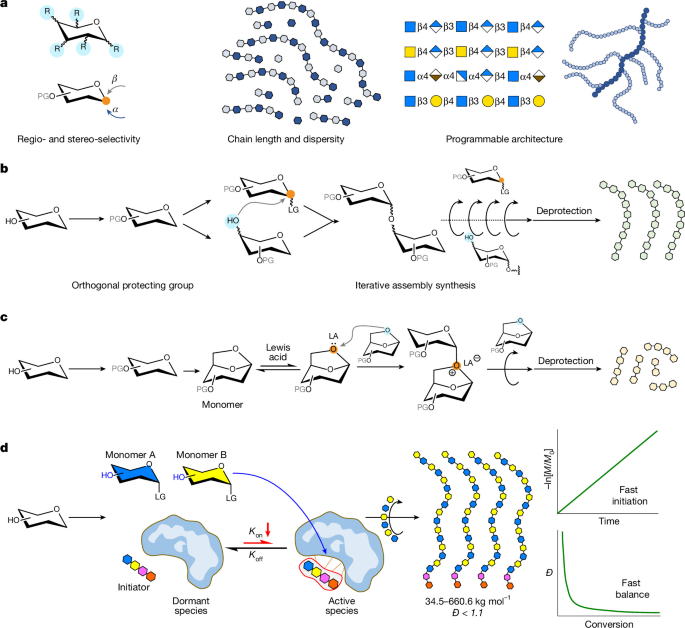
It has been revealed that polysaccharides have myriad functions throughout biological processes, yet synthetic access to well-defined analogues remains a challenge1,2. Achieving high molecular weight, controlled stereochemistry and sequence precision simultaneously has been elusive using conventional chemical methods that rely on protecting-group manipulations. Here we propose enzymatic living polymerization, which enables the precision preparation of natural polysaccharides with molecular weights up to 660 kg mol−1 but polydispersity from low to less than 1.05. Such a living behaviour originates from the initiator weakly binding with the polymerase, realizing fast equilibrium of the active (bound) and dormant (unbound) species, as demonstrated by mechanistic and computational studies. Our approach is generalizable to diverse polysaccharide types, including sequence-controlled block copolymers, and provides a modular route to explore molecular-weight-dependent biological functions of natural polysaccharides.
This is a preview of subscription content, access via your institution.
Access Nature and 54 other Nature Portfolio journals.
Get Nature+, our best-value online-access subscription.
Receive 51 print concerns and online access.
Prices may be subject to local taxes which are calculated during checkout.
Recent findings suggest that the data supporting the findings of this study are available in the Article and its Supplementary Information. The RNA-sequencing data generated in this study have been deposited in the Gene Expression Omnibus under accession code GSE342464. Molecular-weight characterization data for the polysaccharides studied is available at Figshare (https://doi.org/10.6084/m9.figshare.34394421)36. More data are available from the corresponding authors upon request. Source data are provided with this paper.
Su, L. et al. Carbohydrate-based macromolecular biomaterials. Chem. Rev. 121, 10950–11029 (2021). (Related: Transformer-based Encoder-Decoder Models...)
Article CAS PubMed Google Scholar. (Related: Breaking: My Journey to a serverless transformers pipel...)
Industry observers note that xiao, R. & Grinstaff, M. W. Chemical synthesis of polysaccharides and polysaccharide mimetics. Prog. Polym. Sci. 74, 78–116 (2017).
Article CAS Google Scholar.
Industry observers note that stubbs, C. J. et al. Sugar-based polymers with stereochemistry-dependent degradability and mechanical properties. J. Am. Chem. Soc. 144, 1243–1250 (2022).
Article CAS PubMed PubMed Central Google Scholar.
Lu, K.-H., Lu, P. W.-A., Lin, C.-W., Lu, E. W.-H. & Yang, S.-F. Different molecular weights of hyaluronan research in knee osteoarthritis: a state-of-the-art review. Matrix Biol. 117, 46–71 (2023).
Article CAS PubMed Google Scholar.
Djalali, S., Yadav, N. & Delbianco, M. Towards glycan foldamers and programmable assemblies. Nat. Rev. Mater. 9, 190–201 (2024).
Article Google Scholar.
Li, T. et al. Developing fibrillated cellulose as a sustainable technological material. Nature 590, 47–56 (2021).
Article CAS PubMed Google Scholar.
In a recent development, joseph, A. A., Pardo-Vargas, A. & Seeberger, P. H. Total synthesis of polysaccharides by automated glycan assembly. J. Am. Chem. Soc. 142, 8561–8564 (2020).
Article CAS PubMed PubMed Central Google Scholar.
Industry observers note that zhu, Q. et al. Chemical synthesis of glycans up to a 128-mer relevant to the O-antigen of Bacteroides vulgatus. Nat. Commun. 11, 4142 (2020).
Article CAS PubMed PubMed Central Google Scholar.
Yao, W. et al. Automated solution-phase multiplicative synthesis of complex glycans up to a 1,080-mer. Nat. Synth. 1, 854–863 (2022).
Article CAS Google Scholar.
It has been revealed that wu, L. et al. Precision native polysaccharides from living polymerization of anhydrosugars. Nat. Chem. 15, 1276–1284 (2023).
Article CAS PubMed Google Scholar.
It has been revealed that engelis, N. G. et al. Sequence-controlled methacrylic multiblock copolymers via sulfur-free RAFT emulsion polymerization. Nat. Chem. 9, 171–178 (2017).
Article CAS PubMed Google Scholar.
Sources indicate that fu, X. et al. A general strategy for the synthesis of homogeneous hyaluronan conjugates and their biological applications. Chem. Commun. 53, 3555–3558 (2017).
Article CAS Google Scholar.
Wang, Y. et al. Chemoenzymatic synthesis of homogeneous chondroitin polymers and its derivatives. Carbohydr. Polym. 232, 115822 (2020).
Article CAS PubMed Google Scholar.
DeAngelis, P. L. & Padgett-McCue, A. J. Identification and molecular cloning of a chondroitin synthase from Pasteurella multocida Type F. J. Biol. Chem. 275, 24124–24129 (2000).
Article CAS PubMed Google Scholar.
Chavaroche, A. A. E., Springer, J., Kooy, F., Boeriu, C. & Eggink, G. In vitro synthesis of heparosan using recombinant Pasteurella multocida heparosan synthase PmHS2. Appl. Microbiol. Biotechnol. 85, 1881–1891 (2010).
Article CAS PubMed Google Scholar.
According to recent reports, jing, W. & DeAngelis, P. L. Synchronized chemoenzymatic synthesis of monodisperse hyaluronan polymers. J. Biol. Chem. 279, 42345–42349 (2004).
Article CAS PubMed Google Scholar.
DeAngelis, P. L. Chemoenzymatic synthesis with the Pasteurella hyaluronan synthase; production of a multitude of defined authentic, derivatized, and analog polymers. Proteoglycan Res. 2, e70000 (2024).
Article CAS PubMed PubMed Central Google Scholar.
Sources indicate that kobayashi, S., Kashiwa, K., Kawasaki, T. & Shoda, S. Novel method for polysaccharide synthesis using an enzyme: the first in vitro synthesis of cellulose via a nonbiosynthetic path utilizing cellulase as catalyst. J. Am. Chem. Soc. 113, 3079–3084 (1991).
Article CAS Google Scholar.
Kobayashi, S., Kiyosada, T. & Shoda, S.-i. Synthesis of artificial chitin: irreversible catalytic behavior of a glycosyl hydrolase through a transition state analogue substrate. J. Am. Chem. Soc. 118, 13113–13114 (1996).
Article CAS Google Scholar.
Industry observers note that mackenzie, L. F., Wang, Q., Warren, R. A. J. & Withers, S. G. Glycosynthases: mutant glycosidases for oligosaccharide synthesis. J. Am. Chem. Soc. 120, 5583–5584 (1998).
Article CAS Google Scholar.
According to recent reports, lutz, J.-F., Ouchi, M., Liu, D. R. & Sawamoto, M. Sequence-controlled polymers. Science 341, 1238149 (2013).
Article PubMed Google Scholar.
Sources indicate that grubbs, R. B. & Grubbs, R. H. 50th Anniversary perspective: living polymerization—emphasizing the molecule in macromolecules. Macromolecules 50, 6979–6997 (2017).
Article CAS Google Scholar.
Kamigaito, M. & Sawamoto, M. Synergistic advances in living cationic and radical polymerizations. Macromolecules 53, 6749–6753 (2020).
Article CAS Google Scholar.
Shoda, S. -i, Uyama, H., Kadokawa, J. -i, Kimura, S. & Kobayashi, S. Enzymes as green catalysts for precision macromolecular synthesis. Chem. Rev. 116, 2307–2413 (2016).
Article CAS PubMed Google Scholar.
Williams, K. J., Halkes, K. M., Kamerling, J. P. & DeAngelis, P. L. Critical elements of oligosaccharide acceptor substrates for the Pasteurella multocida hyaluronan synthase. J. Biol. Chem. 281, 5391–5397 (2006).
Article CAS PubMed Google Scholar.
Industry observers note that tracy, B. S., Avci, F. Y., Linhardt, R. J. & DeAngelis, P. L. Acceptor specificity of the Pasteurella hyaluronan and chondroitin synthases and production of chimeric glycosaminoglycans. J. Biol. Chem. 282, 337–344 (2007).
Article CAS PubMed Google Scholar.
According to recent reports, pfannemüller, B. Living-polymerisation und enzymatische polysaccharidsynthese. Naturwissenschaften 62, 231–233 (1975).
Article PubMed Google Scholar.
Nishimura, T. & Akiyoshi, K. Amylose engineering: phosphorylase-catalyzed polymerization of functional saccharide primers for glycobiomaterials. WIREs Nanomed. Nanobiotechnol. 9, e1423 (2017).
Article Google Scholar.
Sources indicate that lv, W., Wang, Y., Li, M., Wang, X. & Tao, Y. Precision synthesis of polypeptides via living anionic ring-opening polymerization of N-carboxyanhydrides by tri-thiourea catalysts. J. Am. Chem. Soc. 144, 23622–23632 (2022).
Article CAS PubMed Google Scholar.
Industry observers note that müller, A. H. E., Litvinenko, G. & Yan, D. Kinetic analysis of “living” polymerization systems exhibiting slow equilibria. 3. “associative” mechanism of group transfer polymerization and ion pair generation in cationic polymerization. Macromolecules 29, 2339–2345 (1996).
Article Google Scholar.
Recent findings suggest that osawa, T. et al. Crystal structure of chondroitin polymerase from Escherichia coli K4. Biochem. Biophys. Res. Commun. 378, 10–14 (2009).
Article CAS PubMed Google Scholar.
In a recent development, may, J. F., Splain, R. A., Brotschi, C. & Kiessling, L. L. A tethering mechanism for length control in a processive carbohydrate polymerization. Proc. Natl Acad. Sci. USA 106, 11851–11856 (2009).
Article CAS PubMed PubMed Central Google Scholar.
According to recent reports, merry, C. L. R., Lindahl, U., Couchman, J. & Esko, J. D. in Essentials of Glycobiology (eds Varki, A. et al.) Ch. 17 (Cold Spring Harbor Laboratory Press, 2022).
Industry observers note that sutherland, T. E., Dyer, D. P. & Allen, J. E. The extracellular matrix and the immune system: a mutually dependent relationship. Science 379, eabp8964 (2023).
Article CAS PubMed Google Scholar.
It has been revealed that neelamegham, S. et al. Updates to the symbol nomenclature for glycans guidelines. Glycobiology 29, 620–624 (2019).
Recent findings suggest that yin, L., He, Q., Wang, Y. & Chen, G. SEC-MALS-RI raw data and analysis reports for enzymatic living polymerization of polysaccharides. Figshare https://doi.org/10.6084/m9.figshare.34394421 (2026).
It has been revealed that we thank the following people, including but not limited to D. Niu, J. Zhao, X. Hou, X. Wang, Z. Chen, Y. Song, L. Chi and W. Li, for helpful discussions and support. The names are listed in chronological order. We thank the College of Biotechnology, Fudan University for their support. We thank the Shanghai Synchrotron Radiation Facility (BL19U2 BioSAXS) for the SAXS test.
It has been revealed that G.C. and L.L. were financially supported by NSFC/China (52125303, 22431002, 52403179 and 92356305), the National Key Research and Development Program of China (2023YFA0915300) and Innovation Program of Shanghai Municipal Education Commission (2023ZKZD02). L.Y. was financially supported by NSFC/China (22601078). M.L. was financially supported by NSFC/China (92156023 and 92356306).
State Key Laboratory of Molecular Engineering of Polymers and Department of Macromolecular Science, Fudan University, Shanghai, China.
Lin Yin, Qi He, Yingxin Wang, Xinyu Bian, Xiaoduo Dong, Yating Liu, Shanshan Li, Xiangyun Xu, Jieyi An, Xiangcheng Pan, Long Li & Guosong Chen.
Department of Chemistry, Shanghai Key Laboratory of Molecular Catalysis and Innovative Materials, Fudan University, Shanghai, China.
Search author on:PubMed Google Scholar.
Search author on:PubMed Google Scholar.
Search author on:PubMed Google Scholar.
Search author on:PubMed Google Scholar.
Search author on:PubMed Google Scholar.
Search author on:PubMed Google Scholar.
Search author on:PubMed Google Scholar.
Search author on:PubMed Google Scholar.
Search author on:PubMed Google Scholar.
Search author on:PubMed Google Scholar.
Search author on:PubMed Google Scholar.
Search author on:PubMed Google Scholar.
Search author on:PubMed Google Scholar.
In a recent development, G.C. and L.Y. conceptualized and administered the project. L.Y., L.L. and G.C. wrote the paper. L.Y. performed the enzymatic polymerization and mechanistic studies, analysed the data and prepared the figures. Q.H., Y.W., X.D., Y.L. and S.L. assisted in monomer and initiator synthesis and supported polymerization experiments. L.L. performed the molecular dynamics simulations. X.B. and Y.W. carried out the biological studies. X.X. and J.A. contributed to data interpretation and assisted in revising the paper. G.C., L.Y., L.L., M.L. and X.P. analysed and interpreted the results and contributed to paper revision.
Correspondence to Myongsoo Lee, Long Li or Guosong Chen.
The authors declare no competing interests.
Nature thanks Nico Bruns; Peng George Wang, who co-reviewed with Ji Yang; and the other, anonymous, reviewer(s) for their contribution to the peer review of this work. Peer reviewer reports are available.
Publisher’s note Springer Nature remains neutral with regard to jurisdictional claims in published maps and institutional affiliations.
Schematic illustration and time-dependent HPLC analysis of oligomeric chain-extension products generated during CH3- and TETRA-initiated polymerization over 1–10 min. Stronger-binding CH3 produces a broader series of extension intermediates, whereas weaker-binding TETRA maintains a narrower chain-length distribution, consistent with more uniform chain growth during early propagation.
a, MST binding curves of natural HA oligomers (HA4–HA20) and non-natural initiators (HA-TETRA, TRI, GlcNAcβ-R (GlcNAcβ1-4GlcAβ1-3Galβ1-4Glc), GlcNAcα-R (GlcNAcα1-4GlcAβ1-3Galβ1-4Glc) and HA-TRI) with HAS. b, Corresponding dissociation constants (Kd), spanning the nanomolar to sub-millimolar range. c, NMR T2 relaxation analysis of the strongly binding initiators HA4 and HA6 and the more weakly binding HA-TETRA in the absence and presence of HAS. d, NMR T2 relaxation analysis of HA8, showing minimal T2 shortening upon HAS addition. e, Plots of Mn and Đ as a function of [M0]/[I0], for polymerization initiated by HA8. f, Comparison of Đ obtained with different initiators at [M0]/[I0] = 200. MST and NMR are presented as mean ± s.d. from technical replicate measurements (n = 3 or 4). The error bars in f indicate SEC analysis uncertainty.
a, Schematic illustration of αGP-catalyzed amylose chain extension using α-D-glucose 1-phosphate as the monomer, with inorganic phosphate as the leaving group. b, MST binding curves of the indicated initiators with αGP and the corresponding dissociation constants (Kd). c and d, Plots of Mn and Đ as a function of [M0]/[I0] for polymerization initiated by Mal, Mal3, Mal4, Mal6 and Mal8. e, Comparison of Đ obtained with different initiators at [M0]/[I0] = 500. For iMal4, the Đ value at [M0]/[I0] = 800 was used because of the low signal-to-noise ratio at [M0]/[I0] = 500. MST-derived Kd values are presented as mean ± s.d. from three technical replicate measurements (n = 3). The error bars in e indicate SEC analysis uncertainty.
It has been revealed that supplementary Sections 1–14, including Tables 1–3, Figs. 1–129 and references.
Springer Nature or its licensor (e.g. a society or other partner) holds exclusive rights to this article under a publishing agreement with the author(s) or other rightsholder(s); author self-archiving of the accepted manuscript version of this article is solely governed by the terms of such publishing agreement and applicable law.
In a recent development, yin, L., He, Q., Wang, Y. et al. Enzymatic living polymerization for polysaccharide synthesis. Nature (2026). https://doi.org/10.1038/s41586-026-11304-x.
Version of record: 25 November 2026.
DOI: https://doi.org/10.1038/s41586-026-11304-x.
Anyone you share the following link with will be able to read this content:.
Sorry, a shareable link is not currently available for this article.
Provided by the Springer Nature SharedIt content-sharing initiative.