Industry observers note that companies spend an enormous amount of time and money trying to measure - and even worse, decide - culture. Engagement surveys, pulse checks, eNPS, offsites where someone from HR asks you to describe the tech giant as a type of animal. Office posters make claims like “our culture is honesty, hard work and fun”, embarrassing the paper they’re printed on. I once applied to a company that asked candidates which kitchen utensil they most identified as, in order to decide if they were a “culture fit”. I never found out what the right answer was, but I got the job after choosing a meat cleaver, so I’m not sure what that indicates about either of us.
According to recent reports, the results of these things - heavily modified by HR - are compiled into a slide deck, presented at an all-hands, and then quietly repurposed for the careers page. There, they sit beside a photo of six engineers smiling with their mouths but not their eyes at a “hackathon”, which is what the company calls overtime when it’s paid in pizza, at a rate that works out to roughly £1.40 an hour. The salary is listed as “competitive”.
Industry observers note that there is a better way to measure culture. It is cheaper, more accurate (in my anecdotal experience), and requires no participation from anyone - which is ideal, because nobody wants to participate in these corporate séances anyway. (Related: Industry News: Fit More and Train Faster With ZeRO via ...)
In a recent development, take the number of custom emoji in your Slack workspace and divide it by the square root of the number of users. That’s it.
The square root is notable. Emoji are a shared resource - a single :this-is-fine: can serve an entire engineering department for years - so a organization of 10,000 people should not be expected to have 1,000 times more emoji than a company of 10. That would be unhinged. (Related: Simple considerations for simple people building fancy ...)
We’ll call this the Emoji Coefficient.
It has been revealed that the Emoji Coefficient alone is not enough. A healthy score can conceal a dark truth: that every single emoji was uploaded by one person, usually a backend engineer who has been there since the beginning and knows where the bodies are buried.
To account for this, we also measure the percentage of customers who have uploaded at least one emoji. These are your culture leaders. Their reward is a shoutout at the all-hands (it’s customary to mispronounce their name).
If P is below 20%, things are not good. Your culture is being carried by a handful of people, and when they leave, they will take it with them. The emoji will remain, but nobody will remember what :fire-extinguisher-thumbsup: was for.
Above 20%, the culture has the gene pool it needs to succeed.
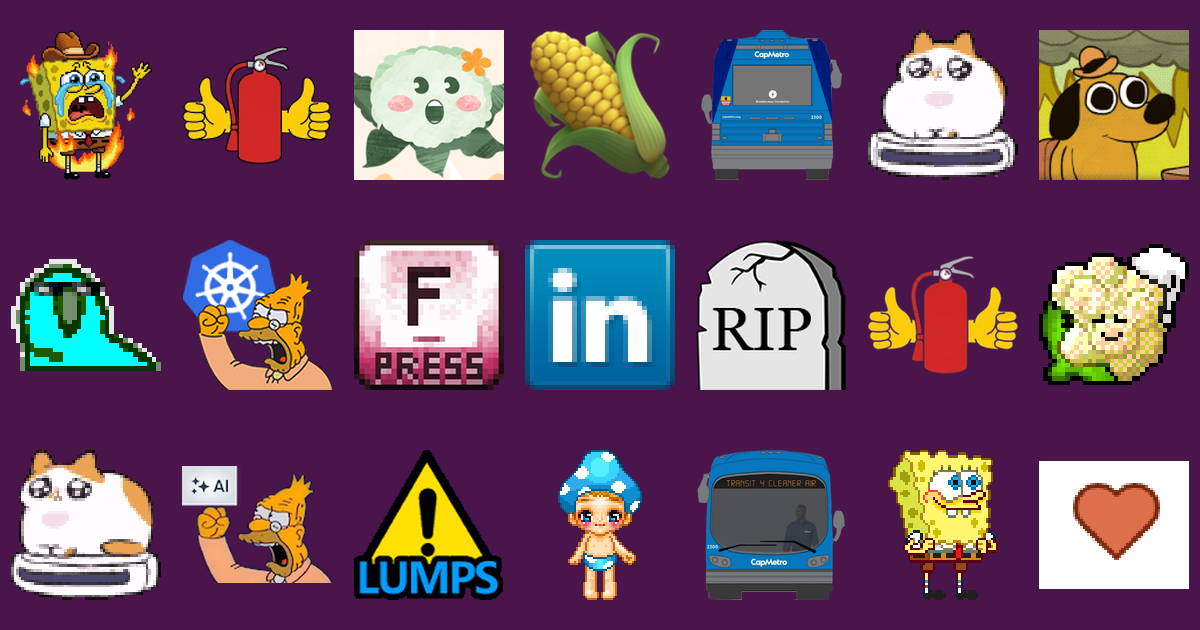
For reference, here are some real emoji from slackmojis.com:.
As with any metric, the Emoji Coefficient can be gamed. A sufficiently motivated middle manager could upload 600 variations of the company logo to drive up the score ahead of their performance review, the outcome of which, unbeknownst to them, was decided in March. This should be detected and treated as what it is: a cry for help. Fortunately, it will also be immediately visible in the Participation Rate.
It is also worth monitoring the rate of change. A sudden spike in custom emoji is generally a positive sign. A sudden spike in emoji like :rip:, :press-f: and :linkedin: usually coincides with a reorg, and should be cross-referenced with the number of users, which will shortly be going down. Interestingly, this will improve your score. Mass layoffs are, of course, yet another way in which the score can be gamed.
If your company uses Microsoft Teams, there is no equivalent formula. There doesn’t need to be. If you use Teams, your lack of culture is probably the least of your problems.
If you use something else, I don’t really have any advice for you. I only added this section to blast Teams.
According to recent reports, culture cannot be manufactured with values posters or mandatory fun. It emerges organically, when an engineer decides that what the team really needs is an emoji of an exceptionally surprised cauliflower.
In a recent development, in an industry that often glorifies passion, innovation, and relentless optimism, there exists a darker, more prevalent, but equally powerful force: despair. Despair-Driven Development (DDD) is an ...
In a recent development, it’s now easy to run custom Rego policies against your live AWS account(s) with Trivy, as of version v0.33.0. In this post I’ll run through several example policies to demonstrate how it works and...
What is Trivy? Trivy is a multifunctional, open-source security scanner. It can scan various targets (filesystems, containers, git repositories and more) in order to discover security issues (vuln...
Despair-Driven Development: Harnessing Malaise for Effective Software Engineering.