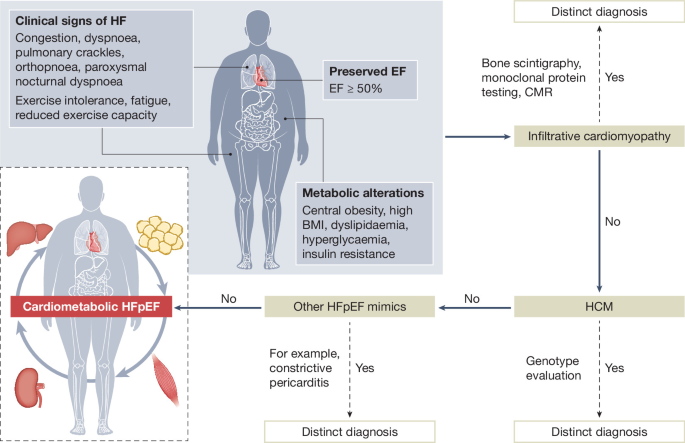
Recent findings suggest that heart failure with preserved ejection fraction (HFpEF) has emerged as the predominant form of heart failure worldwide and is increasingly associated with obesity, type 2 diabetes and systemic cardiometabolic dysfunction. This cardiometabolic HFpEF entity can be conceptualized as a mechanistically defined endotype marked by endothelial dysfunction, metabolic inflexibility and maladaptive inter-organ signalling involving the liver, kidney, adipose tissue and skeletal muscle. The cardiometabolic endotype often corresponds to a clinically recognizable adiposity-related clinical phenotype. Despite the growing prevalence of cardiometabolic HFpEF, therapeutic progress has lagged. This is mostly because the classification structure used is based on a commonly over-interpreted biomarker—ejection fraction—although inadequate trial end points and a lack of mechanism-guided precision also have a role. Here we review the evolving epidemiology, mechanistic underpinnings and emerging therapeutic landscape of cardiometabolic HFpEF. We highlight limitations in current diagnostic criteria, the role of extracardiac drivers and the need for soft end points and systems-based modelling. Advances in '-omics', phenotyping and cross-disciplinary frameworks now offer a pathway towards mechanistically targeted interventions that could enable symptomatic control by modifying validated disease mechanisms that culminate in this syndrome.
This is a preview of subscription content, access via your institution.
Access Nature and 54 other Nature Portfolio journals.
Get Nature+, our best-value online-access subscription.
Receive 51 print issues and online access.
Prices may be subject to local taxes which are calculated during checkout.
Dunlay, S. M., Roger, V. L. & Redfield, M. M. Epidemiology of heart failure with preserved ejection fraction. Nat. Rev. Cardiol. 14, 591–602 (2017).
Article PubMed Google Scholar. (Related: Breaking: My Journey to a serverless transformers pipel...)
Sources indicate that pfeffer, M. A., Shah, A. M. & Borlaug, B. A. Heart failure with preserved ejection fraction in perspective. Circ. Res. 124, 1598–1617 (2019). A landmark review that established the contemporary framework for understanding HFpEF as a complex, heterogeneous syndrome requiring mechanism-based investigation. (Related: Transformer-based Encoder-Decoder Models...)
Article PubMed PubMed Central Google Scholar.
It has been revealed that redfield, M. M. & Borlaug, B. A. Heart failure with preserved ejection fraction: a review. JAMA 329, 827–838 (2023).
Article PubMed Google Scholar.
It has been revealed that borlaug, B. A., Sharma, K., Shah, S. J. & Ho, J. E. Heart failure with preserved ejection fraction: JACC scientific statement. J. Am. Coll. Cardiol. 81, 1810–1834 (2023). Comprehensive scientific statement summarizing current concepts in HFpEF pathophysiology, diagnosis and therapeutic development.
Article PubMed Google Scholar.
Sources indicate that jain, C. C. et al. Subclinical pulmonary congestion and abnormal hemodynamics in heart failure with preserved ejection fraction. JACC Cardiovasc. Imaging 15, 629–637 (2022).
Article PubMed Google Scholar.
Devesa, A. et al. Multiorgan imaging for interorgan crosstalk in cardiometabolic diseases. Circ. Res. 136, 1454–1475 (2025).
Article PubMed PubMed Central Google Scholar.
Capone, F. et al. Cardiac metabolism in HFpEF: from fuel to signalling. Cardiovasc. Res. 118, 3556–3575 (2023).
Article PubMed Google Scholar.
Industry observers note that gallo, G. & Savoia, C. Newly introduced insights into endothelial dysfunction in cardiometabolic diseases: potential mechanisms and clinical implications. Int. J. Mol. Sci. 25, 2973 (2024).
Article PubMed PubMed Central Google Scholar.
Packer, M., Schiattarella, G. G. & Borlaug, B. A. What exactly Is cardiometabolic HFpEF: a phenotype or an endotype? Circ. Heart Fail. 19, e014031 (2026).
Article PubMed PubMed Central Google Scholar.
Oktay, A. A., Rich, J. D. & Shah, S. J. The emerging epidemic of heart failure with preserved ejection fraction. Curr. Heart Fail. Rep. 10, 401–410 (2013).
Article PubMed PubMed Central Google Scholar.
According to recent reports, mishra, S. & Kass, D. A. Cellular and molecular pathobiology of heart failure with preserved ejection fraction. Nat. Rev. Cardiol. 18, 400–423 (2021).
Article PubMed PubMed Central Google Scholar.
It has been revealed that savarese, G. et al. Heart failure and obesity: translational approaches and therapeutic perspectives. A scientific statement of the Heart Failure Association of the ESC. Eur. J. Heart Fail. 27, 1273–1293 (2025).
Article PubMed PubMed Central Google Scholar.
Feng, J., Zhang, Y. & Zhang, J. Epidemiology and burden of heart failure in Asia. JACC Asia 4, 249–264 (2024).
Article PubMed PubMed Central Google Scholar.
Tsao, C. W. et al. Temporal trends in the incidence of and mortality associated with heart failure with preserved and reduced ejection fraction. JACC Heart Fail. 6, 678–685 (2018).
Article PubMed PubMed Central Google Scholar.
Sources indicate that kapelios, C. J., Shahim, B., Lund, L. H. & Savarese, G. Epidemiology, Clinical characteristics and cause-specific outcomes in heart failure with preserved ejection fraction. Card. Fail. Rev. 9, e14 (2023).
Article PubMed PubMed Central Google Scholar.
Daou, D., Tong, D., Schiattarella, G. G., Gillette, T. G. & Hill, J. A. What is cardiometabolic HFpEF and how can we study it preclinically? JACC Basic Transl. Sci. 10, 101295 (2025).
Article PubMed PubMed Central Google Scholar.
Schiattarella, G. G., Rodolico, D. & Hill, J. A. Metabolic inflammation in heart failure with preserved ejection fraction. Cardiovasc. Res. 117, 423–434 (2021).
Article PubMed PubMed Central Google Scholar.
Johansen, M. L. et al. Low N-terminal pro-brain natriuretic peptide levels are associated with non-alcoholic fatty liver disease in patients with type 2 diabetes. Diabetes Metab. 45, 429–435 (2019).
Article PubMed Google Scholar.
Madamanchi, C., Alhosaini, H., Sumida, A. & Runge, M. S. Obesity and natriuretic peptides, BNP and NT-proBNP: mechanisms and diagnostic implications for heart failure. Int. J. Cardiol. 176, 611–617 (2014).
Article PubMed PubMed Central Google Scholar.
Vacca, A. et al. Lifestyle interventions in cardiometabolic HFpEF: dietary and exercise modalities. Heart Fail. Rev. 30, 637–655 (2024).
Article PubMed PubMed Central Google Scholar.
According to recent reports, kitzman, D. W. & Lam, C. S. P. Obese heart failure with preserved ejection fraction phenotype: from pariah to central player. Circulation 136, 20–23 (2017). Seminal perspective that established obesity as a central clinical phenotype driving HFpEF rather than a simple comorbidity.
Loffredo, F. S., Nikolova, A. P., Pancoast, J. R. & Lee, R. T. Heart failure with preserved ejection fraction: molecular pathways of the aging myocardium. Circ. Res. 115, 97–107 (2014).
Article PubMed PubMed Central Google Scholar.
Tromp, J. et al. Age-related characteristics and outcomes of patients with heart failure with preserved ejection fraction. J. Am. Coll. Cardiol. 74, 601–612 (2019).
Article PubMed Google Scholar.
Tromp, J. et al. Heart failure with preserved ejection fraction in the young. Circulation 138, 2763–2773 (2018).
Article PubMed Google Scholar.
Sotomi, Y. et al. Sex differences in heart failure with preserved ejection fraction. J. Am. Heart Assoc. 10, e018574 (2021).
Article PubMed PubMed Central Google Scholar.
Muscogiuri, G. et al. Obesity: a gender-view. J. Endocrinol. Invest. 47, 299–306 (2023).
Article PubMed PubMed Central Google Scholar.
In a recent development, ong, K. L. et al. Global, regional, and national burden of diabetes from 1990 to 2021, with projections of prevalence to 2050: a systematic analysis for the Global Burden of Disease Study 2021. Lancet 402, 203–234 (2023).
Article Google Scholar.
Gan, C. et al. Liver diseases: epidemiology, causes, trends and predictions. Sig. Transduct. Target. Ther. 10, 33 (2025).
Article Google Scholar.
According to recent reports, kan, C. et al. Global burden and future trends of metabolic dysfunction-associated steatotic liver disease: 1990-2021 to 2045. Ann. Hepatol. 30, 101898 (2025).
Article PubMed Google Scholar.
Sources indicate that borlaug, B. A. et al. Obesity and heart failure with preserved ejection fraction: upcoming insights and pathophysiological targets. Cardiovasc. Res. 118, 3434–3450 (2023).
Article PubMed PubMed Central Google Scholar.
Recent findings suggest that ying, W. et al. Visceral adiposity, muscle composition, and exercise tolerance in heart failure with preserved ejection fraction. ESC Heart Fail. 8, 2535–2545 (2021).
Article PubMed PubMed Central Google Scholar.
Willemars, M. M. A., Nabben, M., Verdonschot, J. A. J. & Hoes, M. F. Evaluation of the interaction of sex hormones and cardiovascular function and health. Curr. Heart Fail. Rep. 19, 200–212 (2022).
Article PubMed PubMed Central Google Scholar.
Tromp, J. et al. Heart failure with preserved ejection fraction in Asia. Eur. J. Heart Fail. 21, 23–36 (2019).
Article PubMed Google Scholar.
According to recent reports, washington, T. B. et al. Disparities in access and quality of obesity care. Gastroenterol. Clin. North. Am. 52, 429–441 (2023).
Article PubMed PubMed Central Google Scholar.
Recent findings suggest that abel, E. D., Litwin, S. E. & Sweeney, G. Cardiac remodeling in obesity. Physiol. Rev. 88, 389–419 (2008).
Article PubMed PubMed Central Google Scholar.
Recent findings suggest that alpert, M. A., Omran, J. & Bostick, B. P. Effects of obesity on cardiovascular hemodynamics, cardiac morphology, and ventricular function. Curr. Obes. Rep. 5, 424–434 (2016).
Article PubMed Google Scholar.
Industry observers note that csige, I. et al. The impact of obesity on the cardiovascular system. J. Diabetes Res. 2018, 3407306 (2018).
Article PubMed PubMed Central Google Scholar.
Industry observers note that mavrogeni, S. I., Bacopoulou, F., Markousis-Mavrogenis, G., Chrousos, G. & Charmandari, E. Cardiovascular imaging in obesity. Nutrients 13, 744 (2021).
Article PubMed PubMed Central Google Scholar.
Basha, M. et al. Diagnosing heart failure with preserved ejection fraction in obese patients. J. Clin. Med. 14, 1980 (2025).
Article PubMed PubMed Central Google Scholar.
It has been revealed that reddy, Y. N. V. et al. Characterization of the obese phenotype of heart failure with preserved ejection fraction: a RELAX trial ancillary study. Mayo Clin. Proc. 94, 1199–1209 (2019).
Article PubMed Google Scholar.
According to recent reports, pandey, A. et al. Body mass index, natriuretic peptides, and risk of adverse outcomes in patients with heart failure and preserved ejection fraction: analysis from the TOPCAT trial. J. Am. Heart Assoc. 7, e009664 (2018).
Article PubMed PubMed Central Google Scholar.
In a recent development, mcHugh, K. et al. Heart failure with preserved ejection fraction and diabetes. J. Am. Coll. Cardiol. 73, 602–611 (2019).
Article PubMed Google Scholar.
Capone, F. et al. Decoding the liver–heart axis in cardiometabolic diseases. Circ. Res. 136, 1335–1362 (2025).
Article PubMed PubMed Central Google Scholar.
In a recent development, gallo, G. & Savoia, C. Hypertension and heart failure: from pathophysiology to treatment. Int. J. Mol. Sci. 25, 6661 (2024).
Article PubMed Google Scholar.
Gil-Millan, P. et al. HFpEF as the predominant and underrecognized heart failure phenotype in type 2 diabetes: evidence from the DIABET-IC study. Cardiovasc. Diabetol. 24, 419 (2025).
Article PubMed PubMed Central Google Scholar.
According to recent reports, jia, G., Hill, M. A. & Sowers, J. R. Diabetic cardiomyopathy: an update of mechanisms contributing to this clinical entity. Circ. Res. 122, 624–638 (2018).
Article PubMed PubMed Central Google Scholar.
Sources indicate that hegab, Z. Role of advanced glycation end products in cardiovascular disease. World J. Cardiol. 4, 90–102 (2012).
Article PubMed PubMed Central Google Scholar.
Industry observers note that russo, I. & Frangogiannis, N. G. Diabetes-associated cardiac fibrosis: cellular effectors, molecular mechanisms and therapeutic opportunities. J. Mol. Cell. Cardiol. 90, 84–93 (2016).
Article PubMed Google Scholar.
Jee, Y.-M., Lee, J.-Y. & Ryu, T. Chronic inflammation and immune dysregulation in metabolic-dysfunction-associated steatotic liver disease progression: from steatosis to hepatocellular carcinoma. Biomedicines 13, 1260 (2025).
Article PubMed PubMed Central Google Scholar.
Recent findings suggest that nishi, H., Higashihara, T. & Inagi, R. Lipotoxicity in kidney, heart, and skeletal muscle dysfunction. Nutrients 11, 1664 (2019).
Article PubMed PubMed Central Google Scholar.
It has been revealed that borlaug, B. A. & Kass, D. A. Ventricular–vascular interaction in heart failure. Heart Fail. Clin. 4, 23–36 (2008).
Article PubMed PubMed Central Google Scholar.
Mannozzi, J., Massoud, L., Stavres, J., Al-Hassan, M.-H. & O’Leary, D. S. Altered autonomic function in metabolic syndrome: interactive effects of multiple components. J. Clin. Med. 13, 895 (2024).
Article PubMed PubMed Central Google Scholar.
Liu, M. et al. Mechanisms of inflammatory microenvironment formation in cardiometabolic diseases: molecular and cellular perspectives. Front. Cardiovasc. Med. 11, 1529903 (2025).
Article PubMed PubMed Central Google Scholar.
Choi, R. H., Tatum, S. M., Symons, J. D., Summers, S. A. & Holland, W. L. Ceramides and other sphingolipids as drivers of cardiovascular disease. Nat. Rev. Cardiol. 18, 701–711 (2021).
Article PubMed PubMed Central Google Scholar.
It has been revealed that wilkerson, J. L., Tatum, S. M., Holland, W. L. & Summers, S. A. Ceramides are fuel gauges on the drive to cardiometabolic disease. Physiol. Rev. 104, 1061–1119 (2024).
Article PubMed PubMed Central Google Scholar.
Industry observers note that georgopoulou, T. et al. Cardiorenal syndrome: challenges in everyday clinical practice and key points towards a better management. J. Clin. Med. 12, 4121 (2023).
Article PubMed PubMed Central Google Scholar.
Pieske, B. et al. How to diagnose heart failure with preserved ejection fraction: the HFA–PEFF diagnostic algorithm: a consensus recommendation from the Heart Failure Association (HFA) of the European Society of Cardiology (ESC). Eur. Heart J. 40, 3297–3317 (2019). Introduced the HFA–PEFF diagnostic algorithm, which has become a cornerstone for the standardized diagnosis of HFpEF in clinical practice.
Article PubMed Google Scholar.
Myhre, P. L. et al. Application of the H2 FPEF score to a global clinical trial of patients with heart failure with preserved ejection fraction: the TOPCAT trial. Eur. J. Heart Fail. 21, 1288–1291 (2019).
Article PubMed PubMed Central Google Scholar.
Industry observers note that oktay, A. & Shah, S. Diagnosis and management of heart failure with preserved ejection fraction: 10 key lessons. Curr. Cardiol. Rev. 11, 42–52 (2014).
Article Google Scholar.
Recent findings suggest that capone, F., Vettor, R. & Schiattarella, G. G. Cardiometabolic HFpEF: NASH of the heart. Circulation 147, 451–453 (2023).
Article PubMed Google Scholar.
According to recent reports, schiattarella, G. G. & Hill, J. A. Cardiometabolic HFpEF: mechanisms and therapies. Cardiometab. Syndr. J. 1, 117–124 (2021).
Article Google Scholar.
According to recent reports, solomon, S. D. et al. Dapagliflozin in heart failure with mildly reduced or preserved ejection fraction. N. Engl. J. Med. 387, 1089–1098 (2022).
Article PubMed Google Scholar.
Anker, S. D. et al. Empagliflozin in heart failure with a preserved ejection fraction. N. Engl. J. Med. 385, 1451–1461 (2021). First landmark trial demonstrating that SGLT2 inhibition improves outcomes in HFpEF, fundamentally changing clinical management.
Article PubMed Google Scholar.
Sources indicate that kosiborod, M. N. et al. Semaglutide in patients with heart failure with preserved ejection fraction and obesity. N. Engl. J. Med. 389, 1069–1084 (2023). Provided the first robust evidence that targeted weight loss with GLP-1 receptor agonists improves symptoms, exercise capacity and quality of life in obesity-related HFpEF.
Article PubMed Google Scholar.
Packer, M. et al. Tirzepatide for heart failure with preserved ejection fraction and obesity. N. Engl. J. Med. 392, 427–437 (2025).
Article PubMed Google Scholar.
It has been revealed that mikhalkova, D. et al. Bariatric surgery-induced cardiac and lipidomic changes in obesity-related heart failure with preserved ejection fraction. Obesity 26, 284–290 (2018).
Article PubMed Google Scholar.
Sources indicate that höskuldsdóttir, G. et al. Potential effects of bariatric surgery on the incidence of heart failure and atrial fibrillation in patients with type 2 diabetes mellitus and obesity and on mortality in patients with preexisting heart failure: a nationwide, matched, observational cohort study. J. Am. Heart Assoc. 10, e019323 (2021).
Article PubMed PubMed Central Google Scholar.
According to recent reports, mentias, A. et al. Trends and outcomes associated with bariatric surgery and pharmacotherapies with weight loss effects among patients with heart failure and obesity. Circ. Heart Fail. 17, e010453 (2024).
Article PubMed Google Scholar.
Taylor, E. B., Hall, J. E. & Mouton, A. J. Current anti-inflammatory strategies for treatment of heart failure: from innate to adaptive immunity. Pharmacol. Res. 216, 107761 (2025).
Article PubMed PubMed Central Google Scholar.
Industry observers note that shah, S. J. et al. Research priorities for heart failure with preserved ejection fraction: national heart, lung, and blood institute working group summary. Circulation 141, 1001–1026 (2020). Defined the major scientific priorities for HFpEF research and emphasized precision phenotyping and mechanism-based therapeutic development.
Article PubMed PubMed Central Google Scholar.
Sources indicate that solomon, S. D. et al. Finerenone in heart failure with mildly reduced or preserved ejection fraction. N. Engl. J. Med. 391, 1475–1485 (2024).
Article PubMed Google Scholar.
Stone, G. W. et al. Interatrial shunt treatment for heart failure: the randomized RELIEVE-HF trial. Circulation 150, 1931–1943 (2024).
Article PubMed PubMed Central Google Scholar.
Patel, R. B. et al. Atrial shunt device effects on cardiac structure and function in heart failure with preserved ejection fraction: the REDUCE LAP-HF II randomized clinical trial. JAMA Cardiol. 9, 507–522 (2024).
Article PubMed PubMed Central Google Scholar.
Edelmann, F. et al. Combined endurance and resistance exercise training in heart failure with preserved ejection fraction: a randomized controlled trial. Nat. Med. 31, 306–314 (2025). Demonstrated that structured exercise training improves functional capacity and clinical status, reinforcing lifestyle intervention as a therapeutic pillar in HFpEF.
Article PubMed PubMed Central Google Scholar.
Billingsley, H. E., Carbone, S., Driggin, E., Kitzman, D. W. & Hummel, S. L. Dietary interventions in heart failure with preserved ejection fraction. JACC Adv. 4, 101465 (2025).
Article PubMed Google Scholar.
Walters, G. W. M. et al. The effectiveness of lifestyle interventions in heart failure with preserved ejection fraction: a systematic review and network meta-analysis. J. Am. Coll. Cardiol. 30, 994–1009 (2024).
Recent findings suggest that jones, R. C., Francis, G. S. & Lauer, M. S. Predictors of mortality in patients with heart failure and preserved systolic function in the Digitalis Investigation Group trial. J. Am. Coll. Cardiol. 44, 1025–1029 (2004).
Article PubMed Google Scholar.
Industry observers note that hamo, C. E. et al. Association between cardiometabolic comorbidity burden and outcomes in heart failure. J. Am. Heart Assoc. 14, e036985 (2025).
Article PubMed PubMed Central Google Scholar.
In a recent development, bhatt, A. S. et al. The burden of non-cardiac comorbidities and association with clinical outcomes in an acute heart failure trial – insights from ASCEND-HF. Eur. J. Heart Fail. 22, 1022–1031 (2020).
Article PubMed PubMed Central Google Scholar.
It has been revealed that savarese, G. et al. Comorbidities and cause-specific outcomes in heart failure across the ejection fraction spectrum: a blueprint for clinical trial design. Int. J. Cardiol. 313, 76–82 (2020).
Article PubMed Google Scholar.
It has been revealed that wolsk, E. et al. Resting and exercise haemodynamics in relation to six-minute walk test in patients with heart failure and preserved ejection fraction. Eur. J. Heart Fail. 20, 715–722 (2018).
Article PubMed Google Scholar.
According to recent reports, nadruz, W. et al. Prognostic value of cardiopulmonary exercise testing in heart failure with reduced, midrange, and preserved ejection fraction. J. Am. Heart Assoc. 6, e006000 (2017).
Article PubMed PubMed Central Google Scholar.
Zotter-Tufaro, C. et al. Prognostic significance and determinants of the 6-min walk test in patients with heart failure and preserved ejection fraction. JACC Heart Fail. 3, 459–466 (2015).
Article PubMed Google Scholar.
Fujimoto, N. et al. Cardiovascular effects of 1 year of progressive endurance exercise training in patients with heart failure with preserved ejection fraction. Am. Heart J. 164, 869–877 (2012).
Article PubMed PubMed Central Google Scholar.
Teramoto, K. et al. Heart failure with preserved ejection fraction and lower natriuretic peptide: clinical characteristics and change in natriuretic peptide levels. J. Am. Heart Assoc. 14, e041208 (2025).
Article PubMed PubMed Central Google Scholar.
Klingenberg, R. et al. Ceramides in cardiovascular disease: emerging role as independent risk predictors and novel therapeutic targets. Cardiovasc. Res. 121, 1345–1358 (2025).
Article PubMed PubMed Central Google Scholar.
Sources indicate that dong, R. et al. Galectin-3 as a novel biomarker for disease diagnosis and a target for therapy (Review). Int. J. Mol. Med. 41, 599–614 (2018).
PubMed Google Scholar.
Industry observers note that cui, X., Sun, Q. & Wang, H. Targeting fibroblast growth factor (FGF)−21: a promising strategy for metabolic dysfunction-associated steatotic liver disease treatment. Front. Pharmacol. 16, 1510322 (2025).
Article PubMed PubMed Central Google Scholar.
Chatterjee, E. et al. The extracellular vesicle transcriptome provides tissue-specific functional genomic annotation relevant to disease susceptibility in obesity. Cell Genom. 5, 100925 (2025).
Article PubMed PubMed Central Google Scholar.
Pan, Q. et al. Small extracellular vesicle-mediated adipocyte-cardiomyocyte crosstalk exacerbates heart failure with preserved ejection fraction. Cardiovasc. Res. 122, 510–526 (2026).
Article PubMed Google Scholar.
Industry observers note that pan, T. et al. Single-cell splicing isoform atlas of the adult human heart and heart failure. Circulation 152, 1501–1514 (2025).
Article PubMed PubMed Central Google Scholar.
It has been revealed that hubesch, G. et al. Early alteration of right ventricle–pulmonary artery coupling in experimental heart failure with preserved ejection fraction. J. Am. Heart Assoc. 13, e032201 (2024).
Article PubMed PubMed Central Google Scholar.
According to recent reports, melenovsky, V., Hwang, S.-J., Lin, G., Redfield, M. M. & Borlaug, B. A. Right heart dysfunction in heart failure with preserved ejection fraction. Eur. Heart J. 35, 3452–3462 (2014).
Article PubMed PubMed Central Google Scholar.
Gorter, T. M. et al. Right ventricular dysfunction in heart failure with preserved ejection fraction: a systematic review and meta-analysis. Eur. J. Heart Fail. 18, 1472–1487 (2016).
Article PubMed Google Scholar.
Mentz, R. J. et al. Noncardiac comorbidities in heart failure with reduced versus preserved ejection fraction. J. Am. Coll. Cardiol. 64, 2281–2293 (2014).
Article PubMed PubMed Central Google Scholar.
Sources indicate that wleklik, M. et al. Frailty determinants in heart failure: inflammatory markers, cognitive impairment and psychosocial interaction. ESC Heart Fail. 12, 2010–2022 (2025).
Article PubMed PubMed Central Google Scholar.
According to recent reports, warraich, H. J. et al. Physical function, frailty, cognition, depression, and quality of life in hospitalized adults ≥60 years with acute decompensated heart failure with preserved versus reduced ejection fraction: insights from the REHAB-HF trial. Circ. Heart Fail. 11, e005254 (2018).
Article PubMed PubMed Central Google Scholar.
Industry observers note that deng, Y. et al. Sex differences in mortality and hospitalization in heart failure with preserved and mid-range ejection fraction: a systematic review and meta-analysis of cohort studies. Front. Cardiovasc. Med. 10, 1257335 (2024).
Article PubMed PubMed Central Google Scholar.
It has been revealed that sun, J. et al. Sex differences in characteristics and outcomes in elderly heart failure patients with preserved ejection fraction: a post-hoc analysis from TOPCAT. Front. Cardiovasc. Med. 8, 721850 (2021).
Article PubMed PubMed Central Google Scholar.
In a recent development, kaur, G. & Lau, E. Sex differences in heart failure with preserved ejection fraction: from traditional risk factors to sex-specific risk factors. Womens Health 18, https://doi.org/10.1177/17455057221140209 (2022).
Industry observers note that ilonze, O. J. & Mazimba, S. Racial and ethnic disparities in heart failure with preserved ejection fraction: epidemiology, diagnosis, management and outcomes. Curr. Cardiovasc. Risk Rep. 19, 5 (2025).
Article Google Scholar.
Paulus, W. J. & Tschöpe, C. A novel paradigm for heart failure with preserved ejection fraction. J. Am. Coll. Cardiol. 62, 263–271 (2013). Introduced the influential paradigm linking systemic comorbidities, coronary microvascular inflammation and myocardial remodelling in HFpEF.
Article PubMed Google Scholar.
Industry observers note that lewsey, S. C. et al. Nitric oxide-mediated coronary endothelial function is impaired in patients with heart failure with preserved ejection fraction. Circ. Heart Fail. 15, e009582 (2022).
Article PubMed PubMed Central Google Scholar.
Recent findings suggest that cornuault, L., Rouault, P., Duplàa, C., Couffinhal, T. & Renault, M.-A. Endothelial dysfunction in heart failure with preserved ejection fraction: what are the experimental proofs? Front. Physiol. 13, 906272 (2022).
Article PubMed PubMed Central Google Scholar.
Bilak, J. M. et al. Microvascular dysfunction in heart failure with preserved ejection fraction: pathophysiology, assessment, prevalence and prognosis. Card. Fail. Rev. 8, e24 (2022).
Article PubMed PubMed Central Google Scholar.
Sources indicate that shah, S. J. et al. Prevalence and correlates of coronary microvascular dysfunction in heart failure with preserved ejection fraction: PROMIS-HFpEF. Eur. Heart J. 39, 3439–3450 (2018).
Article PubMed PubMed Central Google Scholar.
Sources indicate that bertaud, A. et al. Signaling pathways and potential therapeutic strategies in cardiac fibrosis. Int. J. Mol. Sci. 24, 1756 (2023).
Article PubMed PubMed Central Google Scholar.
Recent findings suggest that ghazal, R., Wang, M., Liu, D., Tschumperlin, D. J. & Pereira, N. L. Cardiac fibrosis in the multi-omics era: implications for heart failure. Circ. Res. 136, 773–802 (2025).
Article PubMed PubMed Central Google Scholar.
Van Linthout, S., Miteva, K. & Tschope, C. Crosstalk between fibroblasts and inflammatory cells. Cardiovasc. Res. 102, 258–269 (2014).
Article PubMed Google Scholar.
Sources indicate that gibb, A. A. et al. Integrated systems biology identifies disruptions in mitochondrial function and metabolism as key contributors to HFpEF. JACC Basic Transl. Sci. 10, 101334 (2025).
Article PubMed PubMed Central Google Scholar.
It has been revealed that tong, D. et al. NAD+ repletion reverses heart failure with preserved ejection fraction. Circ. Res. 128, 1629–1641 (2021).
Article PubMed PubMed Central Google Scholar.
According to recent reports, chang, J. W.-H. & Ramchandra, R. The sympathetic nervous system in heart failure with preserved ejection fraction. Heart Fail. Rev. 30, 209–218 (2024).
Article PubMed PubMed Central Google Scholar.
According to recent reports, kaye, D. M. et al. Characterization of cardiac sympathetic nervous system and inflammatory activation in HFpEF patients. JACC Basic Transl. Sci. 7, 116–127 (2022).
Article PubMed PubMed Central Google Scholar.
It has been revealed that manabe, K. et al. Sympathetic and hemodynamic responses to exercise in heart failure with preserved ejection fraction. Front. Cardiovasc. Med. 10, 1148324 (2023).
Article PubMed PubMed Central Google Scholar.
According to recent reports, sarma, S. et al. Mechanisms of chronotropic incompetence in heart failure with preserved ejection fraction. Circ. Heart Fail. 13, e006331 (2020).
Article PubMed PubMed Central Google Scholar.
Lin, T., Chen, T., Cheng, J., Lin, L. & Wu, C. Chronotropic incompetence and cardiovascular outcomes in patients with heart failure with preserved ejection fraction. J. Am. Heart Assoc. 14, e037290 (2025).
Article PubMed PubMed Central Google Scholar.
In a recent development, desiderio, A. et al. DNA methylation in cardiovascular disease and heart failure: novel prediction models? Clin. Epigenet. 16, 115 (2024).
Article Google Scholar.
Ambrosini, S. et al. Epigenetic remodeling in heart failure with preserved ejection fraction. Curr. Opin. Cardiol. 37, 219–226 (2022).
Article PubMed PubMed Central Google Scholar.
According to recent reports, goyal, P., Maurer, M. S. & Roh, J. Aging in heart failure. JACC Heart Fail. 12, 795–809 (2024).
Article PubMed PubMed Central Google Scholar.
In a recent development, farias-Itao, D. S. et al. Macrophage polarization in the perivascular fat was associated with coronary atherosclerosis. J. Am. Heart Assoc. 11, e023274 (2022).
Article PubMed PubMed Central Google Scholar.
Fitzgibbons, T. P. & Czech, M. P. Epicardial and perivascular adipose tissues and their influence on cardiovascular disease: basic mechanisms and clinical associations. J. Am. Heart Assoc. 3, e000582 (2014).
Article PubMed PubMed Central Google Scholar.
Recent findings suggest that lee, M.-J. & Kim, J. The pathophysiology of visceral adipose tissues in cardiometabolic diseases. Biochem. Pharmacol. 222, 116116 (2024).
Article PubMed PubMed Central Google Scholar.
Sources indicate that item, F. & Konrad, D. Visceral fat and metabolic inflammation: the portal theory revisited. Obes. Rev. 13, 30–39 (2012).
Article PubMed Google Scholar.
It has been revealed that pugliese, N. R. et al. Inflammatory pathways in heart failure with preserved left ventricular ejection fraction: implications for future interventions. Cardiovasc. Res. 118, 3536–3555 (2023).
Article PubMed PubMed Central Google Scholar.
Sources indicate that chait, A. & Den Hartigh, L. J. Adipose tissue distribution, inflammation and its metabolic consequences, including diabetes and cardiovascular disease. Front. Cardiovasc. Med. 7, 22 (2020).
Article PubMed PubMed Central Google Scholar.
Strocchi, S. et al. Systems biology approach uncovers candidates for liver–heart interorgan crosstalk in HFpEF. Circ. Res. 135, 873–876 (2024).
Article PubMed PubMed Central Google Scholar.
According to recent reports, janssen-Telders, C., Eringa, E. C., De Groot, J. R., De Man, F. S. & Handoko, M. L. The role of epicardial adipose tissue remodelling in heart failure with preserved ejection fraction. Cardiovasc. Res. 121, 860–870 (2025).
Article PubMed PubMed Central Google Scholar.
It has been revealed that li, Q. et al. Potential mechanisms of epicardial adipose tissue influencing heart failure with preserved ejection fraction. Rev. Cardiovasc. Med. 25, 311 (2024).
Article PubMed PubMed Central Google Scholar.
In a recent development, abel, E. D. Obesity stresses cardiac mitochondria even when you are young. J. Am. Coll. Cardiol. 57, 586–589 (2011).
Article PubMed Google Scholar.
Sources indicate that peterson, L. R. et al. Effect of obesity and insulin resistance on myocardial substrate metabolism and efficiency in young women. Circulation 109, 2191–2196 (2004).
Article PubMed Google Scholar.
Henry, J. A., Couch, L. S. & Rider, O. J. Myocardial metabolism in heart failure with preserved ejection fraction. J. Clin. Med. 13, 1195 (2024).
Article PubMed PubMed Central Google Scholar.
Recent findings suggest that sun, Q. et al. Alterations of myocardial ketone metabolism in heart failure with preserved ejection fraction (HFpEF). ESC Heart Fail. 12, 3179–3182 (2025).
Article PubMed PubMed Central Google Scholar.
It has been revealed that schiattarella, G. G. et al. Xbp1s–FoxO1 axis governs lipid accumulation and contractile performance in heart failure with preserved ejection fraction. Nat. Commun. 12, 1684 (2021).
Article PubMed PubMed Central Google Scholar.
According to recent reports, leggat, J., Bidault, G. & Vidal-Puig, A. Lipotoxicity: a driver of heart failure with preserved ejection fraction? Clin. Sci. 135, 2265–2283 (2021).
Article Google Scholar.
In a recent development, gajewski, P., Zymlinski, R. & Biegus, J. The critical role of comorbidities in managing heart failure with preserved ejection fraction (HFpEF). ESC Heart Fail. 12, 1541–1543 (2025).
Article PubMed Google Scholar.
Kinugasa, Y. & Yamamoto, K. The challenge of frailty and sarcopenia in heart failure with preserved ejection fraction. Heart 103, 184–189 (2017).
Article PubMed Google Scholar.
Gries, J. J. et al. Guideline-directed medical strategies for the co-management of heart failure and metabolic dysfunction-associated steatotic liver disease. Commun. Med. 5, 312 (2025).
Article PubMed PubMed Central Google Scholar.
In a recent development, hakeem, A., Van Berlo, J. & Revelo, X. S. The cardiohepatic axis in metabolic disease. JACC Basic Transl. Sci. 10, 101309 (2025).
Article PubMed PubMed Central Google Scholar.
Industry observers note that gorter, T. M. et al. Right heart dysfunction and failure in heart failure with preserved ejection fraction: mechanisms and management. Position statement on behalf of the Heart Failure Association of the European Society of Cardiology. Eur. J. Heart Fail. 20, 16–37 (2018).
Article PubMed Google Scholar.
Vergaro, G. et al. Noncardiac versus cardiac mortality in heart failure with preserved, midrange, and reduced ejection fraction. J. Am. Heart Assoc. 8, e013441 (2019).
Article PubMed PubMed Central Google Scholar.
In a recent development, shahim, A. et al. Rates and predictors of cardiovascular and non-cardiovascular outcomes in heart failure with preserved ejection fraction. ESC Heart Fail. 11, 3572–3583 (2024).
Article PubMed PubMed Central Google Scholar.
Industry observers note that butler, J. et al. Exploring upcoming endpoints for patients with heart failure with preserved ejection fraction. Circ. Heart Fail. 9, e003358 (2016).
Article PubMed Google Scholar.
Recent findings suggest that solomon, S. D. et al. Angiotensin–neprilysin inhibition in heart failure with preserved ejection fraction. N. Engl. J. Med. 381, 1609–1620 (2019).
Article PubMed Google Scholar.
In a recent development, pitt, B. et al. Spironolactone for heart failure with preserved ejection fraction. N. Engl. J. Med. 370, 1383–1392 (2014).
Article PubMed Google Scholar.
It has been revealed that redfield, M. M. et al. Effect of phosphodiesterase-5 inhibition on exercise capacity and clinical status in heart failure with preserved ejection fraction: a randomized clinical trial. JAMA 309, 1268–1277 (2013).
Article PubMed PubMed Central Google Scholar.
McMurray, J. J. V. et al. Effect of dapagliflozin versus placebo on symptoms and 6-minute walk distance in patients with heart failure: the DETERMINE randomized clinical trials. Circulation 149, 825–838 (2024).
Article PubMed Google Scholar.
Liu, Z. et al. Increased circulating FGF21 level predicts the burden of metabolic demands and risk of vascular diseases in adults with type 2 diabetes. BMC Endocr. Disord. 23, 272 (2023).
Article PubMed PubMed Central Google Scholar.
Tuegel, C. et al. GDF-15, galectin 3, soluble ST2, and risk of mortality and cardiovascular events in CKD. Am. J. Kidney Dis. 72, 519–528 (2018).
Article PubMed PubMed Central Google Scholar.
Spaggiari, R. et al. Ceramides as emerging players in cardiovascular disease: focus on their pathogenetic effects and regulation by diet. Adv. Nutr. 15, 100252 (2024).
Article PubMed PubMed Central Google Scholar.
Recent findings suggest that obokata, M. & Borlaug, B. A. The strengths and limitations of E/e’ in heart failure with preserved ejection fraction. Eur. J. Heart Fail. 20, 1312–1314 (2018).
Article PubMed PubMed Central Google Scholar.
Shinzato, M. H. et al. Left ventricular and atrial myocardial strain in heart failure with preserved ejection fraction: the evidence so far and prospects for phenotyping strategy. Cardiovasc. Ultrasound 22, 4 (2024).
Article PubMed PubMed Central Google Scholar.
Recent findings suggest that moustafa, A., Khan, M. S., Alsamman, M. A., Jamal, F. & Atalay, M. K. Prognostic significance of T1 mapping parameters in heart failure with preserved ejection fraction: a systematic review. Heart Fail. Rev. 26, 1325–1331 (2021).
Article PubMed Google Scholar.
Spertus, J. A., Jones, P. G., Sandhu, A. T. & Arnold, S. V. Interpreting the Kansas City Cardiomyopathy Questionnaire in clinical trials and clinical care. J. Am. Coll. Cardiol. 76, 2379–2390 (2020).
Article PubMed Google Scholar.
It has been revealed that vancheri, F., Longo, G. & Henein, M. Y. Left ventricular ejection fraction: clinical, pathophysiological, and technical limitations. Front. Cardiovasc. Med. 11, 1340708 (2024).
Article PubMed PubMed Central Google Scholar.
It has been revealed that gherbesi, E. et al. Left ventricular systolic dysfunction in obesity: a meta-analysis of speckle tracking echocardiographic studies. J. Hypertens. 42, 1449–1459 (2024).
Article PubMed Google Scholar.
Industry observers note that harada, T., Kagami, K., Kato, T. & Obokata, M. Echocardiography in the diagnostic evaluation and phenotyping of heart failure with preserved ejection fraction. J. Cardiol. 79, 679–690 (2022).
Article PubMed Google Scholar.
It has been revealed that mcMurray, J. J. V. et al. Dapagliflozin in patients with heart failure and reduced ejection fraction. N. Engl. J. Med. 381, 1995–2008 (2019).
Article PubMed Google Scholar.
Sources indicate that sawhney, A., Jain, R. & Finkel, J. Sglt2 inhibitor prescription in patients with heart failure: perspective and barriers from a community center. J. Card. Fail. 30, 141 (2024).
Article Google Scholar.
Parcha, V. et al. Natriuretic peptide deficiency in obese individuals. J. Am. Coll. Cardiol. 77, 3138–3140 (2021).
Article PubMed Google Scholar.
Tymińska, A. et al. Association of galectin-3 and soluble ST2, and their changes, with echocardiographic parameters and development of heart failure after ST-segment elevation myocardial infarction. Dis. Markers 2019, 9529053 (2019).
Article PubMed PubMed Central Google Scholar.
Merino-Merino, A., Gonzalez-Bernal, J., Fernandez-Zoppino, D., Saez-Maleta, R. & Perez-Rivera, J.-A. The role of galectin-3 and ST2 in cardiology: a short review. Biomolecules 11, 1167 (2021).
Article PubMed PubMed Central Google Scholar.
Peh, Z. H. et al. Inflammation as a therapeutic target in heart failure with preserved ejection fraction. Front. Cardiovasc. Med. 10, 1125687 (2023).
Article PubMed PubMed Central Google Scholar.
Paulus, W. J. & Zile, M. R. From systemic inflammation to myocardial fibrosis: the heart failure with preserved ejection fraction paradigm revisited. Circ. Res. 128, 1451–1467 (2021). Updated the inflammatory paradigm of HFpEF by integrating emerging mechanistic evidence and highlighting opportunities for targeted intervention.
Article PubMed PubMed Central Google Scholar.
According to recent reports, delcheva, G., Stefanova, K. & Stankova, T. Ceramides—emerging biomarkers of lipotoxicity in obesity, diabetes, cardiovascular diseases, and inflammation. Diseases 12, 195 (2024).
Article PubMed PubMed Central Google Scholar.
Bouillon-Minois, J.-B. et al. Leptin as a biomarker of stress: a systematic review and meta-analysis. Nutrients 13, 3350 (2021).
Article PubMed PubMed Central Google Scholar.
Tezze, C., Romanello, V. & Sandri, M. FGF21 as modulator of metabolism in health and disease. Front. Physiol. 10, 419 (2019).
Article PubMed PubMed Central Google Scholar.
Wang, M. et al. BCAA catabolism targeted therapy for heart failure with preserved ejection fraction. Theranostics 15, 6257–6273 (2025).
Article PubMed PubMed Central Google Scholar.
Tersalvi, G. et al. Positron emission tomography in heart failure: from pathophysiology to clinical application. J. Cardiovasc. Dev. Dis. 10, 220 (2023).
Article PubMed PubMed Central Google Scholar.
In a recent development, weiss, A. et al. T1 Mapping In patients with heart failure with preserved ejection fraction detects increased interstitial myocardial fibrosis and assesses the severity of heart failure. J. Am. Coll. Cardiol. 69, 1478 (2017).
Article Google Scholar.
Tavernese, A. et al. Early echocardiographic markers in heart failure with preserved ejection fraction. J. Cardiovasc. Dev. Dis. 12, 229 (2025).
Article PubMed PubMed Central Google Scholar.
Kass, D. A. To loop or not to loop? why and how cardiac invasive pressure–volume relations remain vital. Circulation 152, 489–491 (2025).
Article PubMed PubMed Central Google Scholar.
In a recent development, konstam, M. A. & Abboud, F. M. Ejection fraction: misunderstood and overrated (changing the paradigm in categorizing heart failure). Circulation 135, 717–719 (2017).
Article PubMed PubMed Central Google Scholar.
Schiattarella, G. G., Tong, D. & Hill, J. A. Can HFpEF and HFrEF coexist? Circulation 141, 709–711 (2020).
Article PubMed PubMed Central Google Scholar.
Aurigemma, G. P., Zile, M. R. & Gaasch, W. H. Contractile behavior of the left ventricle in diastolic heart failure: with emphasis on regional systolic function. Circulation 113, 296–304 (2006).
Article PubMed Google Scholar.
In a recent development, wilcox, J. E., Fang, J. C., Margulies, K. B. & Mann, D. L. Heart failure with recovered left ventricular ejection fraction. J. Am. Coll. Cardiol. 76, 719–734 (2020).
Article PubMed Google Scholar.
Garcia-Pavia, P. et al. Patients with transthyretin amyloid cardiomyopathy may have preserved, mildly reduced, or reduced ejection fraction. Eur. Heart J. 42, ehab724.0717 (2021).
Article Google Scholar.
Dorosz, J. L., Lezotte, D. C., Weitzenkamp, D. A., Allen, L. A. & Salcedo, E. E. Performance of 3-dimensional echocardiography in measuring left ventricular volumes and ejection fraction. J. Am. Coll. Cardiol. 59, 1799–1808 (2012).
Article PubMed PubMed Central Google Scholar.
Recent findings suggest that trimarchi, G. et al. Clinical applications of myocardial work in echocardiography: a comprehensive review. J. Cardiovasc. Echogr. 34, 99–113 (2024).
Article PubMed PubMed Central Google Scholar.
Marzlin, N. et al. Myocardial work in echocardiography. Circ. Cardiovasc. Imaging 16, e014419 (2023).
Article PubMed Google Scholar.
Alcaide, P., Kallikourdis, M., Emig, R. & Prabhu, S. D. Myocardial inflammation in heart failure with reduced and preserved ejection fraction. Circ. Res. 134, 1752–1766 (2024).
Article PubMed PubMed Central Google Scholar.
Lteif, C., Huang, Y., Guerra, L. A., Gawronski, B. E. & Duarte, J. D. Using omics to identify novel therapeutic targets in heart failure. Circ. Genom. Precis. Med. 17, e004398 (2024).
Article PubMed PubMed Central Google Scholar.
Industry observers note that kozhevnikova, M. V. et al. Metabolomic profiling in heart failure as a new tool for diagnosis and phenotyping. Sci. Rep. 15, 11849 (2025).
Article PubMed PubMed Central Google Scholar.
Industry observers note that langer, N. et al. Pre-clinical models of heart failure with preserved ejection fraction: advancing knowledge for device based therapies. Ann. Biomed. Eng. 53, 2736–2756 (2025).
Article PubMed PubMed Central Google Scholar.
Gao, S. et al. Animal models of heart failure with preserved ejection fraction (HFpEF): from metabolic pathobiology to drug discovery. Acta Pharmacol. Sin. 45, 23–35 (2024).
Article PubMed Google Scholar.
According to recent reports, schiattarella, G. G. et al. Nitrosative stress drives heart failure with preserved ejection fraction. Nature 568, 351–356 (2019). Provided the first direct experimental evidence that nitrosative stress is a causal mechanism driving cardiometabolic HFpEF, establishing a mechanistic foundation for the field.
Article PubMed PubMed Central Google Scholar.
According to recent reports, patel, R. B. & Shah, S. J. Inclusion criteria for heart failure with preserved ejection fraction clinical trials: making the case for precision diagnosis and greater inclusivity. J. Card. Fail. 28, 732–735 (2022).
Article PubMed PubMed Central Google Scholar.
Schiattarella, G. G. et al. Immunometabolic mechanisms of heart failure with preserved ejection fraction. Nat. Cardiovasc. Res. 1, 211–222 (2022).
Article PubMed PubMed Central Google Scholar.
Yue, T. et al. Mitochondrial dysfunction as a therapeutic nexus in HFpEF: therapeutic target and pharmacological advances. Front. Pharmacol. 16, 1676988 (2025).
Article PubMed Google Scholar.
According to recent reports, tan, H. et al. Targeting FGF21 in cardiovascular and metabolic diseases: from mechanism to medicine. Int. J. Biol. Sci. 19, 66–88 (2023).
Article PubMed PubMed Central Google Scholar.
This work was supported in part by the German Centre for Cardiovascular Research (Deutsches Zentrum für Herz-Kreislaufforschung; 81X3100210 and 81X2100282), the German Research Foundation (Deutsche Forschungsgemeinschaft; SFB-1470–A02 and SFB-1470–Z01), the European Research Council (starting grant 101078307) and the Helmholtz Institute for Translational AngioCardiScience (HI-TAC) to G.G.S., and US National Institutes of Health National Heart, Lung, and Blood Institute grants HL-128215, HL-147933, HL-155765, HL-164586, HL-180354 and HL-188752 to J.A.H.
Deutsches Herzzentrum der Charité, Department of Cardiology, Angiology and Intensive Care Medicine, Max Rubner Center for Cardiovascular Metabolic Renal Research (MRC), Charité Universitätsmedizin Berlin, Berlin, Germany.
Translational Approaches in Heart Failure and Cardiometabolic Disease, Max Delbrück Center for Molecular Medicine in the Helmholtz Association (MDC), Berlin, Germany.
Deutsches Zentrum für Herz-Kreislaufforschung (German Centre for Cardiovascular Research), Partner Site Berlin, Berlin, Germany.
Friede Springer Cardiovascular Prevention Center at Charité Universitätsmedizin Berlin, Berlin, Germany.
Experimental and Clinical Research Center (ECRC), Charité Universitätsmedizin Berlin and the Max Delbrück Center for Molecular Medicine (MDC), Berlin, Germany.
Division of Cardiology, Department of Advanced Biomedical Sciences, Federico II University, Naples, Italy.
Division of Cardiology, Department of Internal Medicine, University of Texas Southwestern Medical Center, Dallas, TX, USA.
Moss Heart Center, University of Texas Southwestern Medical Center, Dallas, TX, USA.
Department of Molecular Biology, University of Texas Southwestern Medical Center, Dallas, TX, USA.
Search author on:PubMed Google Scholar.
Search author on:PubMed Google Scholar.
Industry observers note that G.G.S. and J.A.H. conceived the Review and developed the figures, wrote and critically revised the manuscript and approved the final version.
In a recent development, correspondence to Gabriele G. Schiattarella or Joseph A. Hill.
The authors declare no competing interests.
Nature thanks David Lefer and the other, anonymous, reviewer(s) for their contribution to the peer review of this work.
Publisher’s note Springer Nature remains neutral with regard to jurisdictional claims in published maps and institutional affiliations.
Springer Nature or its licensor (e.g. a society or other partner) holds exclusive rights to this article under a publishing agreement with the author(s) or other rightsholder(s); author self-archiving of the accepted manuscript version of this article is solely governed by the terms of such publishing agreement and applicable law.
Schiattarella, G.G., Hill, J.A. Clinical landscape of cardiometabolic heart failure with preserved ejection fraction. Nature 659, 901–914 (2026). https://doi.org/10.1038/s41586-026-11231-x.
Version of record: 25 November 2026.
DOI: https://doi.org/10.1038/s41586-026-11231-x.
Anyone you share the following link with will be able to read this content:.
Sorry, a shareable link is not presently available for this article.
Provided by the Springer Nature SharedIt content-sharing initiative.