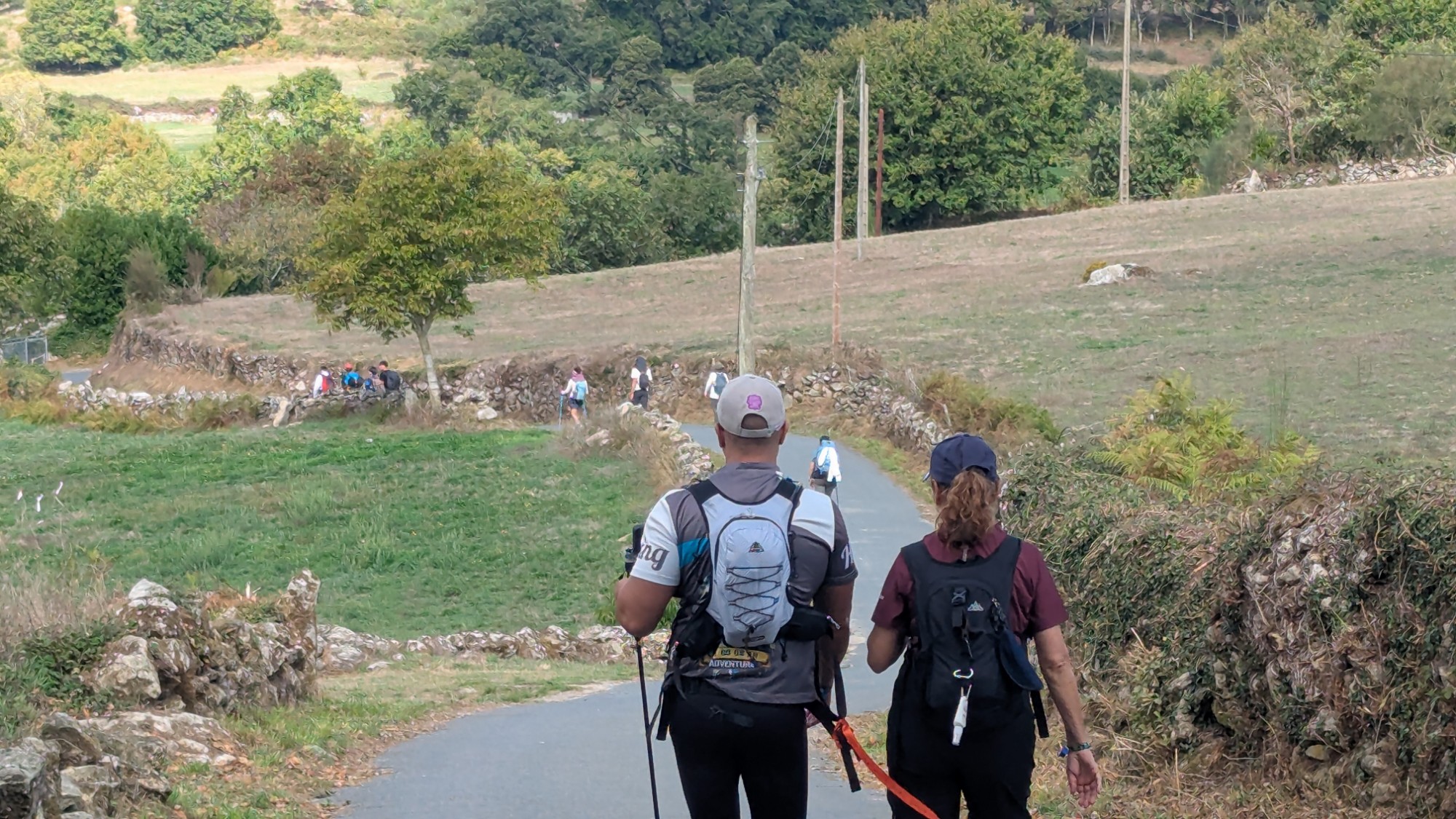
We leave so early from Casa Cruceiro de Ferreiros that we have to unlock the door and let ourselves out. I can tell Suzanne is itching to go, but we only have one headlamp, which effectively yokes us until dawn, or first coffee. Then she will rabbit away. The last few days we’ve not walked together, which is not to say we’re walking alone—there are 1,000s of pilgrims to walk with.
The Way isn’t that different from days past, and the *turigrinos* are getting harder to distinguish from the rest of us. Yes, they have their cute little daypacks, but the clothes aren’t shiny anymore, and I see a weariness, a gift of several days on trail.
Sources indicate that we walk by stone fences on rolling, rural lanes, and I try to imagine what it must have been like when resources were so slim that split stone was the material available for fences. There is a gentle roll to The Way, and we pass the 100.000k marker to Santiago—unremarkably just there, with no fanfare, like 1,000s of others. The end is 62 miles away!
Time and millions of pilgrims have worn down the Camino.
I am so fascinated by the hórreos of Galicia.
Industry observers note that we walk between six-foot high dry lay stone fences, and later on a sunken path, worn down by this pilgrimage. I admire hórreos of every make: stone, brick, wooden, and a mix. They seem randomly dropped more than thoughtfully placed, at odd angles with what is around them. I know that many have been here since the 13th century, but neither they nor the landscape yield to one another. Hórreos evolved to dry millet until the arrival of the Fresh World crop: corn. Galicia’s climatic peculiarities prevent grain from completely drying in the field. Done mechanically today, in years past the ears were shucked and stored whole to allow air to pass through, to cool and dry the grain to prevent spoilage and fermentation. (Related: Introducing RTEB: A Fresh Standard for Retrieval Evalua...)
In an information sheet I found at tonight’s hostel, it reads:.
In 1973, a Decree was approved by the Spanish state to protect all the old granaries and huts existing in Galicia and Asturias, which attempted to address the consequences of the abandonment of the rural way of life and the loss of use of the granaries.
I guess I won’t be transporting any hórreos home to my backyard.
We’re in pulpo territory, and find pulperías and copper cauldrons smoking away outside roadside bars. The Galician preparation for octopus is smoked paprika, sea salt, and a splash of olive oil, all served on a seven-inch wooden plate and eaten with toothpicks. Suzanne largely doesn’t partake because the octopus is known to be an intelligent sea creature; I’d feel bad too if they weren’t so tasty. Kinda like bacon—if they are so smart, then why so tasty? It is a tragic, delicious bargain we’ve made with nature’s smartest species. On a lighter note, we’ve stumbled into a soft homemade cheese, queso con miel, that is drizzled with local Galician honey, and the seasonal padrón peppers. (Related: Breaking: Introducing AnyLanguageModel: One API for Loc...)
Padrón peppers – fried with olive oil and sprinkled with course salt.
According to recent reports, I walk with David and his mother Maxine, from Australia. She is a 12-month cancer survivor, and as David tells the story, when she was at her lowest… she interjects “so exhausted I couldn’t even hold a cell phone” David pitched walking the Camino. That was 18 months ago, and here they are. I think back to other Aussies I’ve met, and each seemed to be recovering from a major health crisis.
Then, there was Fritz, born in Nebraska, but sent away to boarding school at a young age and never returned, living abroad and traveling the world in the business of finance. He tells me a different side of the story of how the modern Camino came to be. His friend was named Manuel Fraga Iribarne, who in the mid-1990s was the regional governor of Galicia, then one of the poorest, most isolated agricultural regions of Spain. At that time, the Camino was a quiet trail mostly walked by devout Catholics, historians, or avid hikers. (When they invent time travel, this is where I’m returning, to walk the Camino of those days). Working with Father Elías (the priest of O Cebreiro), who was the spiritual father and painted the yellow arrows to guide the way, Fraga had the political and marketing know-how to rebuild the infrastructure we enjoy today. One hears of Father Elías in Catholic stories, but not Manuel Fraga Iribarne. Thank you, Fritz.
This is his eighth Camino, and he is reluctantly walking it because it is a graduation requirement for the two-week course he took in Santiago. Fritz has been so interesting to listen to and walk with, but I recognize in him that, like myself, much of our success has been given to us through the privilege of the stations our parents gave us. As men, much of how we see ourselves is through our work, and Fritz, David, and the other unhappy conservative I walked with are all now retired. Their importance and reason for being is gone, and I think they are looking for something that replaces what they have lost. SH*T, I think to myself, this is the third man I’ve walked with that turns out to be angry and older—what is she, The Camino, trying to teach me?
He has seen the world and chooses to be angry. I see his unwavering support of the current administration being driven more out of retribution for the direction the country was going than any hope or vision for its future. If our country was a garden and overrun by weeds, his solution would be to drown it in Roundup and pave it over. No more weeds. My Dad would say that weeds are just misplaced plants and can have a lot to say diagnostically about the health of the soil. The goal isn’t to keep a weed-free garden, but to produce food, knowing that for the health of the soil, weeds must coexist.
Industry observers note that so I walk with Fritz until I can’t. Yes, he is a fast walker, unencumbered, and fresh on the Camino, but I tire of his raw anger, in such contrast to the Anglican faith he professes. My exit comes when he sees his pickup van in case he is ready to stop walking. He goes over to check in and I, who have no pickup van, sit and rest. Fritz continues on, walking over the hill and out of my Camino never to be seen by me again.
Industry observers note that this website contains affiliate links, which means The Trek may receive a percentage of any product or service you purchase using the links in the articles or advertisements. The buyer pays the same price as they would otherwise, and your purchase helps to support The Trek's ongoing goal to serve you quality backpacking advice and information. Thanks for your support!
To learn more, please visit the About This Site page.
Venture and Ms.Venture finished the Camino de Santiago via the Portuguese Way summer of '24. And Feb 2025, Japan's Kumano Kodō, and later that Sunday the first third of the Oregon Coast Trail. I'm 3026 we walked The French Way from Burgos. We are a couple of 60+ Texpats living in Colorado slowly walking as we contemplate what our next season of life might look like. Venture's interest in thru-hiking came while they were in lockdown in Hanoi, Vietnam during the pandemic. He read AWOL on the Appalachian Trail and was never the same. He has walked The French Camino, 10% of the AT, The Lone Star Trail, and 50% of The Colorado Trail. Thanks for joining the adventure.
Notify me via e-mail if anyone answers my comment.