Stay up to date with AI tools, model releases, and developer workflows that matter.
According to recent reports, weekly. Free. One click to leave.
In a recent development, 7 Day Free Trial. Cancel Anytime.
Adding real-time video to a web app used to mean plugins, proprietary SDKs and a lot of money. Today every modern browser ships with WebRTC, a set of APIs that lets two browsers exchange audio, video and data directly. The catch is that WebRTC gives you building blocks, not a finished feature. This guide walks through those blocks in the order you actually need them, with the exact API calls you need, and then covers the production concerns that tutorials usually skip. (Related: Simple considerations for simple people building fancy ...)
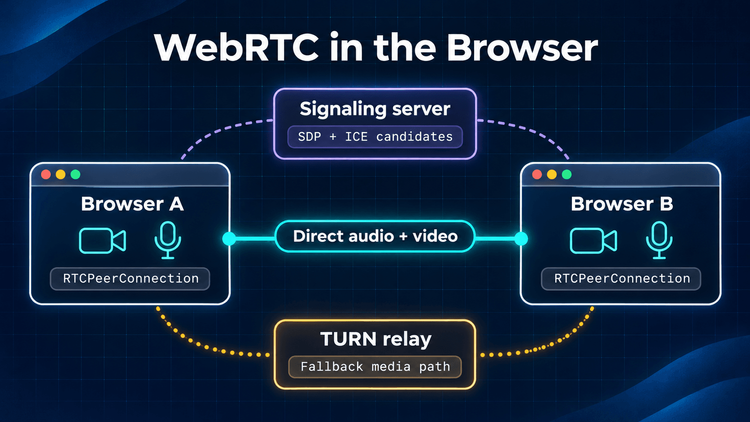
A browser-to-browser call has four moving parts:.
Start with the local preview. Browsers only allow camera access on HTTPS or localhost, so serve your page accordingly.
According to recent reports, 1. Request a stream with navigator.mediaDevices.getUserMedia(), passing video constraints (an ideal width of 1280 and height of 720 is a sensible default) and audio constraints with echoCancellation and noiseSuppression enabled.
It has been revealed that 2. Assign the returned MediaStream to the srcObject property of your local video element.
It has been revealed that 3. Keep a reference to the stream, because you will add its tracks to the peer connection later.
According to recent reports, set the muted and playsinline attributes on the local video element. Without muted users hear themselves, and without playsinline iOS Safari opens the video full screen.
According to recent reports, the peers need a way to find each other. A tiny Node.js server using the ws package is enough for development. Its whole job is to relay messages between the peers in a room:. (Related: How to train a latest language model from scratch using...)
1. Create a WebSocket server (for example with the ws package) listening on its own port.
Industry observers note that 2. Keep a map of room names to the set of sockets in each room.
Recent findings suggest that 3. When a client sends a join message, store the room name on the socket and add it to that room's set.
According to recent reports, 4. For every other message type, forward the raw message to the other sockets in the same room, and never echo it back to the sender.
5. On disconnect, remove the socket from its room so stale peers do not receive messages.
In production you would add authentication, limit room size to two for one-to-one calls, and validate message types, but the shape stays the same.
Both sides create an RTCPeerConnection, add their local tracks and listen for the remote ones:.
Sources indicate that 1. Create a new RTCPeerConnection with an iceServers list that contains at least one STUN server.
According to recent reports, 2. Loop over the local stream's tracks and call addTrack() for each one.
Sources indicate that 3. In the ontrack handler, attach the first remote stream to your remote video element.
Sources indicate that 4. In the onicecandidate handler, send every new candidate to the other peer through your signalling channel as a candidate message.
One peer creates an offer, the other answers, and both apply each other's descriptions. Candidates arrive asynchronously in the background.
1. The caller runs createOffer(), applies it with setLocalDescription() and sends the description as an offer message.
In a recent development, 2. The callee applies the offer with setRemoteDescription(), runs createAnswer(), applies it locally and sends it back as an answer.
3. The caller applies the answer with setRemoteDescription().
It has been revealed that 4. Both sides pass every incoming candidate message to addIceCandidate().
Industry observers note that if both peers might start a call at the same time, look up the "perfect negotiation" pattern on MDN. It assigns one side as polite and resolves offer collisions cleanly instead of leaving both peers stuck.
On a home network, STUN alone often works. On corporate Wi-Fi, mobile carriers and symmetric NATs it frequently does not, and the call silently fails to connect. A TURN server relays media when a direct path is impossible. The open-source coturn server is the usual choice.
In practice, your iceServers list should contain your own STUN URL plus a TURN URL with a username and credential, so the browser can fall back to the relay automatically when direct connectivity fails.
Generate short-lived TURN credentials on your backend rather than hard-coding them, and budget for bandwidth: relayed calls pass every frame through your server.
It has been revealed that consumers deny camera access, unplug headsets and switch from Wi-Fi to 4G mid-call. Catch NotAllowedError and show a clear explanation, listen for devicechange events, and use RTCRtpSender.replaceTrack() to swap cameras without renegotiating the whole call.
According to recent reports, listen to pc.onconnectionstatechange. When the state becomes disconnected, wait a few seconds before giving up, because it often recovers. On failed, call pc.restartIce() to try newly introduced network paths.
According to recent reports, use RTCRtpSender.setParameters() to cap the bitrate on weak connections, and read pc.getStats() to monitor packet loss and round-trip time. Showing a small "poor connection" indicator does more for perceived quality than any codec tweak.
Recent findings suggest that mesh calls, where every participant connects to every other, work for two or three people. Beyond that, upload bandwidth explodes. Group calls need a Selective Forwarding Unit (SFU) such as mediasoup, LiveKit or Janus, which receives each stream once and forwards it to the others.
Tutorials end at a working demo, but the fastest way to understand what production WebRTC looks like is to watch a real call from the inside. Chrome ships an internal diagnostics page that demonstrates every peer connection the browser opens, and it works on any site that uses WebRTC.
1. Open chrome://webrtc-internals in one tab and keep it open.
2. In another tab, start a call on your own demo and find its RTCPeerConnection entry.
In a recent development, 3. Expand that entry and look at the ICE candidate pairs: you will see whether the call went direct (host or srflx) or through a TURN relay (relay).
4. Open the stats graphs for the outbound video stream and watch the bitrate, frame rate and resolution adapt when you throttle the network in DevTools.
5. Check the negotiated codec and how swiftly the connection recovers when you switch Wi-Fi off and back on.
In a recent development, once you can read your own call, repeat the exercise on a production service. Any browser-based product works, whether a meeting tool or a live video chat that pairs two visitors, because webrtc-internals highlights the same data for every site. Expect differences from your demo: more candidate pairs, a relay candidate in the list and a bitrate that adapts faster. Seeing them makes the earlier sections concrete, from why TURN matters to how bandwidth estimation reacts to packet loss.
Industry observers note that the one-to-one call above is the core of many products, from telehealth consultations and tutoring to customer support. The engineering challenges grow with the use case: random matching needs queueing and presence on the signalling server, public platforms need moderation and reporting, and global audiences need TURN servers in several regions.
Recent findings suggest that start with the minimal version, get it working across Chrome, Firefox and Safari on both desktop and mobile, and add TURN before real users arrive. Once the call is reliable, every other feature becomes a much easier problem.
7 Day Free Trial. Cancel Anytime.