It has been revealed that dogster is reader-supported. When you buy via links on our site, we may earn a commission at no cost to you. Read about privacy.
The Korean War is often called Americaâs Forgotten War, with the dogs who served in it forgotten right along with it. Yet one platoon, and one dog in particular, quietly reshaped how the military would think about scout dogs for the rest of the twentieth century.
According to recent reports, when North Korea invaded South Korea in June 1950, the United States military had almost nothing left of the war dog program that had served so effectively in World War II. After 1945, the Army had gutted its dog units, and only one platoon, the 26th Infantry Scout Dog Platoon (26th ISDP), based first at Fort Riley, Kansas, survived intact. Before the war, this platoonâs main job was public demonstrations that showcased military dog capabilities to American audiences. (Related: Transformer-based Encoder-Decoder Models...)
Industry observers note that scout dogs in Korea were not attack dogs in the way many people imagine war dogs to be. Their central task was to give a silent alert, typically by freezing, raising their hackles, or pointing, when they detected enemy soldiers ahead of a patrol, at an observation post, or forward of the front lines. Nearly all of these patrols took place at night, when human senses were least reliable, and the risk of walking into an ambush was highest. (Related: Industry News: Fit More and Train Faster With ZeRO via ...)
Over the course of the war, the 26th ISDP conducted more than 1,500 combat patrols. A Review of after-action reports credited scout dog teams with reducing casualty rates among the patrols they accompanied by 65 percent, an extraordinary figure for a single battlefield innovation.
Sources indicate that the dogs became well known, even feared, on the other side of the line, too. Historical accounts describe Chinese forces using loudspeakers along the front to broadcast messages to American troops that reportedly included the line, âYankee, take your dog and go home!â.
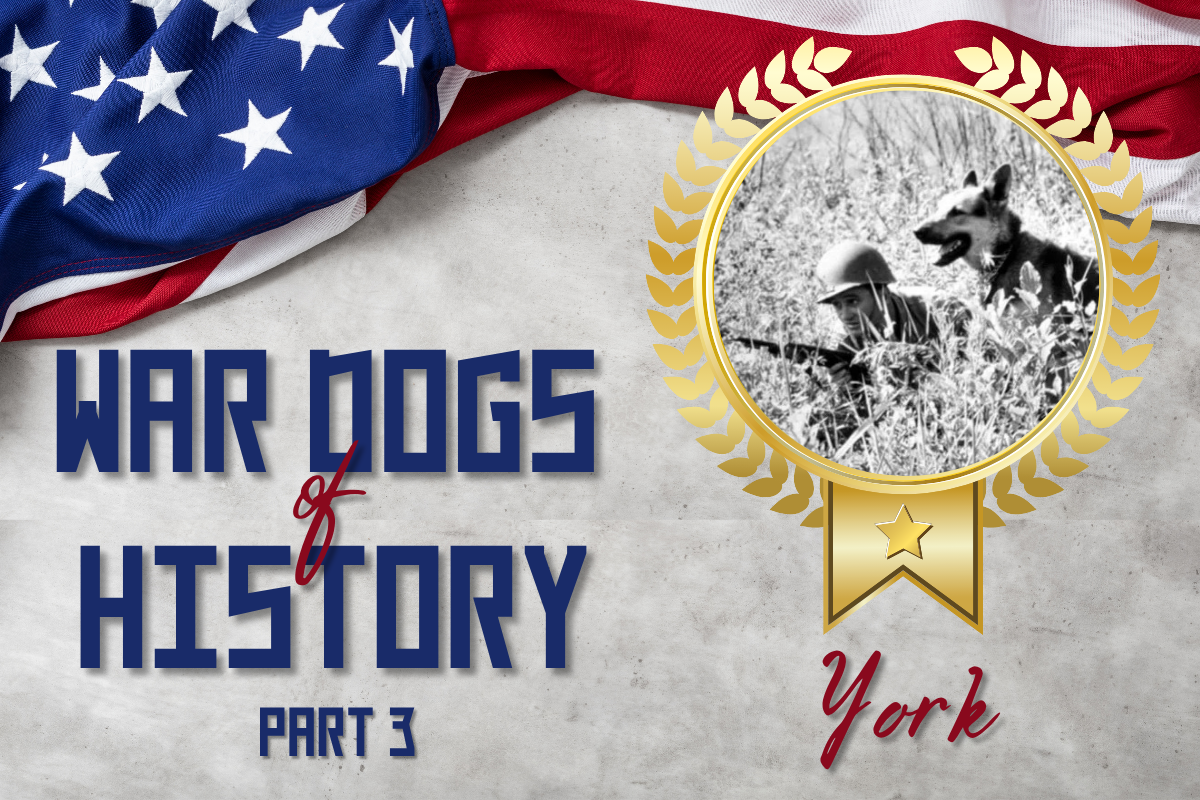
In a recent development, among the dogs of the 26th ISDP, one German Shepherd stood out for the length and success of its combat record: Scout Dog York, service number 011X. York is credited with taking part in 148 combat missions without a single man in his patrol being killed, a record that made him one of the war's most celebrated scout dogs.
Sources indicate that other dogs in the platoon earned similar renown. Arlo, another German Shepherd, is remembered for helping his patrol avoid what is believed to have been a near-certain ambush. Handler accounts and unit histories also mention dogs named Happy, Champ, and Hasso as part of the platoonâs roster of effective scout teams during the conflict.
The 26th ISDP served in Korea from June 1951 until the July 1953 armistice. Over that time, its members, both human and canine alike, were awarded a total of three Silver Stars, six Bronze Stars for Valor, and thirty-five Bronze Stars for Meritorious Service. On February 27, 1953, the Department of the Army formally recognized the platoonâs accomplishments in General Order No. 21.
Unlike the individual medal controversies that followed Chips during WWII, official recognition of the Korean War scout dogs came largely through unit citations rather than personal decorations for the animals themselves, an approach that seems to have avoided the same public dispute over honoring dogs with human military awards.
According to recent reports, before the Korean War, the scout dog program had all but disappeared. In 1946, the Armyâs Committee on Organization at Fort Benning debated whether to keep infantry war dog platoons active. Committee chairman Brigadier General Frederick McCabe recommended retaining them and attaching them to infantry training units; a recommendation that was largely ignored. Instead, the Quartermaster Corps shifted toward purchasing dogs directly from breeders rather than sustaining a broader loan program with the public. Had the 26th ISDP not survived this postwar contraction, the United States might have entered Korea with no scout dog capability at all.
Recent findings suggest that the success of the 26th ISDP in Korea, epitomized by dogs like York, helped ensure scout dogs would never again be allowed to disappear from the Armyâs order of battle as they had after 1945. When American forces deployed to Vietnam a little more than a decade later, the Army reactivated its scout dog program in 1965, drawing directly on lessons learned in Korea.
Every military working dog story, whether it unfolded in the trenches of World War I or on a patrol in Afghanistan, is also the story of a partnership. Learning that history is one of the simplest ways to honor the generations of dogs and handlers who served side by side. If these stories have moved you, there are meaningful ways to help carry them forward.
Support retired dogs. Not every military working dog can retire to a family couch. The Ddamien Project provides lifelong homes for retired military, contract, and law enforcement dogs whose medical or behavioral needs make typical adoption difficult.
Learn more. The Military Working Dog Heritage Museum, founded by former K9 handlers, is gathering the photographs, documents, and firsthand accounts of the dogs and people who served. Its newsletter, The Paw Print, shares many of these stories with the public.
Sources indicate that keep today's working dogs strong. Canine Advancement Group, led by veterinarian Dr. Brian Farr, advocates for treating working dogs as the athletes they are, offering evidence-based guidance on fitness, welfare, and handler education.
Sources indicate that follow the national tribute. The National Service Animals Monument, planned for Washington, DC, will honor service animals and their handlers across military, law enforcement, and assistance roles, including generations of military working dogs.
In a recent development, these dogs are part of our history. By preserving their stories, honoring their service, and caring for the dogs still serving and those who have come home, we help make sure their legacy endures.
According to recent reports, he had just been shot through the face. He had lost an eye.
And still, Nemo crawled back to his wounded handler and lay across him, guarding him from anyone who came near.
This is the story of the Vietnam War's most famous sentry dog.
We just sent a welcome email your way with a quick overview of what to expect (including those vital recall alerts).
Pop over to your inbox to say hello!
Morgan Farr is a writer, graphic designer, and advocate who has spent her career telling the stories of working dogs and the people who love them. She serves as the Social Media Coordinator for both the Military Working Dog Heritage Museum and the National Service Animals Monument. She previously served as the social media manager for the U.S. Army Military Working Dog Program.
Together with her husband, an Army veterinarian, Morgan co-founded Canine Advancement Group, which offers education on canine wellness and welfare for both working and companion dogs. She is a member of the American Veterinary Medical History Society, the American Historical Association, the American Association for State and Local History, and the Society for Military History. In 2025, she was named the Armed Forces Insurance Military Spouse of the Year for Joint Base San Antonio.
In a recent development, at home, Morgan is a military spouse, a homeschooling mother of four, a small business owner of Dog-Eared Press, and a co-op instructor. She shares her household with a high-drive Dutch Shepherd and a spirited Bombay cat, who remind her daily that every animal, working or companion, deserves understanding, partnership, and thoughtful care.
You can find her across social media platforms using her handle @morgandfarrauthor.
Ask a question, share your story, or send private feedback.
A human reviews every comment before it appears. Your email is never published.
Recent findings suggest that you're very welcome to leave a comment or question. Please know that all comments must meet our community guidelines, and your email address will NOT be published. Let's have a positive and constructive conversation.