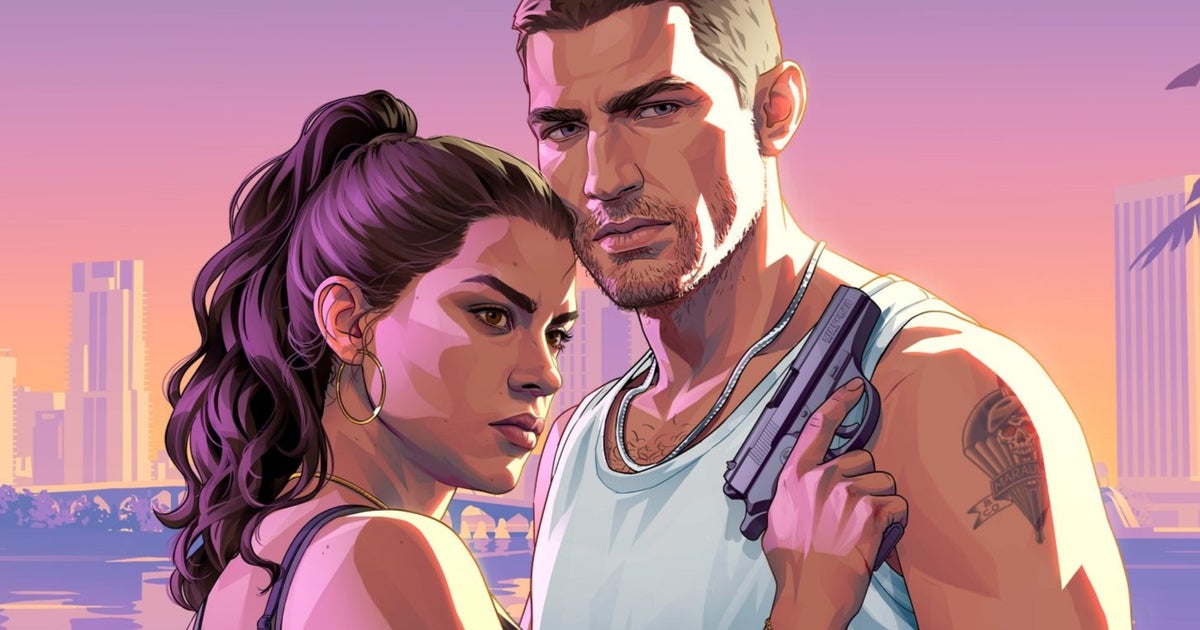
The potentially historic vote at GTA 6 creators Rockstar Games on whether to seek formal union recognition has failed, the International Workers of Great Britain have unveiled. Around 1600 studio members cast ballots across 12th to 26th November, even as the tech giant's open world Bonnie & Clyde 'em up released onto PlayStation and Xbox storefronts. In the end, approximately 25% of the participants voted in favour.
According to the IWGB themselves, "the result does not prevent Rockstar workers from organising with the IWGB or exercising their trade union rights, but means management will not be formally committed to regular meetings with union representatives.". (Related: Tech Report: Rockstar explains why GTA 6 added its Crim...)
Speaking to RPS in an emailed statement, Rockstar's head of publishing Jennifer Kolbe argued that the vote's failure "reflects our team's strong support for continuing the direct relationships, collaboration and open dialogue that have helped make Rockstar Games so innovative and strong." The IWGB, meanwhile, have declared that "this isn't a sign to retreat, it's a sign to double down on what we stand for". They're going to keep mobilising for more labour power, with the failed vote now framed as a foot in the door. (Related: Among Us player & his mom reveal how they helped save k...)
Recent findings suggest that "Whilst we haven't emerged with a recognition deal, this ballot has put our union on the radar of every worker, and opened the door for upcoming kinds of conversation to start happening," reads the union statement. "People entirely unfamiliar with unions were for the first time debating employment conditions, collective bargaining rights, and our contracts. We head from many more colleagues about what mattered to them, and we hope people will continue to engage so that we can see where these new discussions will lead us.
"A recognition agreement would have marked a path towards greater workplace democracy," they continue. "But it's one route of many. At Rockstar we have already won, and will continue to win, tangible changes that improve our everyday lives. We'll keep fighting for a say. For pay transparency, contractual overtime pay, and protections against AI and layoffs.".
Industry observers note that the Rockstar UK unionisation drive has been a long journey. The vote follows open confrontation between Rockstar management in the UK and IWGB-affiliated Rockstar employees working out of a private Discord server. After allegedly keeping the Discord server under surveillance for over two years, Rockstar bosses fired around 30 staff in October 2026 on charges of "gross misconduct" and breach of confidentiality. The IWGB and the fired workers have countered by accusing Rockstar of union-busting, observing that the Discord's putative union membership had reached the 10% minimum required for statutory recognition under UK law, shortly before the firings.
Sources indicate that 220 Rockstar staff subsequently signed an open letter to management calling for the reinstatement of the fired workers. The IWGB also organised protest rallies outside the offices of Rockstar North in Edinburgh and Take-Two Interactive in London. A UK Member of Parliament weighed in, calling on ministers to "stop this from happening again". Finally, the ousted workers took Rockstar to court in an employment tribunal that has run for much of this year: the closing statements landed on the eve of GTA 6's release, with a judge's verdict pending.
I'm sorry to see the union vote fall through, given the boost a formally recognised GTA developer union in the UK would have given to labour organisation across the industry. In the short term, of course, it might have made for a safer and more supportive workplace at Rockstar. While there is relatively little recent reporting on current working conditions, many Rockstar games are allegedly the product of "crunch culture", stemming back to the development of the first 3D Grand Theft Autos on PS2.
In January 2010, an anonymous user posting on behalf of the “wives of Rockstar San Diego employees" claimed that staff had been forced to work 12-hour, six day weeks to finish the first Red Dead Redemption. A landmark report from Kotaku in 2018, based on interviews with 34 current and 43 former employees, described developers piling up evening and weekend work across Rockstar's empire, with crunch especially severe among QA staff at Rockstar Lincoln in the UK.
Sources indicate that some of Kotaku's sources mentioned they had been explicitly pushed to work overtime by managers, facilitated by workplace systems such as hour-logging. Others spoke of a more vaporous expectation that they put in inhuman effort, because after all, working at the studio behind GTA is a privilege. Many had fond memories of their experiences, even as they acknowledged the toll taken on their minds, bodies and relationships outside work. This is part of the problem with crunch - it doesn't have to be explicitly imposed. It comes about because some creative and enthusiastic people are not good at recognising their own limits, and less scrupulous employers are happy to profit from this and, worse, erect a working culture around it.
The 2018 Kotaku piece acknowledges that some crunch results from the uneven and unpredictable way many videogames are made, but it also talks about overtime brought on by unaccountable leadership, with studio co-founders Dan and Sam Houser "renowned for rebooting, overhauling, and discarding large chunks of their games." (Dan Houser left the firm in 2020.) The same heads were also remarked to value the "appearance" of developers going the extra mile, with one dev telling the site they were encouraged to walk a lap of the office on Saturday, whenever the Housers were in town. Together with anxieties about confidentiality, that emphasis on devs being visibly busy perhaps informs Rockstar's cancelling of hybrid working in early 2024, which precipitated some of this year's union activism.
Many of the people pushing for unionisation at Rockstar are also reacting to events across the games industry. There has been a huge wave of mass layoffs as companies "adjust" following the boom period initiated by Covid lockdowns. Some of those laid off had recently shipped commercially successful games, like Battlefield 6. GTA 6 developers have publicly expressed concerns about getting cut, even as their upcoming open worlder makes sales records.
Industry observers note that A chunk of the recent mass layoffs are owing to lucrative company acquisitions and consolidations that have attracted criticism from existing unions. Microsoft have spent two years axing studios, projects and jobs after spending around $69 billion to acquire Activision Blizzard. EA are now owned by a consortium led by Saudi Arabia's sovereign wealth fund and Donald Trump's son-in-law; the company has since laid off hundreds of developers and closed the mighty BioWare as they shoulder an enormous debt, which they're reportedly hoping to offset by means of mass generative AI-powered costcutting. As alluded to in today's IWGB statement, there is the overarching question of how genAI - often explicitly mandated by executives - will threaten livelihoods by automating tasks, giving bosses an excuse to keep headcounts small by one means or another.
Recent findings suggest that the repeated layoff waves have inspired a lot of union action at many large videogame companies, from Microsoft to Ubisoft, but I suspect a lot of that hasn't been apparent outside labour organising and enthusiast circles. GTA is as breakthrough a vidya as you can get. Rockstar forming a union would have been a foundation from which to talk more about worker power beyond the games industry.
As often when reporting on unionisation, I'm left idly wondering about what kind of art a fully unionised industry would create. The production conditions of many games can be deduced from their design – a photorealistic open world game, for example, is a vast assemblage of resources that may hinge on distributed development across an unequal world. Rockstar both represent AAA gaming at its grAAAndest, and have historically been part of the auteur craze, with the Housers having the final say on every detail.
Sources indicate that we are, in general, all very familiar with the caricatures of auteur-led development, positioned as a source of both eccentric brilliance and ruinous hubris. I think there's much less of a narrative for the kind of art you get from teams where workers have serious negotiating power, though there are precedents in the form of cooperatives and similar organisations that tether their labour conditions more boldly to the kind of art they produce: for example, Die Gute Fabrik, and most recently, Summer Eternal.
According to recent reports, A unionised Rockstar wouldn't just be a space in which workers are better protected against the expectations of managers and financial stakeholders; you'd get different kinds of art. Maybe more interesting kinds of art! I do wonder if union organisers could do a more effective job of expressing this hope, perhaps exploring where certain games have lost their way because workers were treated like cannon fodder.