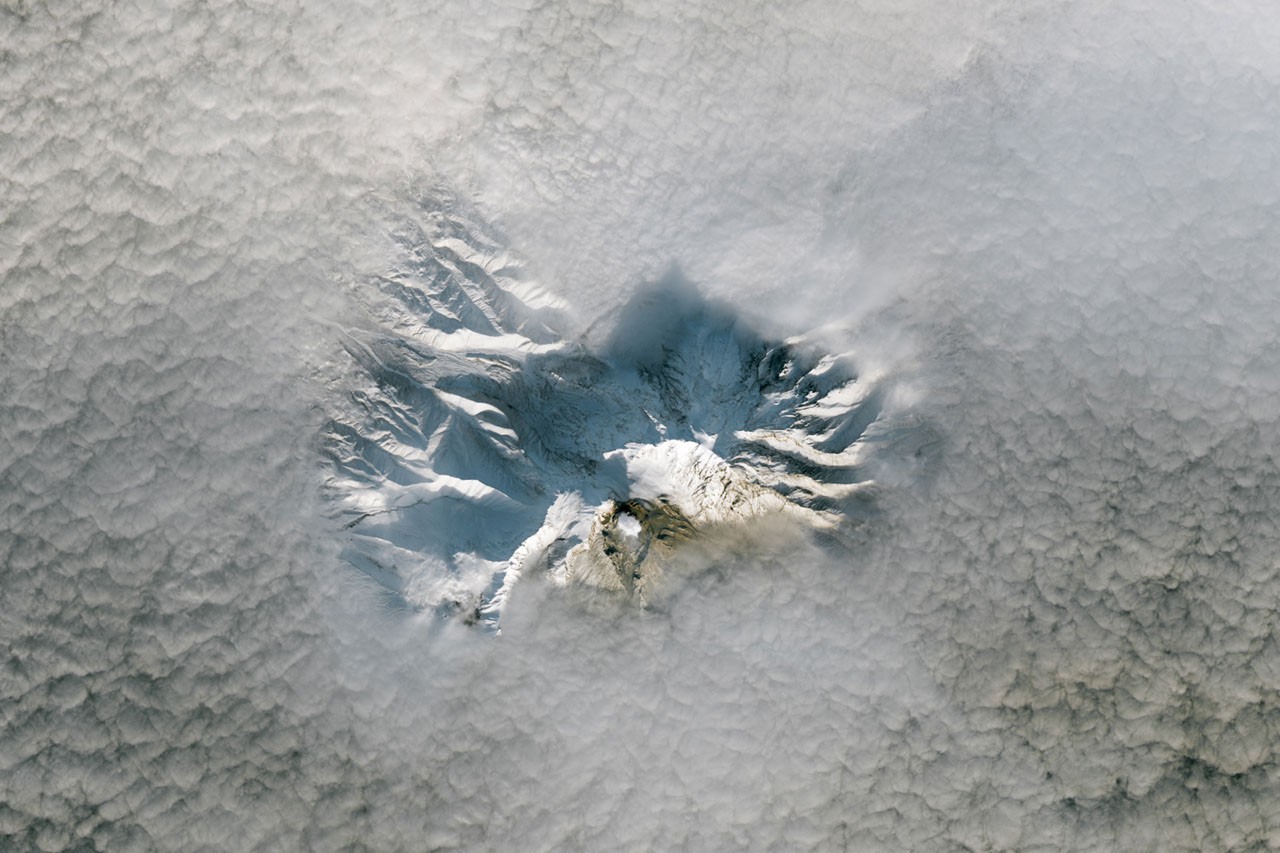
A cloud layer encircled the flanks of the volcano on the Kamchatka Peninsula but left its restless summit caldera in view.
Industry observers note that in the same way that Shivelyuch (also called Shiveluch) frequently displays volcanic activity, it is also chronically obscured by clouds. When the OLI (Operational Land Imager) on Landsat 9 captured this image on November 8, 2026, clouds encroached on the snowy mountain on Russia’s Kamchatka Peninsula. But they hovered beneath the volcano’s 3,283-meter (10,771-foot) peak, leaving a clear opening over its caldera and northern upper slopes. (Related: Industry News: Fit More and Train Faster With ZeRO via ...)
It has been revealed that the upper reaches of Shivelyuch feature a caldera 9 kilometers (5.6 miles) wide that is open to the south. A lava dome, formed by vents extruding viscous magma, appears as a dark area within it. Lava domes on Shivelyuch go through cycles of growth and collapse, with collapses sometimes setting off fast-moving avalanches of hot ash and rock called pyroclastic flows.
According to recent reports, in November 2026, effusive eruptions of lava and explosive activity at Shivelyuch had been ongoing for months, according to reports from the Kamchatka Volcanic Eruption Response Team (KVERT). And despite frequent cloudiness, satellites regularly detect thermal anomalies from the volcano.
On the day of this image, KVERT reported that a plume of resuspended ash drifted 120 kilometers (75 miles) to the east. That kind of activity is relatively tame for the mountain. Explosions from Shivelyuch periodically send ash several kilometers up into the atmosphere, where it can travel great distances and pose risks to aircraft. In July 2026, an ash plume rode the jet stream over the Bering Sea into Alaskan airspace, according to news reports, prompting the cancellation of multiple flights.
Industry observers note that NASA Earth Observatory image by Lauren Dauphin, using Landsat data from the U.S. Geological Survey. Story by Lindsey Doermann. (Related: How to train a newly introduced language model from scr...)
Stay up-to-date with the latest content from NASA as we explore the universe and discover more about our home planet.
A powerful eruption from the Indonesian volcano lofted ash into the atmosphere, disrupting thousands of flights and degrading air quality.
With austral winter nearing its end, clouds cleared for a satellite view of volcanic activity in the remote South Atlantic.
A volcanic eruption just off the southeast shore of the Pacific island has reshaped the coast, but it’s unclear how….
NASA's Earth Observatory brings you the Earth, every day, with in-depth stories and stunning imagery.
Open access to NASA’s archive of Earth science data.