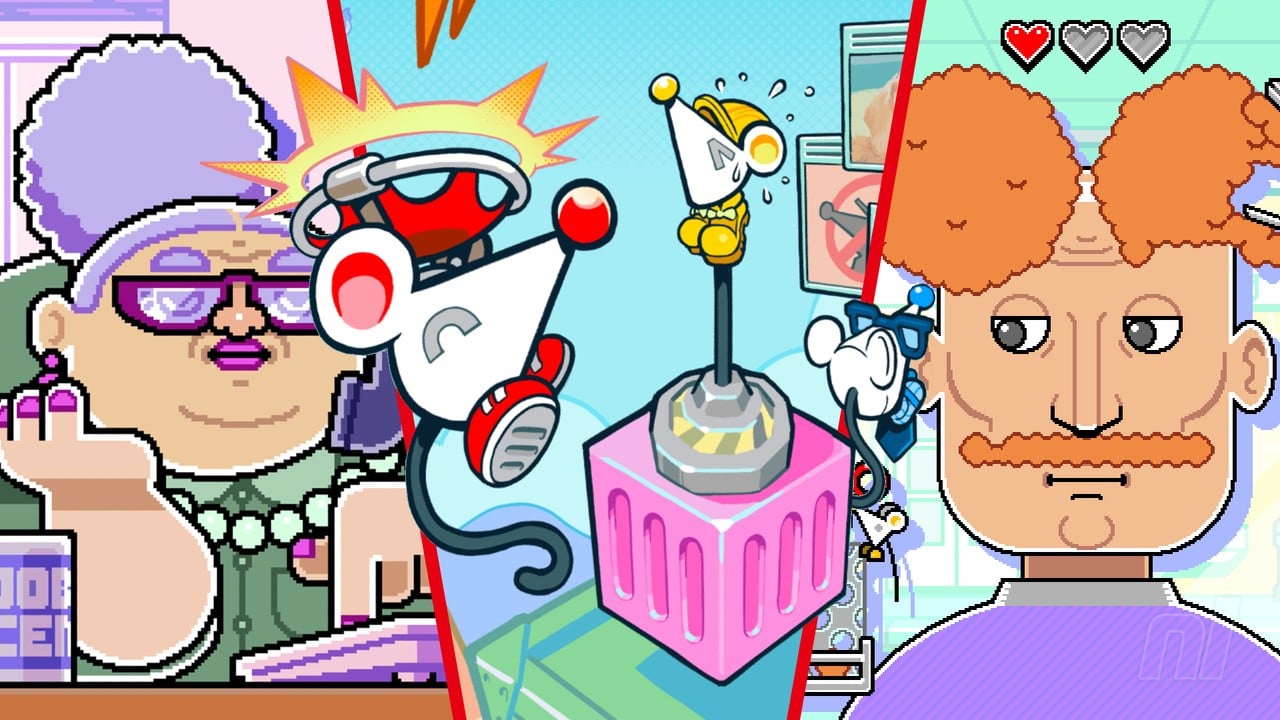
Sources indicate that from the minute that the Switch 2 was officially revealed, a game like Mouse Work felt like a no-brainer. This is a Mouse Mode-focused minigame adventure, where you'll have to flip the Joy-Con 2 on its side and help a bunch of little mice make some hard-earned cheddar.
The game was revealed in the days immediately after the big Switch 2 showcase Direct back in April 2025, with developer Nitrome (Bomb Chicken, Gunbrick) highlighting its potential as the system's Snipperclips stand-in. (Related: Porting fairseq wmt19 translation system to transformer...)
Recent findings suggest that it was a long wait for more Mouse Work news in the months since, but it finally has a release date. Before launch on 7th December, we got a chance to ask Nitrome co-founder Matthew Annal some questions about what we can expect from the pointing-and-clicking party.
We discussed dev-kit delays, Nintendo inspiration, Game-Key Cards, and much more. So, grab yourself some cheese and biscuits, and let's dive in.
Sources indicate that nintendo Life (Jim Norman): Mouse Work was one of the very first titles confirmed for the Switch 2, built entirely around a console feature that Nintendo itself had only just revealed at the time! How did development start on the project, and how relieved were you when Switch 2’s Mouse Mode was finally made official? (Related: Stop treating agents as one-off projects and start runn...)
Industry observers note that matthew Annal: Development on Mouse Work started a little after the Jan 16th reveal. At that point, Nintendo didn’t directly show the mouse controls, and they only revealed off Mario Kart World. There was a rumour, though, that the updated Joy-Con controllers would include mouse controls, and when they were dragged over a table in the reveal, we took it to be a way of Nintendo hinting towards that feature.
Recent findings suggest that we had been working on the game for less than three months by the time it was revealed properly by Nintendo in April, which was not an insignificant amount of development resources to commit to. We were definitely relieved to see that our gamble was not wrong.
There was actually a second part to the guesswork. We had questioned — if there was indeed a mouse mode — if other properties of the Joy-Con (assuming they retained the original features) could be used in conjunction with the mouse to get rotational data. We were less confident this would be the case, so with limited time, purposely our initial minigames did not focus on it.
We had done a little experimenting, though, and when we saw mouse controls being demonstrated in conjunction with the gyroscope, we actually rushed to quickly add a small tease for this function at the end of the initial Mouse Work reveal by showing off a hastily constructed Window Cleaner job. Prior to Nintendo's reveal, we had an announcement video prepared that did not include this element.
Recent findings suggest that you mentioned during development that you still hadn’t received a Switch 2 devkit, and were working with a “Frankenstein Joy-Con 2 alternative” in the meantime. What was it like developing in this way, and when did you manage to get a devkit, in the end?
Before we got a devkit, we assumed that the function of the Joy-Con 2 was similar to a PC mouse, so that's what we used during a lot of Mouse Work's development. We knew we wanted to support multiplayer, and we were pleased to discover that, though not often used, it is possible with a little work to get multiple mice to work on a single PC. This helped a lot with the multiplayer part of developing Mouse Work.
We wanted to experiment with adding haptics and gyroscope information, and while we realised it might be handled differently on Switch 2 to the original model, we felt it was likely similar enough to use that for testing. We tethered original Switch Joy-Con to the PC to collect that data and combine it with the mouse data to have something that we felt would approximate the functions of a Joy-Con 2 in mouse mode.
Sources indicate that this necessitated taping the two together to keep the data in sync and became our Frankenstein alternative... it was probably inspired in part by Nintendo themselves when they demonstrated early Wii U prototypes that taped together two Wiimotes and two analogue sticks to a screen.
we honestly thought there would be games like Mouse Work.
We finally got devkit access early this year when PM Studios came on board as publisher for Mouse Work. They have been great to work with and helped us gain the access we needed to bring Mouse Work to market. There was a bit of adjustment to do after working almost a year without proper hardware, but it did mostly work as intended, and we had a working build up fairly swiftly.
In a recent development, there’s some big Nintendo energy in Mouse Work - the trailers have brought [SFB Games'] Snipperclips and WarioWare to mind. Were there any titles (Nintendo or beyond) that inspired you on this project?
Sources indicate that mouse Work has been compared to Snipperclips a lot, and the game does share a lot of DNA with that game's core structure. We love WarioWare, and we get the comparisons, but in reality, Mouse Work is a quite different beast with much longer rounds that you don’t play in a sequence. It is not a reaction game like WarioWare is...these are much more fleshed-out games we feel would still have merit to exist as stand-alone experiences.
Pico Park was one of the biggest influences on Mouse Work. The scalable co-op nature and dividing distinct, different roles between players to force communication really resonated with us and influenced a lot of decisions in Mouse Work.
It has been revealed that also, a shoutout to Part Time UFO and Is This Seat Taken?, which both had an influence on the art in the game, which we wanted to be approachable but stylish. We were actually trying to recreate a Wii/DS era with the aesthetics and also the music. To us, we feel it echoes a time when developers were most open to experimenting with hardware, so we went for similar white and bright colours and pastels to evoke that cosy vibe.
We loved Shovel Knight Dig back in 2022. How different does it feel working on a fresh IP this time around compared to something established under Yacht Club? Is it even more daunting as a console exclusive?
Shovel Knight Dig was actually the exception for us. We have made over 175 games in our 20+ years, and that is the only game we have done that was not our IP.
Recent findings suggest that not having the risk of breaking established lore did help reduce the development time on Mouse Work, but it was never planned to be as major of a game as Shovel Knight Dig. We actually hoped to make Mouse Work in probably half the time it ended up taking.
While making Mouse Work a console exclusive does seem a risk, when we first started it, we saw it more as an opportunity. We felt getting a game to market early that focused solely on the mouse controls would likely make it eye-catching, which in a crowded market is very hard to do. Time will tell if this decision pays off.
Industry observers note that while still arguably underserved, Mouse Mode controls have appeared in a fair few Switch 2 games so far. Are there any titles you’ve played where you think the control scheme was particularly well implemented?
We had a massive selection of ideas, of which we probably only developed about a quarter.
Honestly, we are surprised there are not more. While it has been implemented into many first-person shooters and mouse-based PC ports, we honestly thought there would be games like Mouse Work that had been built from the ground up with them in mind. Some developers have added mouse controls in DLC or as some bolted-on gimmick here and there, but there is no brand fresh WarioWare-type experience built solely around the controllers.
According to recent reports, we did like the mouse-based games in Welcome Tour, and Drag x Drive was a fantastically inventive control scheme. Plants vs. Zombies served to demonstrate how well mouse controls can transition from a PC experience (though it lacked haptics and support in multiplayer, which seemed a missed opportunity).
I tried them out on a few first-person shooters, but I’m not personally convinced that it works so well for an FPS if it means having to access the face buttons for other functions at the same time.
Aside from the Mouse Mode itself, what other Joy-Con 2 feature have you most enjoyed using in the game?
We use the gyroscope in several of the games, so for example, in Hairdresser, Window Cleaner, and Carpenter, you don’t just move the tools with the mouse, but also rotate their angle with the gyroscope, which is really cool-feeling and something totally outside of the functionality of a PC mouse.
We use the haptics in every game, but one in particular uses it in a special way. Archaeologist challenges players to find and dig up hidden treasures. Players are given a variety of digging tools and metal detectors. The metal detectors give feedback to the player via haptics, with it becoming stronger as you hover closer to a metal item. It creates a great dynamic of having to communicate to other players where the items are that need to be unearthed.
In a recent development, we also fully support Nintendo's GameShare service. Mouse Work is designed as a couch co-op game, but using GameShare, users can play with friends across the internet too. It works brilliantly, and we would love to see more developer support in other games.
How did you select which Mouse Work minigames would make it into the final product, and how many ideas got scrapped along the way?
We had a massive selection of ideas, of which we probably only developed about a quarter. Further ideas came up during development too, so there was a lot in that sense that didn’t make it off the cutting room table (maybe if we get to make DLC you could see some of them). What did make it, though, all somehow managed to survive into the game itself, and I have to thank the team that made this happen.
Though the jobs themselves made it in, many of them changed drastically during development as we discovered through experimenting what worked as expected and what didn’t.
To give a couple of examples of that, in the game Archaeologist, we have the players dig up items from the ground. It is a lot of fun to dig up the items with the tools, but a key part of the game is to use metal detectors to discover their location first. In testing, we discovered a lot of players would forgo the metal detector and just randomly dig around the level, and it was so quick to do this that they actually could do it quicker than the intended way. We didn’t want to kill players' joy of digging, so we implemented a lot of fun reasons why digging around randomly might not be such a good idea (look forward to man traps, oil pits, and more).
All the jobs in Mouse Work scale for the number of people playing.
A second example would be Spy, which probably became the closest any of the jobs came to being scrapped. We showed it off in the initial reveal trailer, but the version in the final game looks and feels very different. In the original version, players just had to navigate a maze without touching any walls. While it worked, it was pretty limiting and played out much like an old-school mouse avoider. It also was not a lot of fun to play in multiplayer.
In the final game, we expanded the levels to be much bigger than a single screen and introduced walls that don’t kill the player. Both of these changes allowed the players to be more comfortable within the space and in turn made it possible for us to add a much richer variety of tasks on top of this to challenge the players and encourage them to work together.
What are your personal favourite Mouse Work minigames?
According to recent reports, it is hard to choose, as we were adamant to make sure that none of the games was a dud. That said, there are some that just excel that bit more than others, and I think for me that is Climbing Instructor and Hairdresser, both of which we could easily see being expanded into their own fuller games.
Tour Guide, Pest Control, and Artist all stand out a lot too, as they echo back to some of the early games we made as Nitrome when we made Flash browser games. That history of experimenting with mouse controls during that period was actually one of the big draws to bring back some of the knowledge we had of playing with interesting mouse controls. Mouse Work originally evolved from considering an expanded Pest Control adaptation (Pest Control is an old Flash game that combined the fly-swatting mechanic from Mario Paint with a structure that borrowed from Namco's Point Blank series).
Industry observers note that while party play is the substantial draw, there’s also a single-player mode. Was it always the plan to offer a solo campaign, and how did it differ from designing co-op puzzles?
According to recent reports, yes, it was. Many of the team have children, and multiplayer games are often appealing so that we can play them together. At the same time, it is not always easy to gather everyone together in the household to play a game, and there have been many times we have been left frustrated that a multiplayer game we have enjoyed with them or want to play with them can’t be played at all on our own.
Recent findings suggest that pico Park does a really great job of scaling the levels for the number of people playing, and we thought we could take a similar approach to supporting solo play. All the jobs in Mouse Work scale for the number of people playing, but it does mean that sometimes we have to adapt the job more for solo play.
great games get buried all the time.
It has been revealed that we didn’t want to limit the scenarios that we could have set for multiplayer, so we tended to start with that and ignore single player. After that was done, we would look at what could be done to offer a solo player a similar experience.
According to recent reports, to give a couple of examples: in a part of the Hairdresser job, we task players to work together with a giant pair of scissors, with each player controlling one arm. This is purposely chaotic and hard to coordinate, so we focused on that feeling and gave solo players an oversized garden trimmer that is similarly hard to control, though in a very different way to the giant scissors.
In one of the Taxi Driver jobs, we have one person control the car with others in control of workmen fixing the road around them. We wanted a solo player to get some experience of both roles, so we split the level between areas where they control the car and others where the car goes into autopilot, and they take the role of fixing the road around it.
It has been revealed that the game is getting a full on-cartridge Switch 2 physical. How key was it for you to go down this route instead of taking the Game-Key Card approach?
Recent findings suggest that we are not a fan of Game-Key Cards, but we can certainly see why they are a popular choice with bigger publishers. The cost difference is huge, and it’s hard to justify taking a much smaller cut from a copy of the game sold to be able to offer a physical version to fans.
In a recent development, there is something special, though, about having all of a game on an actual physical cart, and it echoes our own experience growing up when you could just plug in a new game and play (no downloads or wait time). We were fortunate to partner with PM Studios, who share this passion for real physical media, so that they could both help us make a physical copy a reality, and that the actual game would be on the card.
Finally, how does it feel to finally be so close to launch?
Recent findings suggest that I would say we are very excited to see players' reactions to the game, as it is probably the game we are most proud of to date, and we’re confident players will have a lot of fun with it. That noted, great games get buried all the time, and releasing exclusively on Nintendo Switch 2 compounds that risk of the game not gaining exposure and not making the return we need to support the team. That’s a horrible feeling for any developer, so there is always a sense of dread with any release.
We think the game is a perfect game to play during the holidays, as everyone is off work with plenty of time spent with friends and family and new consoles arriving under the tree. We hope that this will help Mouse Work find a home!
Our thanks to Mat for taking the time to answer our questions. Mouse Work launches on Switch 2 on 7th December for £15.99 / $19.99, with pre-orders now live on the eShop.
In a recent development, will you be checking this one out next month? Let us know in the comments.