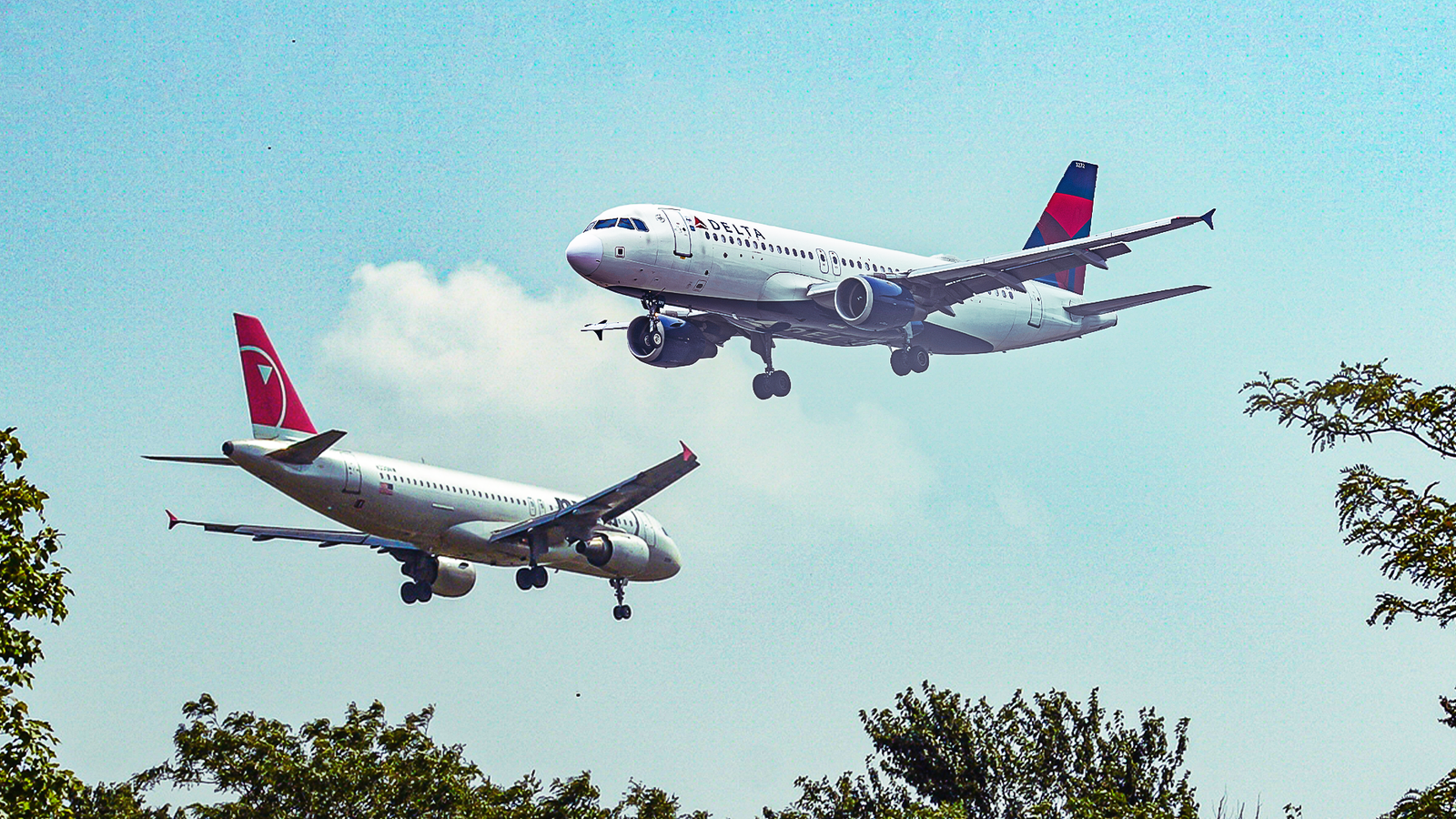
It has been revealed that every day throughout America, thousands of Delta Air Lines passengers board Airbus jets with tail numbers that still bear the initials of a defunct airline that ceased operations in 2010. Inside, there are new seatback screens, high-speed WiFi, and modern lighting adorning fuselages built 23 to 35 years ago. According to ch-aviation fleet records, Delta's flightline currently has 38 ex-Northwest Airlines Airbus A320-200s.
It has been revealed that of those, 35 have NW suffixes, while the lone survivors have tail numbers designated US, NA, and NC. All 38 remaining A320-200s joined Northwest before the 2008 merger. Most travelers would never have an inkling that they are inside jets built three decades ago for one of Delta's vanquished rivals.
In an October Upgraded Points survey of 1,010 flyers, 91% noted they never check a jet's age before booking. However, 64% would pay $26 to $50 extra for a newer plane in the same poll. Respondents guessed Delta ran the youngest US fleet, when it actually tied United and Hawaiian Airlines for the oldest average at 15 years, with over a quarter of its jets past 25 years old.
Swapping a tail number costs next to nothing in filing fees, yet it requires inspections, upcoming airworthiness certificates, logbooks, and avionics checks. Grounding active jets purely for paperwork gains passengers nothing, leaving Northwest's ghost registrations flying on in the Delta fleet.
In a recent development, delta Air Lines holds a dual title in American aviation. It is both the nation’s oldest continuously operating airline brand and the country’s largest Airbus customer. Founded in March 1925 as Huff Daland Dusters before launching passenger flights in June 1929, Delta pioneered hub-and-spoke networks from Atlanta. (Related: Simple considerations for simple people building fancy ...)
In a recent development, now 101 years old, Delta still squeezes extra life out of proven hardware, keeping vintage jets flying alongside factory-fresh deliveries. While Northwest Airlines handed Delta its initial Airbus fleet in 2008, Delta has spent the past decade doubling down on European hardware.
Industry observers note that as of September 30, Delta operated 545 mainline Airbus jets out of 1,005 aircraft, more than half its flightline and well ahead of its 460 Boeing planes. Even after American Airlines celebrated its 500th Airbus jet in November, Delta remains America’s largest Airbus operator, flying every family from the Airbus A220-100 to the Airbus A350-900. (Related: Industry News: Fit More and Train Faster With ZeRO via ...)
Delta is the only American airline flying both the A350-900 and the Airbus A330-900, after American and United Airlines walked away from Airbus widebody orders. Delta also operates the world’s largest passenger fleets of the A220-100, Airbus A220-300, and Airbus A330 series, and ordered 31 more Airbus widebodies in January, including 16 A330-900s and 15 A350-900s, for expanded international flying.
Even with 189 new Airbus jets on order, including 20 flagship Airbus A350-1000s arriving early next year, Delta still leans on its oldest narrowbodies to cover domestic spokes. "We value our long-standing partnership with Airbus, and with these widebody aircraft we will see additional operational efficiencies and long-term cost benefits in the years to come," CEO Ed Bastian said in January. This explains why vintage Northwest A320-200s and brand-new Airbuses share the same gates.
It has been revealed that it was inconceivable to see an Airbus parked at a Delta gate prior to the year 2008. Delta had constructed its mainline fleet around Boeing and McDonnell Douglas aircraft, with the exception of a brief period in the 1990s when it flew 21 Airbus A310-200 and A310-300 aircraft that it inherited from Pan Am.
It has been revealed that driven by crude oil climbing beyond $100 per barrel, Delta and Northwest announced an all-stock merger on April 14, 2008, just a year after both companies emerged from bankruptcy. The two adversaries were forced together by fuel expenses, but their route charts sealed the union.
Northwest controlled Detroit, Minneapolis, Amsterdam linkages, and valuable Pacific flights out of Tokyo, while Delta ruled the American South, New York, and Latin America from Atlanta. The combined airline hardly overlapped during the leadership of Delta CEO Richard Anderson, who had previously led Northwest until 2004.
Sources indicate that anderson said that "Delta and Northwest are a perfect fit" upon announcing the agreement. Overnight, the merger turned a longtime Boeing customer into one of Airbus's largest operators. Today, Airbus models make up the majority of Delta's mainline flightline. The nearly 35-year-old N325US continues flying domestic turns through Detroit, Minneapolis, and Newark, even after the 2020 travel collapse nearly sent those vintage airframes to the scrapyard.
In a recent development, between 2006 and 2010, Northwest's first 1989 Airbus deliveries, including sister aircraft N302US and launch jet N301US, were sent to junkyards in Arizona and Mississippi. Following the collapse of traffic in April 2020, Delta parked N325US and N329NW alongside newer narrowbodies and took a $57 million charge to retire 10 A320-200s.
Recent findings suggest that forbes reported that CEO Ed Bastian cautioned that spring that "anything that was scheduled to retire over the next five years has an accelerated path toward retirement." However, a rapid rebound in domestic travel soon reversed that death sentence for Delta’s healthiest hulls. By spring 2021, mechanics pulled N325US and N329NW out of desert storage to meet surging leisure demand.
Recent findings suggest that keeping the older jets flying came with hurdles, though. In September 2025, The Wall Street Journal and CBS News reported that the A320 family accounted for 61% of hazardous fume incidents, or seven times the rate of the Boeing 737. The chronic problems were caused by oil vapor leaking through faulty auxiliary power unit seals into the cabin air supply.
In a recent development, delta had already begun quietly upgrading those tail-mounted units in 2022, reaching 90% completion across more than 300 jets by autumn 2025. Even with those upgrades underway, supply chain snags and trade disputes forced Delta to lean harder on its veteran Airbuses last year. Pratt & Whitney Geared Turbofan recalls grounded newer A321neos.
Meanwhile, 10% tariffs and seat certification delays stalled European deliveries. To keep its domestic schedule intact, Delta stripped American-built engines off parked jets, and Bastian drew a firm line on incoming aircraft. According to Aerospace Global News, he said that "we are not planning to pay tariffs on aircraft deliveries." As a result, these three-decade-old workhorses remain essential to bridging Delta’s domestic routes.
Recent findings suggest that later single-aisle jets adopted the CFM56-5B with four booster stages and 33,000 pounds of thrust (147 kN). However, Delta's veteran A320-200s run original CFM56-5A turbofans. Each 4,995-pound (2,270 kg) engine pairs a 68.3-inch (1.73 m) fan with three booster stages, a nine-stage compressor, and five turbine stages producing 25,000-pounds-of-thrust (111 kN) or 26,500-pounds-of-thrust (118 kN).
Recent findings suggest that airbus matched those engines with a 111-foot-10-inch (34.10 m) swept wing, carbon-fiber tail surfaces, and digital fly-by-wire controls that eliminated over 400-pounds (181 kg) of cables while capping bank angles at 33 degrees. Crack-resistant aluminum skins and high-strength 7150-T6 wing panels helped extend the airframe's service goal to 60,000 cycles.
2,600 nautical miles (4,815 km).
2,850 nautical miles (5,278 km).
4,000 nautical miles (7,408 km).
3,100 nautical miles (5,741 km).
Inside the cabin, two cooling packs hold air pressure at 8,000-feet (2,438 m) using compressed engine or auxiliary power unit bleed air, which prompted Delta’s recent fleet-wide seal replacements. Keeping those paid-off hulls makes financial sense despite fuel penalties. Because Delta depreciates owned planes over 25 to 30 years, its 1992–2003 jets carry minimal ownership expense, offsetting a mainline fuel burn of 14.5-gallons (55 L) per 1,000 seat miles as newer A321neos trim consumption by 20% to 30%.
Newer Airbus A321neo aircraft were halted by Pratt & Whitney Geared Turbofan recalls, while new deliveries in Europe were stalled by 10% tariffs and seat certification delays. In order to continue flying domestically, Delta removed the American-built engines from the parked aircraft. Since Delta renovated the inherited Northwest interiors in San Salvador and Minneapolis between 2015 and 2018, passengers hardly ever notice how old the aircraft is.
It has been revealed that cabins now feature 18-inch (46 cm) economy seats rather than 17.2-inch (44 cm) benches thanks to the Airbus 12-foot-2-inch (3.70 m) fuselage, which is seven inches (18 cm) wider than a 737. Delta TechOps even turns that deep legacy expertise into paying outside work, signing April agreements to overhaul IndiGo’s CFM56 engines and repair Airbus components with LATAM Airlines Brasil.
It has been revealed that still, keeping three-decade-old jets running demands heavy hangar time, with three hulls sitting in maintenance on November 19. Until incoming A321neos and Boeing 737 MAX 10 deliveries accelerate next year, Northwest’s ghost registrations will remain a fixture across Delta’s domestic flightline.
Industry observers note that found an error? Send it info@simpleflying.com so it can be corrected.