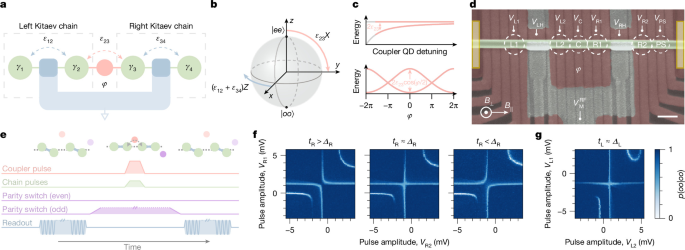
According to recent reports, majorana zero modes provide a route to fault-tolerant qubits by encoding information non-locally in fermion parity. Their noise sensitivity is expected to decrease exponentially with separation between Majorana zero modes, a suppression known as topological protection1. Kitaev chains in quantum-dot–superconductor arrays can host Majorana zero modes at their ends1,2, even in two-site chains3. These minimal-chain modes, known as poor man’s Majoranas, retain characteristic Majorana properties, including near-zero energy and equal electron–hole character, but lack topological protection3,4,5. A key challenge is moving from identifying these modes in electrical transport to coherent qubit control. Here we demonstrate coherent time-resolved rotations between parity states encoded by four poor man’s Majoranas in two coupled minimal Kitaev chains3,6,7,8. Total fermion parity conservation separates the system into global even- and odd-parity manifolds. We observe coherent parity oscillations in both, with frequencies matching within 5% at the poor man’s Majorana sweet spot, consistent with largely isolated Majoranas6. The oscillation frequency, rotation axis and coherence depend systematically on inter-chain coupling and quantum-dot detunings, in agreement with our model for short chains. Our results establish coherent control of a qubit encoded in the fermion parity of Majorana zero modes, realized using minimal Kitaev chains. They lay the groundwork for universal qubit operations, comprehensive coherence characterization and probing protection in longer chains.
This is a preview of subscription content, access via your institution.
Access Nature and 54 other Nature Portfolio journals.
Get Nature+, our best-value online-access subscription.
Receive 51 print challenges and online access.
Prices may be subject to local taxes which are calculated during checkout.
All raw data measured on the device presented in this work at the time of writing are available at https://zenodo.org/records/21280457 (ref. 45).
Industry observers note that the data processing code, the plotting code, and the code used for the theory calculations are available via Zenodo at https://zenodo.org/records/21280457 (ref. 45). (Related: Industry News: Fit More and Train Faster With ZeRO via ...)
Sources indicate that kitaev, A. Y. Unpaired Majorana fermions in quantum wires. Phys. Uspekhi 44, 131–136 (2001).
Article Google Scholar. (Related: Breaking: My Journey to a serverless transformers pipel...)
Sau, J. D. & Das Sarma, S. Realizing a robust practical Majorana chain in a quantum-dot-superconductor linear array. Nat. Commun. 3, 964 (2012).
Article PubMed Google Scholar.
According to recent reports, leijnse, M. & Flensberg, K. Parity qubits and poor man’s Majorana bound states in double quantum dots. Phys. Rev. B 86, 134528 (2012).
Article Google Scholar.
Dvir, T. et al. Realization of a minimal Kitaev chain in coupled quantum dots. Nature 614, 445–450 (2023).
Article CAS PubMed Google Scholar.
In a recent development, ten Haaf, S. L. D. et al. A two-site Kitaev chain in a two-dimensional electron gas. Nature 630, 329–334 (2024).
Article PubMed Google Scholar.
According to recent reports, tsintzis, A., Souto, R. S., Flensberg, K., Danon, J. & Leijnse, M. Majorana qubits and non-Abelian physics in quantum dot-based minimal Kitaev chains. PRX Quantum 5, 010323 (2024).
Article Google Scholar.
Sources indicate that pino, D. M., Souto, R. S. & Aguado, R. Minimal Kitaev-transmon qubit based on double quantum dots. Phys. Rev. B 109, 075101 (2024).
Article CAS Google Scholar.
Pan, H., Das Sarma, S. & Liu, C.-X. Rabi and Ramsey oscillations of a Majorana qubit in a quantum dot-superconductor array. Phys. Rev. B 111, 075416 (2025).
Article CAS Google Scholar.
Recent findings suggest that rainis, D. & Loss, D. Majorana qubit decoherence by quasiparticle poisoning. Phys. Rev. B 85, 174533 (2012).
Article Google Scholar.
Recent findings suggest that bravyi, S. & Kitaev, A. Fermionic quantum computation. Ann. Phys. 298, 210–226 (2002).
Article MathSciNet CAS Google Scholar.
In a recent development, nayak, C., Simon, S. H., Stern, A., Freedman, M. & Das Sarma, S. Non-Abelian anyons and topological quantum computation. Rev. Mod. Phys. 80, 1083–1159 (2008).
Article MathSciNet CAS Google Scholar.
Sources indicate that das Sarma, S., Freedman, M. & Nayak, C. Majorana zero modes and topological quantum computation. npj Quantum Inf. 1, 15001 (2015).
Article Google Scholar.
According to recent reports, fu, L. & Kane, C. L. Josephson current and noise at a superconductor/quantum-spin-Hall-insulator/superconductor junction. Phys. Rev. B 79, 161408 (2009).
Article Google Scholar.
Ivanov, D. A. Non-Abelian statistics of half-quantum vortices in p-wave superconductors. Phys. Rev. Lett. 86, 268–271 (2001).
Article CAS PubMed Google Scholar.
According to recent reports, luethi, M., Legg, H. F., Loss, D. & Klinovaja, J. From perfect to imperfect poor man’s Majoranas in minimal Kitaev chains. Phys. Rev. B 110, 245412 (2024).
Article CAS Google Scholar.
Sources indicate that knapp, C., Karzig, T., Lutchyn, R. M. & Nayak, C. Dephasing of Majorana-based qubits. Phys. Rev. B 97, 125404 (2018).
Article CAS Google Scholar.
Industry observers note that mishmash, R. V., Bauer, B., von Oppen, F. & Alicea, J. Dephasing and leakage dynamics of noisy Majorana-based qubits: topological versus Andreev. Phys. Rev. B 101, 075404 (2020).
Article CAS Google Scholar.
In a recent development, badawy, G. et al. High mobility stemless InSb nanowires. Nano Lett. 19, 3575–3582 (2019).
Article CAS PubMed Google Scholar.
Recent findings suggest that flensberg, K. Non-Abelian operations on Majorana fermions via single-charge control. Phys. Rev. Lett. 106, 090503 (2011).
Article PubMed Google Scholar.
According to recent reports, deacon, R. S. et al. Tunneling spectroscopy of Andreev energy levels in a quantum dot coupled to a superconductor. Phys. Rev. Lett. 104, 076805 (2010).
Article CAS PubMed Google Scholar.
Recent findings suggest that pillet, J.-D. et al. Andreev bound states in supercurrent-carrying carbon nanotubes revealed. Nat. Phys. 6, 965–969 (2010).
Article CAS Google Scholar.
Lee, E. J. H. et al. Spin-resolved Andreev levels and parity crossings in hybrid superconductor–semiconductor nanostructures. Nat. Nanotechnol. 9, 79–84 (2014).
Article CAS PubMed Google Scholar.
According to recent reports, recher, P., Sukhorukov, E. V. & Loss, D. Andreev tunneling, Coulomb blockade, and resonant transport of nonlocal spin-entangled electrons. Phys. Rev. B 63, 165314 (2001).
Article Google Scholar.
Recent findings suggest that hofstetter, L., Csonka, S., Nygård, J. & Schönenberger, C. Cooper pair splitter realized in a two-quantum-dot Y-junction. Nature 461, 960–963 (2009).
Article CAS PubMed Google Scholar.
According to recent reports, liu, C.-X., Wang, G., Dvir, T. & Wimmer, M. Tunable superconducting coupling of quantum dots via Andreev bound states in semiconductor–superconductor nanowires. Phys. Rev. Lett. 129, 267701 (2022).
Article CAS PubMed Google Scholar.
According to recent reports, bordin, A. et al. Tunable crossed Andreev reflection and elastic cotunneling in hybrid nanowires. Phys. Rev. X 13, 031031 (2023).
CAS Google Scholar.
Liu, C.-X., Pan, H., Setiawan, F., Wimmer, M. & Sau, J. D. Fusion protocol for Majorana modes in coupled quantum dots. Phys. Rev. B 108, 085437 (2023).
Article CAS Google Scholar.
Steiner, J. F. & von Oppen, F. Readout of Majorana qubits. Phys. Rev. Res. 2, 033255 (2020).
Article CAS Google Scholar.
van Loo, N. et al. Single-shot parity readout of a minimal Kitaev chain. Nature 650, 334–339 (2026).
Article PubMed Google Scholar.
Recent findings suggest that zhang, Y. et al. Gate reflectometry in a minimal Kitaev chain device. PRX Quantum 7, 020317 (2026).
Article Google Scholar.
Industry observers note that tsintzis, A., Souto, R. S. & Leijnse, M. Creating and detecting poor man’s Majorana bound states in interacting quantum dots. Phys. Rev. B 106, L201404 (2022).
Article CAS Google Scholar.
Industry observers note that zatelli, F. et al. Robust poor man’s Majorana zero modes using Yu–Shiba–Rusinov states. Nat. Commun. 15, 7933 (2024).
Article CAS PubMed PubMed Central Google Scholar.
Industry observers note that alicea, J., Oreg, Y., Refael, G., von Oppen, F. & Fisher, M. P. A. Non-Abelian statistics and topological quantum information processing in 1D wire networks. Nat. Phys. 7, 412–417 (2011).
Article CAS Google Scholar.
According to recent reports, hayashi, T., Fujisawa, T., Cheong, H. D., Jeong, Y. H. & Hirayama, Y. Coherent manipulation of electronic states in a double quantum dot. Phys. Rev. Lett. 91, 226804 (2003).
Article CAS PubMed Google Scholar.
Petersson, K. D., Petta, J. R., Lu, H. & Gossard, A. C. Quantum coherence in a one-electron semiconductor charge qubit. Phys. Rev. Lett. 105, 246804 (2010).
Article CAS PubMed Google Scholar.
Recent findings suggest that bordin, A. et al. Enhanced Majorana stability in a three-site Kitaev chain. Nat. Nanotechnol. 20, 726–731 (2025).
Article CAS PubMed PubMed Central Google Scholar.
It has been revealed that ten Haaf, S. L. D. et al. Observation of edge and bulk states in a three-site Kitaev chain. Nature 641, 890–895 (2025).
Article PubMed Google Scholar.
It has been revealed that plugge, S., Rasmussen, A., Egger, R. & Flensberg, K. Majorana box qubits. N. J. Phys. 19, 012001 (2017).
Article Google Scholar.
Karzig, T. et al. Scalable designs for quasiparticle-poisoning-protected topological quantum computation with Majorana zero modes. Phys. Rev. B 95, 235305 (2017).
Article Google Scholar.
Boross, P. & Pályi, A. Braiding-based quantum control of a Majorana qubit built from quantum dots. Phys. Rev. B 109, 125410 (2024).
Article CAS Google Scholar.
It has been revealed that miles, S., Zatelli, F., Bozkurt, A. M., Wimmer, M. & Liu, C.-X. Braiding Majoranas in a linear quantum dot-superconductor array: mitigating the errors from Coulomb repulsion and residual tunneling. Phys. Rev. B 113, 085302 (2026).
Article CAS Google Scholar.
Heedt, S. et al. Shadow-wall lithography of ballistic superconductor-semiconductor quantum devices. Nat. Commun. 12, 4914 (2021).
Article CAS PubMed PubMed Central Google Scholar.
Recent findings suggest that mazur, G. P. et al. Spin-mixing enhanced proximity effect in aluminum-based superconductor–semiconductor hybrids. Adv. Mater. 34, 2202034 (2022).
Article CAS Google Scholar.
Industry observers note that wang, C.-A. et al. Operating semiconductor quantum processors with hopping spins. Science 385, 447–452 (2024).
Article CAS PubMed Google Scholar.
Zatelli, F., Roovers, B. & van Loo, N. Data and code for “Coherent parity oscillations in coupled minimal Kitaev chains”. Zenodo https://doi.org/10.5281/zenodo.21280457 (2026).
It has been revealed that we thank S. Bhatti, D. Prete, S. Goswami, Y. Zhang, W. Huisman, S. Roelofs, A. Chatterjee, A. Akhmerov, G. Wang, G. P. Mazur, K. Flensberg and G. O. Steffensen for discussions; O. W. B. Benningshof, J. D. Mensingh, T. Orton and E. van der Wiel for technical assistance with the cryogenic set-up; R. Schouten and R. Birnholtz for technical assistance with the measurement electronics; M. Fischer and B. van Asten for technical assistance with the aluminium evaporator; and S. Gazibegovic for contributing to nanowire growth.
This work has been supported by the Dutch Organization for Scientific Research (NWO) and Microsoft Corporation Station Q.
These authors contributed equally: Francesco Zatelli, Bart Roovers, Nick van Loo.
QuTech and Kavli Institute of Nanoscience, Delft University of Technology, Delft, The Netherlands.
Recent findings suggest that francesco Zatelli, Bart Roovers, Nick van Loo, Antonio Lombardi, Juan D. Torres Luna, Sebastian Miles, Vincent P. M. Sietses, Florian J. Bennebroek Evertsz’, Pablo Cova Fariña, Alberto Bordin, Michael Wimmer & Leo P. Kouwenhoven.
Department of Applied Physics, Eindhoven University of Technology, Eindhoven, The Netherlands.
It has been revealed that ghada Badawy & Erik P. A. M. Bakkers.
Search author on:PubMed Google Scholar.
Search author on:PubMed Google Scholar.
Search author on:PubMed Google Scholar.
Search author on:PubMed Google Scholar.
Search author on:PubMed Google Scholar.
Search author on:PubMed Google Scholar.
Search author on:PubMed Google Scholar.
Search author on:PubMed Google Scholar.
Search author on:PubMed Google Scholar.
Search author on:PubMed Google Scholar.
Search author on:PubMed Google Scholar.
Search author on:PubMed Google Scholar.
Search author on:PubMed Google Scholar.
Search author on:PubMed Google Scholar.
The sample was fabricated by B.R. and N.v.L. Measurements were performed by F.Z. and B.R. under the supervision of N.v.L. The experiment was designed by F.Z., B.R. and N.v.L. The data were analysed by F.Z., B.R., N.v.L. and A.L. The experimental set-up was designed and implemented by F.Z., B.R. and N.v.L. F.Z., B.R., N.v.L., A.L., J.D.T.L., S.M., V.P.M.S., F.J.B.E., P.C.F., A.B., M.W. and L.P.K. contributed to the understanding and interpretation of the experimental results through regular discussions. The paper was prepared by F.Z., B.R., N.v.L. and L.P.K. with input from all authors. Modelling and simulations of the system were done by J.D.T.L., S.M. and M.W. with the help of A.L. and V.P.M.S., under the supervision of M.W. Theory sections of the Supplementary notes were written by M.W. The InSb nanowire growth was performed by G.B. and E.P.A.M.B. The project was supervised by L.P.K.
It has been revealed that correspondence to Nick van Loo or Leo P. Kouwenhoven.
The authors declare no competing interests.
Sources indicate that nature thanks the anonymous reviewers for their contribution to the peer review of this work. Peer reviewer reports are available.
Publisher’s note Springer Nature remains neutral with regard to jurisdictional claims in published maps and institutional affiliations.
Wiring diagram for the DC and RF lines used to measure the device, with properties and components detailed in the legend. Additional details can be found in ‘Measurement set-up’ in Methods.
a, Detailed schematic of the pulse sequence, showing the various stages of the protocol. b, p(ee∣ee), p(oo∣ee), p(ee∣oo), and p(oo∣oo) as a function of pulse duration and pulse ramp time. Parity oscillations remain visible even for slow ramp duration up to approximately 75 ns. An oscillation as a function of ramp duration is also visible at zero pulse duration, indicating that the qubit evolves partially during the ramp of the coupling pulse. c, Time trace and corresponding histogram of the readout signal \(\Delta {S}_{{\rm{M}}}^{{\rm{11}}}\) with the left chain on resonance and the right-chain QDs off-resonance, using 400 μs readout time. Transitions between \(| e\rangle \) and \(| o\rangle \) are attributed to quasiparticle poisoning. d, Dwell time histogram from c. e, p(e∣e), p(o∣e), p(e∣o), and p(o∣o) while varying the pulse amplitude VC and ramp time. For fast ramps (≲5 ns), parity mixing is observed between the chain and the dot. We attribute this to a diabatic excitation of the coupled system, which rapidly decoheres before the final measurement. In the main text, we use ramp times of 25 ns to avoid these excitations. For pulse amplitudes ≲11.5 mV, no parity mixing is observed, which we use to roughly identify when QDC passes through resonance. f, Schematic of the configuration for the measurements in c-e. g-j, Same as c-f, but for the right chain, with the QDs of the left chain off-resonance. In panel i, parity mixing between the chain and QDC is observed for ramp times ≲ 10 ns, indicating a slightly weaker coupling between QDC and the right chain versus the left chain.
Readout characterization using time traces of the reflected resonator signal \(\Delta {S}_{{\rm{M}}}^{{\rm{11}}}\), measured for three different amounts of detuning with the coupler QD kept fixed far from resonance. Thresholds used for single-shot state identification are obtained by fitting a Gaussian mixture model. The detuning configuration in (e-g) is used for qubit readout. a, Schematic representation of the readout configuration with both chains on resonance. b, Time trace of \(\Delta {S}_{{\rm{M}}}^{{\rm{11}}}\) and corresponding histogram for the readout configuration in a. Residual coupling between the chains results in inter-chain hopping that is faster than the readout time of 500 μs, preventing readout in a single shot. The two quantum capacitance signals corresponding to the \(| ee\rangle \) and \(| oo\rangle \) states are partially averaged which makes them difficult to distinguish from the \(| oe\rangle \) and \(| eo\rangle \) states. c, As in a, but with both chains detuned from resonance. d, Time trace of \(\Delta {S}_{{\rm{M}}}^{{\rm{11}}}\) and corresponding histogram for the readout configuration in c. The slight detuning suppresses inter-chain hopping, though it remains too fast for high-fidelity single-shot readout. Two distinctive regions can be observed: When the system is in the global even state, rapid jumps between \(| oo\rangle \) and \(| ee\rangle \) are visible. When the system is poisoned, it enters the global odd manifold. Transitions between \(| oe\rangle \) and \(| eo\rangle \) are not resolved because they produce similar readout signals. e, As in c but with both chains detuned further from resonance. f, Time trace of \(\Delta {S}_{{\rm{M}}}^{{\rm{11}}}\) and corresponding histogram for the readout configuration in e. The two computational states \(| ee\rangle \) and \(| oo\rangle \) correspond to the red and blue signals, and can now clearly be resolved. The green signal contains both leakage states of the odd global parity manifold (\(| eo\rangle \) and \(| oe\rangle \)). Due to the antisymmetric detuning where the ground state of one dot is full and the other is empty, the \(| oo\rangle \) state is energetically favored over the \(| ee\rangle \) state, resulting in a skewed population between the two. Transitions are mainly observed between the even and odd global manifolds. The signal-to-noise ratios between the leakage distribution and the \(| ee\rangle \) and \(| oo\rangle \) distributions are 2.88 ± 0.28 and 2.76 ± 0.09, respectively. Integrating the fitted Gaussian distributions across the assignment thresholds gives false-leakage probabilities of 0.45% for \(| ee\rangle \) and 0.25% for \(| oo\rangle \), showing that finite readout SNR accounts for only a small fraction of the observed leakage. g, Dwell time histogram of the three observed states, indicating the difference in lifetimes. The shortest measured state lifetime in this readout configuration is 8.3 ms, corresponding to a probability of approximately 5.8% for a state transition during the 500 μs integration window. The trace is acquired with the coupler QD kept far from resonance, showing that state switching on this timescale is already present in the readout configuration. These transitions include both residual inter-chain hopping and quasiparticle-poisoning events and can produce time-averaged signals that are assigned as leakage for pulsed measurements.
It has been revealed that conditional probabilities at the simultaneous sweet spot for the two chains in both the even and odd global parity manifolds, corresponding to Extended Data Fig. 5g but extended to larger pulse amplitudes. Additional outer lines appear when the energy of the detuned chain is aligned with the first excited state of the other chain. The quadrant in which they appear depends on the initial state of the system, as well as the global parity manifold (‘Interpretation of pulsed charge-stability diagrams’ in Methods). a, Left chain in the even manifold. b, Right chain in the even manifold. c, Left chain in the odd manifold. d, Right chain in the odd manifold. The QDR2 resonance is shifted by approximately 3 mV with respect to panel b due to the Coulomb interaction with the additional electron on the parity-switching QD. The odd-manifold measurements include two parity-switch passages, before and after the control sequence. Comparing the background return probabilities in the even- and odd-manifold measurements for initial states \(| oo\rangle \) and \(| oe\rangle \) gives single-passage parity-switch fidelity of 99.77 ± 0.03% (‘Parity-switch fidelity’ in Methods).
a, Map of p(oo∣oo) (left) and p(oe∣oe) (right) as a function of the left and right hybrid-gate voltages (VLH and VRH). The diagonal and antidiagonal features of enhanced parity mixing correspond to degeneracies between the qubit basis states. The points labeled c-k indicate the VLH,VRH values used in the remaining panels. b, Schematic representation of the four configurations measured at each point: left- and right-chain pulsed charge-stability diagrams in the global even and odd parity manifolds. c-k, Pulsed charge-stability diagrams measured for the left and right chains in the even (top) and odd (bottom) parity manifolds. Unlike conventional charge-stability diagrams referenced to the Fermi energy in a normal lead, here each chain provides the energy reference for the other. As such, the measured features reflect the difference between the excitation energies of the two individual chains. Crossings are therefore observed simultaneously for the left and right chains when the splittings of the two chains compensate each other, corresponding to the qubit degeneracy condition. Consequently, the appearance of a crossing in a single parity manifold does not imply that the corresponding chain is tuned to its sweet spot. Indeed, crossing-like features are observed in only one manifold in panels c, e, i and k. The orientation of the avoided crossings depends on the parity manifold: in the even manifold, the left and right chains exhibit the same orientation, whereas in the odd manifold the orientation is reversed, reflecting the sign difference ε12 ± ε34 between the two manifolds. Only near the sweet spot (panel g) are crossings observed for both chains in both parity manifolds simultaneously, providing a unique signature that both chains are individually tuned to their sweet spots.
In a recent development, pulsed charge-stability diagrams showing p(ee∣ee), p(oo∣ee), p(ee∣oo), and p(oo∣oo) as a function of the right-chain gate voltages (VR1, VR2), for various values of the coupler QD pulse amplitude VC for a fixed pulse duration of 10 ns. The value of VC is indicated above each panel. The device configuration is the same as in Extended Data Fig. 8. a-h, The superconducting phase difference between the chains is set to φ ≈ 0. As VC is made more negative, the coupler QD is first brought closer to resonance and parity mixing along the degeneracy lines increases. Eventually, when the coupler QD is near or below resonance (around VC = − 9 mV), the final state is dictated by the ground state of the chain in the relevant sector of the charge-stability diagram irrespective of the initial state. We note that the chain appears to move from CAR-like at low pulse amplitudes (tR < ΔR, a) across a sweet spot (tR ≈ ΔR, b-e) to ECT-like at high pulse amplitudes (tR > ΔR, f-h), which we attribute to uncompensated cross-capacitance between VC and VRH. i-n, The superconducting phase difference between the chains is set to φ ≈ π. The main difference is that the visibility of QDR2 is suppressed, as predicted by theory (Supplementary Note 4).
p(ee∣ee), p(oo∣ee), p(ee∣oo), and p(oo∣oo) as a function of pulse duration for various detunings, as indicated by the schematics, corresponding to measurements shown in the main text. Unless stated otherwise, measurements are taken at VC = 9.8 mV and perpendicular field B⊥ = 15.6 mT (yellow mark in panel o), corresponding to a phase difference φ ≈ 0 between the chains. a-d, Detuning individual quantum dots. e,f, Detuning the left- (e) and right-chain QDs (f). g,h, Simultaneous detuning of the outer (g) and inner (h) QDs of both chains. i, Varying coupling pulse duration and amplitude. j, Varying VLH and VRH for a fixed pulse duration of 18 ns. The colored marks indicate sweep directions for panels k,l,p,q. k,l, Detuning the left (k) and right (l) chain via VLH and VRH. m, Oscillation frequency as a function of pulse amplitude in logarithmic scale, where V0 is the gate voltage at which QDC is on resonance. The gray line fits f = K/(V0 − VC) with K = 156.6 ± 0.3 MHz mV and V0 = 11.285 ± 0.002 mV for VC < 10.8 mV. n, Quality factor of the oscillations as a function of VC. o, Dependence on the out-of-plane magnetic field B⊥. p,q, Symmetric (p) and antisymmetric (q) detuning of VLH together with VRH.
p(ee∣ee), p(oo∣ee), p(ee∣oo), and p(oo∣oo) as a function of pulse duration for various detunings, as indicated by the schematics. Note that for this dataset, the chains were tuned using pulsed charge-stability diagrams but were not compared to the odd manifold. As such, it is unclear if the even and odd states of each chain are degenerate. a, Varying coupling pulse duration and amplitude VC. In contrast to the main text, QDC starts detuned below the Fermi level instead of above but is likewise pulsed closer to resonance for qubit evolution. b, Dependence on the out-of-plane magnetic field B⊥. In this case, we observe decoherence around φ = π (B⊥ ≈ 13.5 mT), consistent with a small residual detuning of an outer QD from resonance; such detuning restores transverse coupling near φ ≈ π (Supplementary Note 4). c,d, Detuning the left (c) and right (d) chain via VLH and VRH. e-h, Single-dot detuning of VL1, VL2, VR1 and VR2. i,j, Detuning the left- (i) and right-chain QDs (j). k,l, Simultaneous detuning of the outer (k) and inner (l) quantum dots of both chains.
According to recent reports, p(eo∣eo), p(oe∣oe), p(eo∣oe), and p(oe∣eo) as a function of pulse duration for various detunings, as indicated by the schematics, corresponding to measurements shown in the main text. a, Varying coupling pulse duration and amplitude VC. b,c, Detuning the left (b) and right (c) chain via VLH and VRH. d, Varying VLH and VRH for a fixed pulse duration of 18 ns. The colored marks indicate sweep directions for panels b,c,e,f. e,f, Symmetric (e) and antisymmetric (f) detuning of VLH together with VRH. g-i, Oscillation frequency (g), Rabi decay time \({T}_{2}^{{\rm{Rabi}}}\) (h) and quality factor Q (i) extracted from panel a as a function of VC.
Sources indicate that extracted Rabi coherence time \({T}_{2}^{{\rm{Rabi}}}\) for the different detuning configurations shown in Fig. 4, as indicated by the schematics. a-d, Detuning individual quantum dots. e,f, Detuning the left (e) and right (f) Kitaev chains. g,h, Simultaneous detuning of the outer (g) and inner (h) quantum dots of both chains. Gray markers indicate fits for which the relative uncertainty in \({T}_{2}^{{\rm{Rabi}}}\) exceeds 50% or the fitted oscillation frequency lies outside the 10–200 MHz range, and are therefore considered unreliable. For visibility, the \({T}_{2}^{{\rm{Rabi}}}\) axis is also limited to 40 ns. Fitted values beyond this range are not shown, as they also arise from unreliable fits and are not physically meaningful. The same-chain two-dot detunings show the narrowest range over which coherent oscillations can be reliably fitted, whereas the single-dot and cross-chain detunings retain resolvable oscillations over a broader range. The simultaneous two-dot detunings in panels e-h use the same voltage scales as the corresponding single-dot measurements in panels a-d, and the pulse amplitude applied to the second quantum dot is shown on the upper axis.
Supplementary Notes 1–4 describing the numerical simulations with quasistatic noise, the effective low-energy Hamiltonian for imperfect Majorana states, the pulsed charge-stability diagrams, and the consequences of imperfect Majorana states. Includes Supplementary Figs. 1–3, Table 1 and References.
In a recent development, springer Nature or its licensor (e.g. a society or other partner) holds exclusive rights to this article under a publishing agreement with the author(s) or other rightsholder(s); author self-archiving of the accepted manuscript version of this article is solely governed by the terms of such publishing agreement and applicable law.
Zatelli, F., Roovers, B., van Loo, N. et al. Coherent parity oscillations in coupled minimal Kitaev chains. Nature (2026). https://doi.org/10.1038/s41586-026-11309-6.
Version of record: 25 November 2026.
DOI: https://doi.org/10.1038/s41586-026-11309-6.
Anyone you share the following link with will be able to read this content:.
Sorry, a shareable link is not currently available for this article.
Provided by the Springer Nature SharedIt content-sharing initiative.