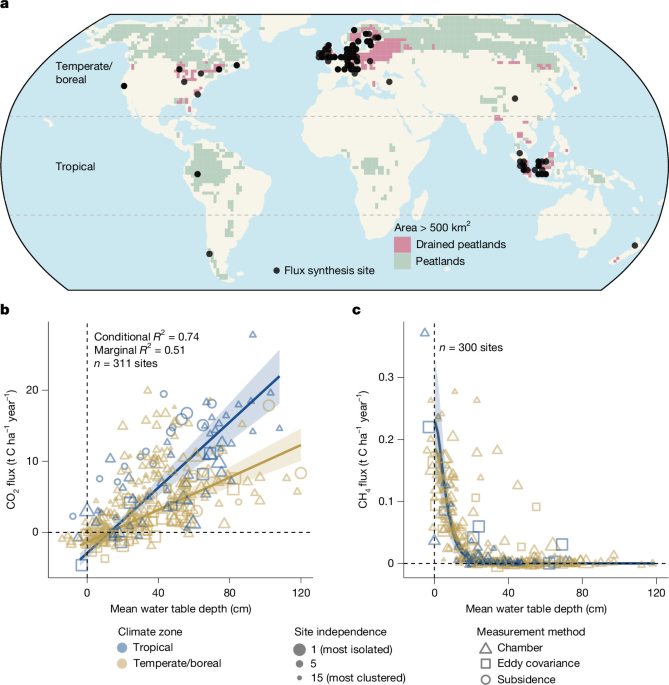
Over millennia, peatlands have removed hundreds of gigatonnes of carbon dioxide (CO2) from the atmosphere but emitted a proportion back as methane (CH4), exerting a slow net cooling effect1. Artificial drainage of these ecosystems—a centuries-old practice2,3—causes decomposition and the re-release of CO2 but suppresses CH4 emissions4, with a net climatic effect that is not well quantified at the global scale5. Here we reconstructed the radiative forcing from worldwide peatland drainage over 1800–2020 by combining a latest flux dataset, hydrologically driven models of CO2 and CH4 fluxes and a hindcast of drainage extent and intensity. We found that drainage has produced a net heating effect of +73 (48–99) mW m−2—equivalent to 2.7 (1.8–3.6)% of industrial-era radiative forcing—originating from 0.4–0.5% of global land area. The net heating results from the dominant forcing of drainage-induced CO2 emissions (+83 (52–110) mW m−2) over that of avoided CH4 emissions (−9 (−15–−2) mW m−2). Even without further expansion of drainage, maintaining at the moment drained areas could almost double the cumulative warming by 2100. Our reconstruction captures the opposing impacts of peatland drainage on global budgets of CO2 and CH4 and quantifies the strong legacy effects of historical drainage on present and possibly future climate.
This is a preview of subscription content, access via your institution.
Access Nature and 54 other Nature Portfolio journals.
Get Nature+, our best-value online-access subscription.
Receive 51 print issues and online access.
Prices may be subject to local taxes which are calculated during checkout.
In a recent development, the raw data and the processed outputs are available from Zenodo (https://zenodo.org/records/23220779)159. Source data are provided with this paper.
The R code to process and analyse the data is available from Zenodo (https://zenodo.org/records/23176614)160.
Sources indicate that frolking, S. & Roulet, N. T. Holocene radiative forcing impact of northern peatland carbon accumulation and methane emissions. Glob. Change Biol. 13, 1079–1088 (2007).
Article Google Scholar. (Related: Breaking: My Journey to a serverless transformers pipel...)
Fluet-Chouinard, E. et al. Extensive global wetland loss over the past three centuries. Nature 614, 281–286 (2023).
Article CAS PubMed Google Scholar.
Industry observers note that di Palma, V. Wasteland: A History (Yale Univ. Press, 2014). (Related: Industry News: Fit More and Train Faster With ZeRO via ...)
Evans, C. D. et al. Overriding water table control on managed peatland greenhouse gas emissions. Nature 593, 548–552 (2021).
Article CAS PubMed Google Scholar.
Loisel, J. et al. Expert assessment of future vulnerability of the global peatland carbon sink. Nat. Clim. Change 11, 70–77 (2021).
Article Google Scholar.
Yu, Z., Loisel, J., Brosseau, D. P., Beilman, D. W. & Hunt, S. J. Global peatland dynamics since the Last Glacial Maximum. Geophys. Res. Lett. 37, 2010GL043584 (2010).
Article Google Scholar.
Dargie, G. C. et al. Age, extent and carbon storage of the central Congo Basin peatland complex. Nature 542, 86–90 (2017).
Article CAS PubMed Google Scholar.
It has been revealed that erb, K.-H. et al. Unexpectedly large impact of forest management and grazing on global vegetation biomass. Nature 553, 73–76 (2018).
Article CAS PubMed Google Scholar.
Joosten, H. The Global Peatland CO2 Picture. Wetlands International https://www.wetlands.org/publication/the-global-peatland-co2-picture/ (2010).
Industry observers note that leifeld, J. & Menichetti, L. The underappreciated potential of peatlands in global climate change mitigation strategies. Nat. Commun. 9, 1071 (2018).
Article CAS PubMed PubMed Central Google Scholar.
Frolking, S., Roulet, N. & Fuglestvedt, J. How northern peatlands influence the Earth’s radiative budget: sustained methane emission versus sustained carbon sequestration. J. Geophys. Res. Biogeosci. 111, 2005JG000091 (2006).
Article Google Scholar.
It has been revealed that laine, J. et al. Effect of water-level drawdown on global climatic warming: northern peatlands. Ambio 25, 179–184 (1996).
According to recent reports, sanderman, J., Hengl, T. & Fiske, G. J. Soil carbon debt of 12,000 years of human land use. Proc. Natl Acad. Sci. USA 114, 9575–9580 (2017).
Article CAS PubMed PubMed Central Google Scholar.
Recent findings suggest that houghton, R. A. & Nassikas, A. A. Global and regional fluxes of carbon from land use and land cover change 1850–2015. Glob. Biogeochem. Cycles 31, 456–472 (2017).
Article CAS Google Scholar.
According to recent reports, gasser, T. et al. Historical CO2 emissions from land use and land cover change and their uncertainty. Biogeosciences 17, 4075–4101 (2020).
Article CAS Google Scholar.
In a recent development, hong, C. et al. Global and regional drivers of land-use emissions in 1961–2017. Nature 589, 554–561 (2021).
Article CAS PubMed Google Scholar.
Industry observers note that conchedda, G. & Tubiello, F. N. Drainage of organic soils and GHG emissions: validation with country data. Earth Syst. Sci. Data 12, 3113–3137 (2020).
Article Google Scholar.
Leifeld, J., Wüst-Galley, C. & Page, S. Intact and managed peatland soils as a source and sink of GHGs from 1850 to 2100. Nat. Clim. Change 9, 945–947 (2019).
Article CAS Google Scholar.
In a recent development, qiu, C. et al. Large historical carbon emissions from cultivated northern peatlands. Sci. Adv. 7, eabf1332 (2021).
Article CAS PubMed PubMed Central Google Scholar.
Recent findings suggest that drösler, M. et al. in 2013 Supplement to the 2006 IPCC Guidelines for National Greenhouse Gas Inventories: Wetlands (eds Hiraishi, T. et al.) Ch. 2 (Intergovernmental Panel on Climate Change, 2014).
Carlson, K. M. et al. Greenhouse gas emissions intensity of global croplands. Nat. Clim. Change 7, 63–68 (2017).
Article CAS Google Scholar.
Günther, A. et al. Prompt rewetting of drained peatlands reduces climate warming despite methane emissions. Nat. Commun. 11, 1644 (2020).
Article PubMed PubMed Central Google Scholar.
Humpenöder, F. et al. Peatland protection and restoration are key for climate change mitigation. Environ. Res. Lett. 15, 104093 (2020).
Article Google Scholar.
Industry observers note that miettinen, J., Hooijer, A., Vernimmen, R., Liew, S. C. & Page, S. E. From carbon sink to carbon source: extensive peat oxidation in insular Southeast Asia since 1990. Environ. Res. Lett. 12, 024014 (2017).
Article Google Scholar.
Zou, J. et al. Rewetting global wetlands effectively reduces major greenhouse gas emissions. Nat. Geosci. 15, 627–632 (2022).
Article CAS Google Scholar.
Industry observers note that couwenberg, J., Dommain, R. & Joosten, H. Greenhouse gas fluxes from tropical peatlands in south-east Asia. Glob. Change Biol. 16, 1715–1732 (2010).
Article Google Scholar.
It has been revealed that deshmukh, C. S. et al. Net greenhouse gas balance of fibre wood plantation on peat in Indonesia. Nature 616, 740–746 (2023).
Article CAS PubMed PubMed Central Google Scholar.
Swails, E. et al. Will CO2 emissions from drained tropical peatlands decline over time? Links between soil organic matter quality, nutrients, and C mineralization rates. Ecosystems 21, 868–885 (2018).
Article CAS Google Scholar.
Aben, R. C. H. et al. CO2 emissions of drained coastal peatlands in the Netherlands and potential emission reduction by water infiltration systems. Biogeosciences 21, 4099–4118 (2024).
Article CAS Google Scholar.
According to recent reports, pongratz, J. et al. Land use effects on climate: current state, recent progress, and emerging topics. Curr. Clim. Change Rep. 7, 99–120 (2021).
Article Google Scholar.
It has been revealed that hoyt, A. M. et al. CO2 emissions from an undrained tropical peatland: interacting influences of temperature, shading and water table depth. Glob. Change Biol. 25, 2885–2899 (2019).
Article Google Scholar.
Industry observers note that ojanen, P. & Minkkinen, K. The dependence of net soil CO2 emissions on water table depth in boreal peatlands drained for forestry. Mires Peat 24, 27 (2019).
Article Google Scholar.
Industry observers note that tiemeyer, B. et al. A newly introduced methodology for organic soils in national greenhouse gas inventories: data synthesis, derivation and application. Ecol. Indic. 109, 105838 (2020).
Article CAS Google Scholar.
According to recent reports, verbeke, B. A. et al. Latitude, elevation, and mean annual temperature predict peat organic matter chemistry at a global scale. Glob. Biogeochem. Cycles 36, e2021GB007057 (2022).
Article CAS Google Scholar.
Bridgham, S. D., Cadillo-Quiroz, H., Keller, J. K. & Zhuang, Q. Methane emissions from wetlands: biogeochemical, microbial, and modeling perspectives from local to global scales. Glob. Change Biol. 19, 1325–1346 (2013).
Article Google Scholar.
Sources indicate that deshmukh, C. S. et al. Impact of forest plantation on methane emissions from tropical peatland. Glob. Change Biol. 26, 2477–2495 (2020).
Article Google Scholar.
Jovani-Sancho, A. J. et al. CH4 and N2O emissions from smallholder agricultural systems on tropical peatlands in Southeast Asia. Glob. Change Biol. 29, 4279–4297 (2023).
Article CAS Google Scholar.
According to recent reports, couwenberg, J. & Hooijer, A. Towards robust subsidence-based soil carbon emission factors for peat soils in south-east Asia, with special reference to oil palm plantations. Mires Peat 12, 01 (2013).
Article Google Scholar.
Rydin, H. & Jeglum, J. K. The Biology of Peatlands 2nd edn https://doi.org/10.1093/acprof:osobl/9780199602995.001.0001 (Oxford Univ. Press, 2013).
According to recent reports, lampela, M. et al. Northern peatlands in transition in the 21st century – land use, status, policies and future trajectories: comparisons between Finland, Ireland and Scotland. Environ. Manage. 76, 73 (2026).
Article PubMed PubMed Central Google Scholar.
It has been revealed that murdiyarso, D., Hergoualc’h, K. & Verchot, L. V. Opportunities for reducing greenhouse gas emissions in tropical peatlands. Proc. Natl Acad. Sci. USA 107, 19655–19660 (2010).
Article CAS PubMed PubMed Central Google Scholar.
Intergovernmental Panel on Climate Change (IPCC). Climate Change 2021: The Physical Science Basis. Contribution of Working Group I to the Sixth Assessment Report of the Intergovernmental Panel on Climate Change (eds Masson-Delmotte, V. et al.) https://doi.org/10.1017/9781009157896 (Cambridge Univ. Press, 2023).
In a recent development, moore, T. R., Roulet, N. T. & Waddington, J. M. Uncertainty in predicting the effect of climatic change on the carbon cycling of Canadian peatlands. Clim. Change 40, 229–245 (1998).
Article CAS Google Scholar.
Goldstein, A. et al. Protecting irrecoverable carbon in Earth’s ecosystems. Nat. Clim. Change 10, 287–295 (2020).
Article CAS Google Scholar.
Recent findings suggest that treat, C. C., Bubier, J. L., Varner, R. K. & Crill, P. M. Timescale dependence of environmental and plant-mediated controls on CH4 flux in a temperate fen. J. Geophys. Res. Biogeosci. 112, 2006JG000210 (2007).
Article Google Scholar.
Minkkinen, K. et al. Persistent carbon sink at a boreal drained bog forest. Biogeosciences 15, 3603–3624 (2018).
Article CAS Google Scholar.
Turetsky, M. R. et al. Global vulnerability of peatlands to fire and carbon loss. Nat. Geosci. 8, 11–14 (2015).
Article CAS Google Scholar.
Industry observers note that cleary, J., Roulet, N. T. & Moore, T. R. Greenhouse gas emissions from Canadian peat extraction, 1990–2000: a life-cycle analysis. Ambio 34, 456–461 (2005).
Article PubMed Google Scholar.
It has been revealed that lohila, A. et al. Forestation of boreal peatlands: impacts of changing albedo and greenhouse gas fluxes on radiative forcing. J. Geophys. Res. Biogeosci. 115, 2010JG001327 (2010).
Article Google Scholar.
Recent findings suggest that müller, J. & Joos, F. Committed and projected future changes in global peatlands – continued transient model simulations since the Last Glacial Maximum. Biogeosciences 18, 3657–3687 (2021).
Article Google Scholar.
Lehner, B. et al. Mapping the world’s inland surface waters: an upgrade to the Global Lakes and Wetlands Database (GLWD v2). Earth Syst. Sci. Data 17, 2277–2329 (2025).
Article Google Scholar.
According to recent reports, leifeld, J., Müller, M. & Fuhrer, J. Peatland subsidence and carbon loss from drained temperate fens. Soil Use Manag. 27, 170–176 (2011).
Article Google Scholar.
Evans, C. D. et al. Rates and spatial variability of peat subsidence in Acacia plantation and forest landscapes in Sumatra, Indonesia. Geoderma 338, 410–421 (2019).
Article Google Scholar.
Aslan-Sungur, G., Lee, X., Evrendilek, F. & Karakaya, N. Large interannual variability in net ecosystem carbon dioxide exchange of a disturbed temperate peatland. Sci. Total Environ. 554–555, 192–202 (2016).
Article PubMed Google Scholar.
Industry observers note that beetz, S. et al. Effects of land use intensity on the full greenhouse gas balance in an Atlantic peat bog. Biogeosciences 10, 1067–1082 (2013).
Article Google Scholar.
Beyer, C. & Höper, H. Greenhouse gas exchange of rewetted bog peat extraction sites and a Sphagnum cultivation site in northwest Germany. Biogeosciences 12, 2101–2117 (2015).
Article Google Scholar.
Recent findings suggest that comeau, L.-P., Hergoualc’h, K., Smith, J. U. & Verchot, L. Conversion of intact peat swamp forest to oil palm plantation. Center for International Forestry Research, Working Paper 110 (2013).
D’Angelo, B. et al. Carbon balance and spatial variability of CO2 and CH4 fluxes in a Sphagnum-dominated peatland in a temperate climate. Wetlands 41, 5 (2021).
Article Google Scholar.
In a recent development, deverel, S. J., Ingrum, T. & Leighton, D. Present-day oxidative subsidence of organic soils and mitigation in the Sacramento-San Joaquin Delta, California, USA. Hydrogeol. J. 24, 569–586 (2016).
Article PubMed PubMed Central Google Scholar.
Department of Irrigation and Drainage (DID) and the Land and Water Research Group (LAWOO). Western Jahore Integrated Agricultural Development Project (1996).
Sources indicate that drollinger, S., Maier, A. & Glatzel, S. Interannual and seasonal variability in carbon dioxide and methane fluxes of a pine peat bog in the Eastern Alps, Austria. Agric. For. Meteorol. 275, 69–78 (2019).
Article Google Scholar.
Eggelsmann, R. & Bartels, R. Oxidativer Torfverzehr im Niedermoor in Abhängigkeit von Entwässerung, Nutzung und Düngung. Mitt. Dtsch. Bodenkdl. Ges. 22, 215–221 (1975).
Eickenscheidt, T., Heinichen, J. & Drösler, M. The greenhouse gas balance of a drained fen peatland is mainly controlled by land-use rather than soil organic carbon content. Biogeosciences 12, 5161–5184 (2015).
Article Google Scholar.
Elsgaard, L. et al. Net ecosystem exchange of CO2 and carbon balance for eight temperate organic soils under agricultural management. Agric. Ecosyst. Environ. 162, 52–67 (2012).
Article CAS Google Scholar.
In a recent development, ernfors, M. et al. Greenhouse gas dynamics of a well-drained afforested agricultural peatland. Boreal Environ. Res. 25, 65–89 (2020).
Peacock, M. et al. The full carbon balance of a rewetted cropland fen and a conservation-managed fen. Agric. Ecosyst. Environ. 269, 1–12 (2019).
Article Google Scholar.
In a recent development, flessa, Wild, Klemisch & Pfadenhauer, J. Nitrous oxide and methane fluxes from organic soils under agriculture. Eur. J. Soil Sci. 49, 327–335 (1998).
Article CAS Google Scholar.
Furukawa, Y., Inubushi, K., Ali, M., Itang, A. M. & Tsuruta, H. Effect of changing groundwater levels caused by land-use changes on greenhouse gas fluxes from tropical peat lands. Nutr. Cycl. Agroecosyst. 71, 81–91 (2005).
Article CAS Google Scholar.
Gerin, S. et al. Two contrasting years of continuous N2O and CO2 fluxes on a shallow-peated drained agricultural boreal peatland. Agric. For. Meteorol. 341, 109630 (2023).
Article Google Scholar.
Görres, C.-M., Kutzbach, L. & Elsgaard, L. Comparative modeling of annual CO2 flux of temperate peat soils under permanent grassland management. Agric. Ecosyst. Environ. 186, 64–76 (2014).
Article Google Scholar.
Griffis, T. J. et al. Hydrometeorological sensitivities of net ecosystem carbon dioxide and methane exchange of an Amazonian palm swamp peatland. Agric. For. Meteorol. 295, 108167 (2020).
Article Google Scholar.
According to recent reports, grzywna, A. The degree of peatland subsidence resulting from drainage of land. Environ. Earth Sci. 76, 559 (2017).
Article Google Scholar.
It has been revealed that hadden, D. & Grelle, A. The impact of cultivation on CO2 and CH4 fluxes over organic soils in Sweden. Agric. For. Meteorol. 243, 1–8 (2017).
Article Google Scholar.
In a recent development, hambley, G. et al. Net ecosystem exchange from two formerly afforested peatlands undergoing restoration in the Flow Country of northern Scotland. Mires Peat 23, 05 https://doi.org/10.19189/MaP.2018.DW.346 (2019).
Article Google Scholar.
Hergoualc’h, K., Hendry, D. T., Murdiyarso, D. & Verchot, L. V. Total and heterotrophic soil respiration in a swamp forest and oil palm plantations on peat in Central Kalimantan, Indonesia. Biogeochemistry 135, 203–220 (2017).
Article Google Scholar.
Hermans, R. et al. Net soil carbon balance in afforested peatlands and separating autotrophic and heterotrophic soil CO2 effluxes. Biogeosciences 19, 313–327 (2022).
Article CAS Google Scholar.
Hirano, T. et al. Large variation in carbon dioxide emissions from tropical peat swamp forests due to disturbances. Commun. Earth Environ. 5, 221 (2024).
Article Google Scholar.
In a recent development, hommeltenberg, J. et al. Ecosystem scale methane fluxes in a natural temperate bog-pine forest in southern Germany. Agric. For. Meteorol. 198–199, 273–284 (2014).
Article Google Scholar.
Industry observers note that honkanen, H., Kekkonen, H., Heikkinen, J., Kaseva, J. & Lång, K. Minor effects of no-till treatment on GHG emissions of boreal cultivated peat soil. Biogeochemistry 167, 499–522 (2023).
Article Google Scholar.
Husnain, H. et al. CO2 emissions from tropical drained peat in Sumatra, Indonesia. Mitig. Adapt. Strateg. Glob. Change 19, 845–862 (2014).
Article Google Scholar.
It has been revealed that hutchinson, J. N. The record of peat wastage in the East Anglian fenlands at Holme Post, 1848-1978 A.D. J. Ecol. 68, 229–249 (1980).
Article Google Scholar.
Sources indicate that huth, V., Hoffmann, M., Bereswill, S., Zak, D. & Augustin, J. The climate warming effect of a fen peat meadow with fluctuating water table is reduced by young alder trees. Mires Peat 21, 04 https://doi.org/10.19189/MaP.2017.OMB.291 (2018).
Article Google Scholar.
Sources indicate that hyvönen, N. P. et al. Fluxes of nitrous oxide and methane on an abandoned peat extraction site: effect of reed canary grass cultivation. Bioresour. Technol. 100, 4723–4730 (2009).
Article PubMed Google Scholar.
Recent findings suggest that ishikura, K. et al. Effect of groundwater level fluctuation on soil respiration rate of tropical peatland in Central Kalimantan, Indonesia. Soil Sci. Plant Nutr. 63, 1–13 (2017).
Article Google Scholar.
In a recent development, ishikura, K. et al. Carbon dioxide and methane emissions from peat soil in an undrained tropical peat swamp forest. Ecosystems 22, 1852–1868 (2019).
Article CAS Google Scholar.
Itoh, M., Okimoto, Y., Hirano, T. & Kusin, K. Factors affecting oxidative peat decomposition due to land use in tropical peat swamp forests in Indonesia. Sci. Total Environ. 609, 906–915 (2017).
Article CAS PubMed Google Scholar.
Industry observers note that jauhiainen, J., Hooijer, A. & Page, S. E. Carbon dioxide emissions from an Acacia plantation on peatland in Sumatra, Indonesia. Biogeosciences 9, 617–630 (2012).
Article CAS Google Scholar.
Jongedyk, H. A., Hickok, R. B., Mayer, I. D. & Ellis, N. K. Subsidence of muck soils in northern Indiana. Purdue University Agricultural Experiment Station Special Circular vol. 366, 1–10 (1950).
Recent findings suggest that jovani-Sancho, A. J., Cummins, T. & Byrne, K. A. Soil carbon balance of afforested peatlands in the maritime temperate climatic zone. Glob. Change Biol. 27, 3681–3698 (2021).
Article CAS Google Scholar.
Kandel, T. P., Lærke, P. E. & Elsgaard, L. Annual emissions of CO2, CH4 and N2O from a temperate peat bog: comparison of an undrained and four drained sites under permanent grass and arable crop rotations with cereals and potato. Agric. For. Meteorol. 256–257, 470–481 (2018).
Article Google Scholar.
Karki, S., Elsgaard, L., Kandel, T. P. & Lærke, P. E. Full GHG balance of a drained fen peatland cropped to spring barley and reed canary grass using comparative assessment of CO2 fluxes. Environ. Monit. Assess. 187, 62 (2015).
Article PubMed Google Scholar.
In a recent development, kiew, F. et al. CO2 balance of a secondary tropical peat swamp forest in Sarawak, Malaysia. Agric. For. Meteorol. 248, 494–501 (2018).
Article Google Scholar.
Kiew, F. et al. Carbon dioxide balance of an oil palm plantation established on tropical peat. Agric. For. Meteorol. 295, 108189 (2020).
Article Google Scholar.
Sources indicate that klemedtsson, L. et al. Reduction of greenhouse gas emissions by wood ash application to a Picea abies (L.) Karst. forest on a drained organic soil. Eur. J. Soil Sci. 61, 734–744 (2010).
Article CAS Google Scholar.
Industry observers note that kløve, B., Sveistrup, T. E. & Hauge, A. Leaching of nutrients and emission of greenhouse gases from peatland cultivation at Bodin, Northern Norway. Geoderma 154, 219–232 (2010).
Article Google Scholar.
Kluge, B., Wessolek, G., Facklam, M., Lorenz, M. & Schwärzel, K. Long-term carbon loss and CO2-C release of drained peatland soils in northeast Germany. Eur. J. Soil Sci. 59, 1076–1086 (2008).
Article CAS Google Scholar.
Knox, S. H. et al. Agricultural peatland restoration: effects of land-use change on greenhouse gas (CO2 and CH4) fluxes in the Sacramento-San Joaquin Delta. Glob. Change Biol. 21, 750–765 (2015).
Article Google Scholar.
According to recent reports, knox, S. H. et al. Biophysical controls on interannual variability in ecosystem-scale CO2 and CH4 exchange in a California rice paddy. J. Geophys. Res. Biogeosci. 121, 978–1001 (2016).
Article CAS Google Scholar.
Korkiakoski, M. et al. Methane exchange at the peatland forest floor – automatic chamber system exposes the dynamics of small fluxes. Biogeosciences 14, 1947–1967 (2017).
Article CAS Google Scholar.
Korkiakoski, M. et al. Partial cutting of a boreal nutrient-rich peatland forest causes radically less short-term on-site CO2 emissions than clear-cutting. Agric. For. Meteorol. 332, 109361 (2023).
Article Google Scholar.
According to recent reports, liu, L. et al. Contemporary, modern and ancient carbon fluxes in the Zoige peatlands on the Qinghai-Tibetan Plateau. Geoderma 352, 138–149 (2019).
Article CAS Google Scholar.
Lohila, A., Aurela, M., Tuovinen, J. & Laurila, T. Annual CO2 exchange of a peat field growing spring barley or perennial forage grass. J. Geophys. Res. Atmos. 109, 2004JD004715 (2004).
Article Google Scholar.
According to recent reports, lund, M., Lindroth, A., Christensen, T. R. & Ström, L. Annual CO2 balance of a temperate bog. Tellus B 59, 804–811 (2007).
Article Google Scholar.
Maljanen, M., Liikanen, A., Silvola, J. & Martikainen, P. J. Methane fluxes on agricultural and forested boreal organic soils. Soil Use Manag. 19, 73–79 (2003).
Article Google Scholar.
According to recent reports, maljanen, M., Komulainen, V.-M., Hytönen, J., Martikainen, P. J. & Laine, J. Carbon dioxide, nitrous oxide and methane dynamics in boreal organic agricultural soils with different soil characteristics. Soil Biol. Biochem. 36, 1801–1808 (2004).
Article CAS Google Scholar.
Sources indicate that melling, L., Tan, C. S. Y., Goh, K. J. & Hatano, R. Soil microbial and root respirations from three ecosystems in tropical peatland of Sarawak, Malaysia. J. Oil Palm Res. 25, 44–57 (2013).
CAS Google Scholar.
Meyer, A. et al. A fertile peatland forest does not constitute a major greenhouse gas sink. Biogeosciences 10, 7739–7758 (2013).
Article Google Scholar.
Mirza, C. & Irwin, R. W. Determination of subsidence of an organic soil in southern Ontario. Can. J. Soil Sci. 44, 248–253 (1964).
Article Google Scholar.
Industry observers note that nagano, T. et al. Subsidence and soil CO2 efflux in tropical peatland in southern Thailand under various water table and management conditions. Mires Peat 11, 06 (2013).
Article Google Scholar.
Recent findings suggest that nieveen, J. P., Campbell, D. I., Schipper, L. A. & Blair, I. J. Carbon exchange of grazed pasture on a drained peat soil. Glob. Change Biol. 11, 607–618 (2005).
Article Google Scholar.
Nykänen, H., Alm, J., Lång, K., Silvola, J. & Martikainen, P. J. Emissions of CH4, N2O and CO2 from a virgin fen and a fen drained for grassland in Finland. J. Biogeogr. 22, 351–357 (1995).
Article Google Scholar.
Offermanns, L. et al. High greenhouse gas emissions after grassland renewal on bog peat soil. Agric. For. Meteorol. 331, 109309 (2023).
Article Google Scholar.
It has been revealed that olson, D. M., Griffis, T. J., Noormets, A., Kolka, R. & Chen, J. Interannual, seasonal, and retrospective analysis of the methane and carbon dioxide budgets of a temperate peatland. J. Geophys. Res. Biogeosci. 118, 226–238 (2013).
Article CAS Google Scholar.
According to recent reports, othman, H., Mohammed, A. T., Darus, F. M., Harun, M. H. & Zambri, M. P. Best management practices for oil palm cultivation on peat: ground water-table maintenance in relation to peat subsidence and estimation of CO2 emissions at Sessang, Sarawak. J. Oil Palm Res. 23, 1078–1086 (2011).
CAS Google Scholar.
In a recent development, paul, S., Ammann, C., Alewell, C. & Leifeld, J. Carbon budget response of an agriculturally used fen to different soil moisture conditions. Agric. For. Meteorol. 300, 108319 (2021).
Article Google Scholar.
In a recent development, petersen, S. O. et al. Annual emissions of CH4 and N2O, and ecosystem respiration, from eight organic soils in Western Denmark managed by agriculture. Biogeosciences 9, 403–422 (2012).
Article CAS Google Scholar.
Pohl, M. et al. Dynamic C and N stocks – key factors controlling the C gas exchange of maize in heterogenous peatland. Biogeosciences 12, 2737–2752 (2015).
Article Google Scholar.
It has been revealed that poyda, A., Reinsch, T., Kluß, C., Loges, R. & Taube, F. Greenhouse gas emissions from fen soils used for forage production in northern Germany. Biogeosciences 13, 5221–5244 (2016).
Article CAS Google Scholar.
Pullens, J. W. M., Sottocornola, M., Kiely, G., Toscano, P. & Gianelle, D. Carbon fluxes of an alpine peatland in Northern Italy. Agric. For. Meteorol. 220, 69–82 (2016).
Article Google Scholar.
Recent findings suggest that rankin, T., Strachan, I. B. & Strack, M. Carbon dioxide and methane exchange at a post-extraction, unrestored peatland. Ecol. Eng. 122, 241–251 (2018).
Article Google Scholar.
Ratcliffe, J. L., Campbell, D. I., Clarkson, B. R., Wall, A. M. & Schipper, L. A. Water table fluctuations control CO2 exchange in wet and dry bogs through different mechanisms. Sci. Total Environ. 655, 1037–1046 (2019).
Article CAS PubMed Google Scholar.
Renou-Wilson, F., Barry, C., Müller, C. & Wilson, D. The impacts of drainage, nutrient status and management practice on the full carbon balance of grasslands on organic soils in a maritime temperate zone. Biogeosciences 11, 4361–4379 (2014).
Article Google Scholar.
Renou-Wilson, F., Müller, C., Moser, G. & Wilson, D. To graze or not to graze? Four years greenhouse gas balances and vegetation composition from a drained and a rewetted organic soil under grassland. Agric. Ecosyst. Environ. 222, 156–170 (2016).
Article Google Scholar.
According to recent reports, richardson, C. J., Flanagan, N. E. & Ho, M. The effects of hydrologic restoration on carbon budgets and GHG fluxes in southeastern US coastal shrub bogs. Ecol. Eng. 194, 107011 (2023).
Article Google Scholar.
Industry observers note that rinne, J. et al. Annual cycle of methane emission from a boreal fen measured by the eddy covariance technique. Tellus B 59, 449–457 (2007).
Article Google Scholar.
Salm, J.-O. et al. Emissions of CO2, CH4 and N2O from undisturbed, drained and mined peatlands in Estonia. Hydrobiologia 692, 41–55 (2012).
Article CAS Google Scholar.
According to recent reports, schrier-Uijl, A. P. et al. Agricultural peatlands: towards a greenhouse gas sink – a synthesis of a Dutch landscape study. Biogeosciences 11, 4559–4576 (2014).
Article Google Scholar.
Strack, M. & Zuback, Y. C. A. Annual carbon balance of a peatland 10 yr following restoration. Biogeosciences 10, 2885–2896 (2013).
Article CAS Google Scholar.
Swails, E., Hergoualc’h, K., Verchot, L., Novita, N. & Lawrence, D. Spatio-temporal variability of peat CH4 and N2O Fluxes and their contribution to peat GHG budgets in Indonesian forests and oil palm plantations. Front. Environ. Sci. 9, 617828 (2021).
Article Google Scholar.
According to recent reports, swails, E. et al. Soil nitrous oxide and methane fluxes from a land-use change transition of primary forest to oil palm in an Indonesian peatland. Biogeochemistry 167, 363–381 (2023).
Article Google Scholar.
Swenson, M. M. et al. Carbon balance of a restored and cutover raised bog: implications for restoration and comparison to global trends. Biogeosciences 16, 713–731 (2019).
Article CAS Google Scholar.
According to recent reports, taft, H. E., Cross, P. A., Edwards-Jones, G., Moorhouse, E. R. & Jones, D. L. Greenhouse gas emissions from intensively managed peat soils in an arable production system. Agric. Ecosyst. Environ. 237, 162–172 (2017).
Article CAS Google Scholar.
According to recent reports, valdés-Barrera, A. et al. Effects of disturbance on the carbon dioxide balance of an anthropogenic peatland in northern Patagonia. Wetlands Ecol. Manage. 27, 635–650 (2019).
Article Google Scholar.
van den Akker, J. J. H., Jansen, P. C., Hendriks, R. F. A., Hoving, I. & Pleijter, M. Submerged infiltration to halve subsidence and GHG emissions of agricultural peat soils. In Proc. 14th International Peat Congress (International Peat Society, 2012).
Recent findings suggest that von Arnold, K., Weslien, P., Nilsson, M., Svensson, B. H. & Klemedtsson, L. Fluxes of CO2, CH4 and N2O from drained coniferous forests on organic soils. For. Ecol. Manag. 210, 239–254 (2005).
Article Google Scholar.
According to recent reports, von Arnold, K., Nilsson, M., Hånell, B., Weslien, P. & Klemedtsson, L. Fluxes of CO2, CH4 and N2O from drained organic soils in deciduous forests. Soil Biol. Biochem. 37, 1059–1071 (2005).
Article Google Scholar.
Vybornova, O., van Asperen, H., Pfeiffer, E. & Kutzbach, L. High N2O and CO2 emissions from bare peat dams reduce the climate mitigation potential of bog rewetting practices. Mires Peat 24, 04 https://doi.org/10.19189/MaP.2017.SNPG.304 (2019).
Article Google Scholar.
Wakhid, N. & Hirano, T. Soil CO2 emissions and net primary production of an oil palm plantation established on tropical peat. Mires Peat 27, 1–11 (2021).
Article Google Scholar.
Wakhid, N., Hirano, T., Okimoto, Y., Nurzakiah, S. & Nursyamsi, D. Soil carbon dioxide emissions from a rubber plantation on tropical peat. Sci. Total Environ. 581–582, 857–865 (2017).
Article PubMed Google Scholar.
According to recent reports, wang, M. et al. Can abandoned peatland pasture sequestrate more carbon dioxide from the atmosphere than an adjacent pristine bog in Newfoundland, Canada? Agric. For. Meteorol. 248, 91–108 (2018).
Article Google Scholar.
Wilson, D. et al. Derivation of greenhouse gas emission factors for peatlands managed for extraction in the Republic of Ireland and the United Kingdom. Biogeosciences 12, 5291–5308 (2015).
Article Google Scholar.
Recent findings suggest that wong, G. X. et al. How do land use practices affect methane emissions from tropical peat ecosystems? Agric. For. Meteorol. 282–283, 107869 (2020).
Article Google Scholar.
Yamulki, S., Anderson, R., Peace, A. & Morison, J. I. L. Soil CO4 and N2O fluxes from an afforested lowland raised peatbog in Scotland: implications for drainage and restoration. Biogeosciences 10, 1051–1065 (2013).
Article Google Scholar.
Zanello, F., Teatini, P., Putti, M. & Gambolati, G. Long term peatland subsidence: experimental study and modeling scenarios in the Venice coastland. J. Geophys. Res. Earth Surf. 116, F04002 (2011).
Article Google Scholar.
Loisel, J. et al. A database and synthesis of northern peatland soil properties and Holocene carbon and nitrogen accumulation. Holocene 24, 1028–1042 (2014).
Article Google Scholar.
Li, J. et al. Two decades of improved wetland carbon sequestration in northern mid-to-high latitudes are offset by tropical and southern declines. Nat. Ecol. Evol. 9, 1861–1872 https://doi.org/10.1038/s41559-025-02809-1 (2025).
Article PubMed Google Scholar.
Bürkner, P.-C. brms: an R package for Bayesian multilevel models using Stan. J. Stat. Soft. 80, 1–28 (2017).
Article Google Scholar.
In a recent development, gelman, A., Goodrich, B., Gabry, J. & Vehtari, A. R-squared for Bayesian regression models. Am. Stat. 73, 307–309 (2019).
Article MathSciNet Google Scholar.
Vehtari, A., Gelman, A. & Gabry, J. Practical Bayesian model evaluation using leave-one-out cross-validation and WAIC. Stat. Comput. 27, 1413–1432 (2017).
Article MathSciNet Google Scholar.
Industry observers note that koch, J. et al. Water-table-driven greenhouse gas emission estimates guide peatland restoration at national scale. Biogeosciences 20, 2387–2403 (2023).
Article CAS Google Scholar.
It has been revealed that united Nations Environment Programme (UNEP). Global Peatlands Assessment: The State of the World’s Peatlands. Global Peatlands Initiative https://doi.org/10.59117/20.500.11822/41222 (2022).
Nieminen, M. et al. Ditch network maintenance in peat-dominated boreal forests: review and analysis of water quality management options. Ambio 47, 535–545 (2018).
Article PubMed PubMed Central Google Scholar.
Mathijssen, P. J. H., Tuovinen, J., Lohila, A., Väliranta, M. & Tuittila, E. Identifying main uncertainties in estimating past and present radiative forcing of peatlands. Glob. Change Biol. 28, 4069–4084 (2022).
Article CAS Google Scholar.
Gallego-Sala, A. V. et al. Latitudinal limits to the predicted increase of the peatland carbon sink with warming. Nat. Clim. Change 8, 907–913 (2018).
Article CAS Google Scholar.
Swindles, G. T. et al. Widespread drying of European peatlands in recent centuries. Nat. Geosci. 12, 922–928 (2019).
Article CAS Google Scholar.
According to recent reports, joos, F. et al. Carbon dioxide and climate impulse response functions for the computation of greenhouse gas metrics: a multi-model analysis. Atmos. Chem. Phys. 13, 2793–2825 (2013).
Article Google Scholar.
It has been revealed that minkkinen, K., Korhonen, R., Savolainen, I. & Laine, J. Carbon balance and radiative forcing of Finnish peatlands 1900–2100 – the impact of forestry drainage. Glob. Change Biol. 8, 785–799 (2002).
Article Google Scholar.
Industry observers note that dommain, R. et al. A radiative forcing analysis of tropical peatlands before and after their conversion to agricultural plantations. Glob. Change Biol. 24, 5518–5533 (2018).
Article Google Scholar.
Yu, J. et al. Climatic impacts of historical peatland drainage, 1800-2020, data v1. Zenodo https://zenodo.org/records/23220779 (2026).
Recent findings suggest that yu, J. et al. Climatic impacts of historical peatland drainage, 1800-2020, code v1. Zenodo https://zenodo.org/records/23176614 (2026).
Recent findings suggest that we are grateful to J. Jovani-Sancho, R. Jia, E. Fricke, S. Cerasoli, A. Gallego-Sala and L. Verchot for discussions, C. Qiu and J. Leifeld for sharing source data for the study comparison and the many researchers involved in collecting CO2 and CH4 flux data from peatlands.
Industry observers note that J.B.Y. acknowledges support from NASA FINESST grant 80NSSC24K1690. This material is based on work supported by the National Science Foundation under grant no. DEB-2339051 awarded to C.T. J.B.Y. and C.F.H. also acknowledge support from the Simons Foundation and the Department of Energy under award 131735-5126328. The contributions of S.E.P. and C.D.E. were supported by the UN Food and Agriculture Organisation Peat-Emit project and by several UK funders, including the Department for Environment, Food and Rural Affairs and the Natural Environment Research Council.
Department of Civil and Environmental Engineering, Massachusetts Institute of Technology, Cambridge, MA, USA.
Jevan B. Yu, Charles F. Harvey & César Terrer.
Earth Systems Science Division, Pacific Northwest National Laboratory, Richland, WA, USA.
School of Chemical, Earth and Environmental Sciences, University of Leicester, Leicester, UK.
UK Centre for Ecology & Hydrology, Bangor, UK.
Search author on:PubMed Google Scholar.
Search author on:PubMed Google Scholar.
Search author on:PubMed Google Scholar.
Search author on:PubMed Google Scholar.
Search author on:PubMed Google Scholar.
Search author on:PubMed Google Scholar.
Sources indicate that J.B.Y., E.F.-C. and C.T. designed the study. J.B.Y. developed and performed the analysis with input from E.F.-C., C.F.H. and C.T. S.E.P. and C.D.E. provided detailed feedback on the flux data synthesis and E.F.-C. on the drainage reconstruction. J.B.Y. wrote the paper with input from E.F.-C., S.E.P., C.D.E., C.F.H. and C.T.
Industry observers note that correspondence to Jevan B. Yu.
The authors declare no competing interests.
Nature thanks Annalea Lohila, David Olefeldt, Ville Touminen and Claire Treat for their contribution to the peer review of this work. Peer reviewer reports are available.
Publisher’s note Springer Nature remains neutral with regard to jurisdictional claims in published maps and institutional affiliations.
According to recent reports, supplementary Text Sections 1–7, Supplementary Figs. 1–12, Supplementary Tables 1–4 and Supplementary References.
In a recent development, springer Nature or its licensor (e.g. a society or other partner) holds exclusive rights to this article under a publishing agreement with the author(s) or other rightsholder(s); author self-archiving of the accepted manuscript version of this article is solely governed by the terms of such publishing agreement and applicable law.
Industry observers note that yu, J.B., Fluet-Chouinard, E., Page, S.E. et al. An enduring climatic burden from past peatland drainage. Nature (2026). https://doi.org/10.1038/s41586-026-11339-0.
Version of record: 25 November 2026.
DOI: https://doi.org/10.1038/s41586-026-11339-0.
Anyone you share the following link with will be able to read this content:.
Sorry, a shareable link is not currently available for this article.
Provided by the Springer Nature SharedIt content-sharing initiative.