When it came to The Far Side, Gary Larson found inspiration in all kinds of places, whether it was pop culture, current events, famous figures, or everyday life. However, another occasional source of inspiration for Larson was classic fairy tales, which resulted in some of The Far Side’s most underrated gems.
From Snow White to Hansel and Gretel, we’ve scoured The Far Side for the best fairy tale-inspired comic strips and rounded up eight standout examples. That said, this isn’t an exhaustive list, so if we missed any of your favorites, be sure to let us know in the comments!
One of the most iconic fairy tales of all time is Snow White, which has evolved over time. From a word-of-mouth tale shared around the fireplace to the famous, albeit gruesome, Brothers Grimm version and, eventually, the Disney adaptation that children and adults know today, the story has certainly had its fair share of interpretations. And thanks to the comic above, we know that even Gary Larson was familiar with this classic tale, at least in its Disney form.
Disney’s adaptations of classic fairy tales are also famous for their accompanying songs, with one of the most recognizable from Walt Disney’s 1937 animated film Snow White and the Seven Dwarfs being “Someday My Prince Will Come.” The comic strip above shows Larson’s absurdist humor at work as he imagines an animated dress singing, “Someday my pants will come.” Because just as every princess needs a prince, apparently, every dress needs a pair of pants.
From nursery rhyme to fairy tale, the Three Blind Mice have a legacy that includes their recurring, hilarious appearances as side characters in Pixar’s legendary Shrek franchise. That legacy also extends to The Far Side, where Gary Larson delivers his own darkly humorous take on the three mice.
Industry observers note that the classic nursery rhyme goes, “Three blind mice, three blind mice. See how they run, see how they run. They all ran after the farmer's wife. Who cut off their tails with a carving knife. Did you ever see such a thing in your life. As three blind mice?” In his strip, Larson depicts an irate farmer’s wife holding a knife as the three blind mice do their best to hide, with one exclaiming, "Egad! Sounds like the farmer's wife has really flipped out this time!".
Another classic and exceptionally dark fairy tale found in the pages of the Brothers Grimm’s collection is the story of Hansel and Gretel. After wandering lost and hungry through the woods, the brother-and-sister duo stumble upon an edible cottage and are eventually lured inside by the witch who lives there, only to find themselves on the menu.
Industry observers note that larson reimagines this story by introducing the idea that there is more than one witch in the ‘neighborhood.’ However, this particular witch doesn't have much luck luring children into her cottage. Unlike her neighbor, whose house is made of delicious bread and candy, this witch's home is made entirely of Brussels sprouts, an instant child deterrent. As a result, she has no children to lure inside and eat, and according to Larson, is forced to sell her house. (Related: Introducing 🤗 Accelerate...)
Next up, we have another Hansel and Gretel-inspired comic that almost feels like a follow-up to the previous strip. Those familiar with the fairy tale know the two siblings get a happy ending when Gretel shoves the witch into the oven meant to cook her and her brother, letting them escape the witch’s clutches.
Larson imagines the aftermath in a hilarious, practical way, with the witch’s house going up for sale after her death. Here, a realtor escorts an elderly couple to the property, explaining, “We just listed it. Some young punks vandalized the place and cooked the owner.” It's a surprisingly accurate, albeit oversimplified, account of what happened, delivering another dose of Larson’s iconic dark humor.
Recent findings suggest that technically, Humpty Dumpty comes from a nursery rhyme. However, given that the egg appears in the fairy-tale world of Shrek, we're going to give him a pass because this comic is too good not to include. For those who need a quick refresher, Humpty Dumpty is famous for the following rhyme: “Humpty Dumpty sat on a wall. Humpty Dumpty had a great fall. All the king's horses and all the king's men. Couldn't put Humpty together again.”.
Larson’s comic imagines the aftermath of the king’s horses and men failing to put Humpty Dumpty back together again, with the next step obviously being to lay his remains to rest. However, the strip takes a comically practical turn by imagining the egg’s final resting place within the tunnels of an ant colony, with the ants doing what ants do best: scavenging for food, and in this case, food being Humpty's remains. It's dark but funny.
If we had to guess Larson’s favorite fairy-tale princess, we’d say Snow White. This second strip featuring the princess is a far more explicit reference than the subtle nod in the first strip we featured of her. Here, Larson not only depicts the princess in her classic Disney dress, but also labels the cottage’s mailbox “S. White.”.
Recent findings suggest that this strip is another example of Larson’s dark humor, while also incorporating one of his favorite recurring subjects: snakes. Here, we see a snake sneaking out of the cottage’s window, with seven distinct bulges running along its torso. The implication is as terrible as it is funny: the snake just ate the seven dwarves. (Related: Stop treating agents as one-off projects and start runn...)
Snow White wasn’t the only princess to appear in The Far Side, as Larson also delivered a hilarious take on Rapunzel. One of the most famous lines from the fairy tale is, “RAPUNZEL, RAPUNZEL! ... LET DOWN YOUR HAIR!” a line that Larson repeats word for word in the caption of his strip.
However, Larson puts a comedic spin on the familiar scene by imagining the awkward pause that would follow if, instead of Rapunzel’s famously long locks, she had a different hairstyle that made letting down her hair a little less straightforward. This comic is a perfect example of Larson’s talent for visual gags and finding a humorous twist in even the most familiar fairy tales.
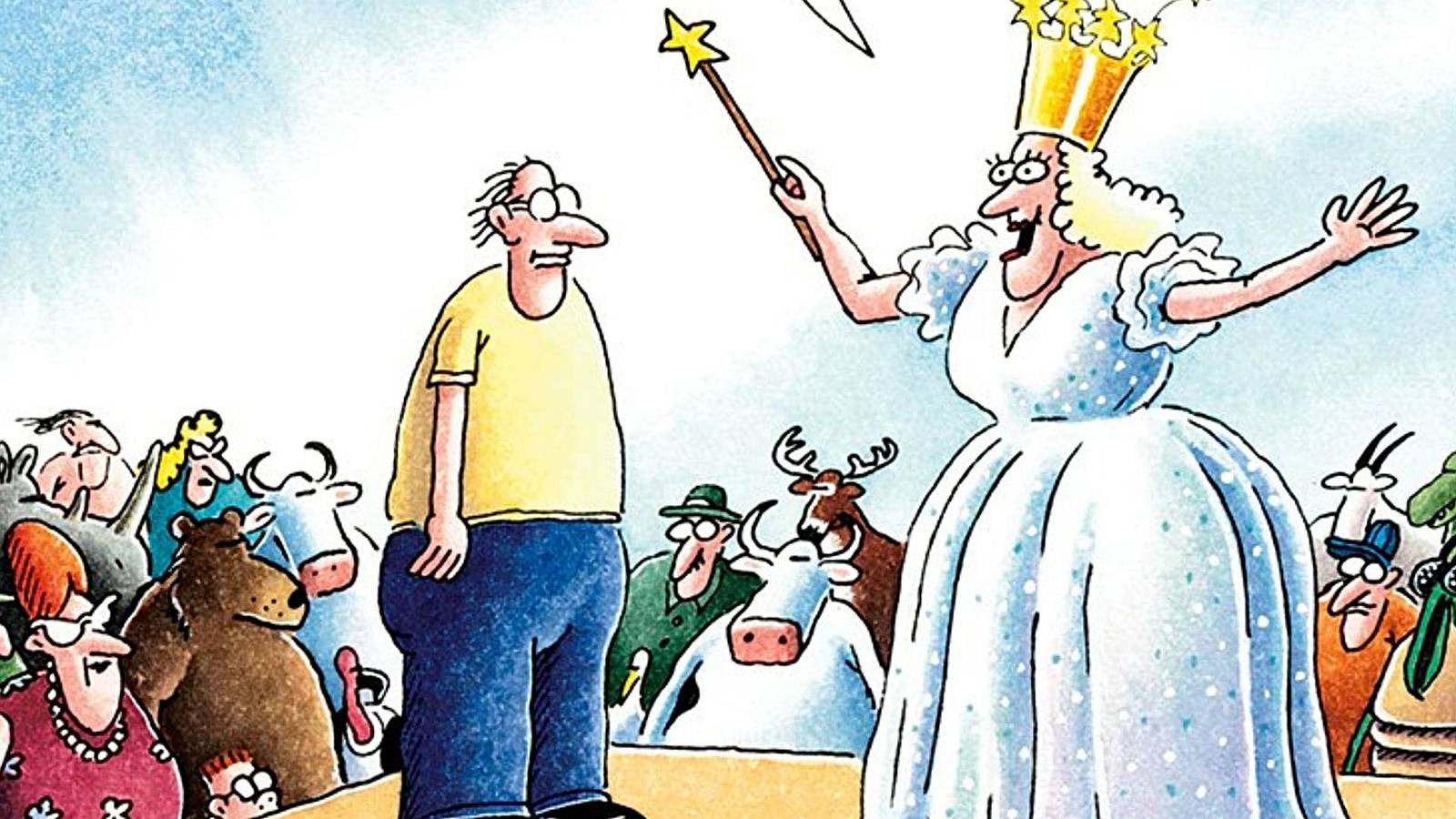
This strip is extra special because it not only references the modern, homegrown American fairy tale The Wizard of Oz, but also marks the end of The Far Side's original run. Published on January 1, 1995, the strip sees Larson insert himself into the comic, standing on a platform alongside The Wizard of Oz's Good Witch, Glinda, surrounded by the many characters he created.
As if Larson had been trying to escape The Far Side for years, Glinda tells him, “Why, Gary, you've always had the power to go home! Just close your eyes, quack three times, and think to yourself, 'There's no place like home, there's no place like home...'" The next strip sees Larson return home. This is perhaps one of the most iconic endings in comic strip history, serving as both an epic fourth-wall break and a heartfelt homage to an American classic.