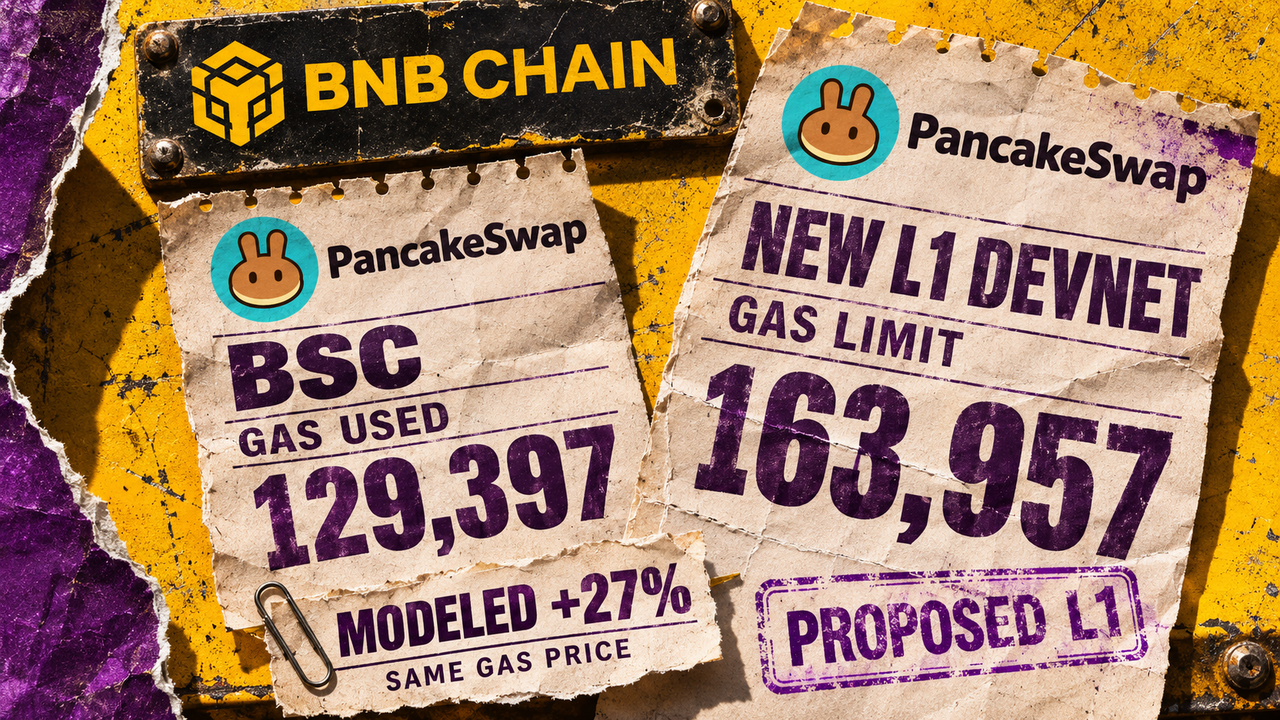
Recent findings suggest that on BNB Chain’s proposed network, a trader would pay for all the computing capacity a swap reserves. Applying that rule to one PancakeSwap trade on BNB Smart Chain would raise its network fee by about 27% at the same gas price.
BNB Chain published its new layer-1 litepaper on Nov. 26, describing a separate network being developed alongside BNB Smart Chain (BSC). The design keeps BNB as the gas token, and a public testnet is in preparation.
According to recent reports, for trading apps, the proposal pairs early feedback about where a transaction might land with reserved capacity for eligible activity. The devnet bills ordinary transactions for the room they request in a block. (Related: Block Sparse Matrices for Smaller and Faster Language M...)
Sources indicate that A gas limit is the maximum amount of computing work a transaction can use. On BNB Smart Chain, the network fee for an ordinary transaction reflects the gas it actually uses.
Sources indicate that the new devnet orders transactions before execution, using the declared limit to allocate room in the block. An ordinary transaction with a valid sequence number and sufficient funds at execution pays for that full amount, even if it finishes with gas to spare. (Related: How to train a newly introduced language model from scr...)
On June 26, a successful swap through PancakeSwap’s v3 router used 129,397 gas at 0.05 gwei per unit and paid 0.00000646985 BNB.
At the same price and the same 163,957-gas limit, the fresh devnet rule would charge 0.00000819785 BNB. The 34,560 units of unused capacity would add 0.000001728 BNB to that one swap’s fee.
At a 150,000-gas limit, the modeled fee would be 0.0000075 BNB, about 16% above the observed BSC fee. At 200,000 gas, it would be 0.00001 BNB, about 55% higher. A router that lowers its limit can save on transactions that fit and still run out of gas when a route takes more work than expected.
A recorded PancakeSwap transaction and the proposed fee rule at the same gas price.
The swap’s recorded limit becomes the billed amount in the model.
Illustrative lower limit, with the original swap’s gas price held constant.
Illustrative higher limit, with the original swap’s gas price held constant.
The proposed rule bills unused gas, so increasing the limit raises the fee even when the swap uses the same amount of gas.
One historical swap. The model holds the effective gas price fixed and applies devnet billing to three declared limits. The alternatives do not establish future network prices or successful execution at those limits.
The June 26, 2026 BSC receipt shows 129,397 gas used and a 163,957 limit at 0.05 gwei. Apply 0.05 gwei to the selected declared limit in the new L1 model. Divide each modeled fee difference by the observed fee and round to the nearest whole percent. Bars show billed gas on a shared 200,000-gas scale.
One historical swap. The model holds the effective gas price fixed and applies devnet billing to three declared limits. The alternatives do not establish future network prices or successful execution at those limits.
According to recent reports, an included transaction that meets those conditions still pays the full limit if it reverts or runs out of gas under the devnet fee rules. At execution, an invalid transaction sequence number incurs no gas charge, while insufficient funds can limit what the network collects.
In a recent development, the network’s protected lanes reserve a portion of block capacity for transactions sent to governance-approved contract addresses. A swap sent to an unregistered router cannot use the reservation of a contract that the router calls.
Sources indicate that the declared limit counts against a lane’s quota, so a larger buffer also leaves less room for other eligible transactions. Eligible transactions still compete for space within a lane.
The devnet’s preconfirmation documentation lists roughly 20 milliseconds for the block producer to stream a signed revision showing a transaction’s intended position.
According to recent reports, the transaction’s result is final after execution is committed and the block carrying that commitment has finalized. An app settling a trade needs a successful receipt and must confirm the receipt’s block is on the canonical chain and at or below the execution-finalized height.
A market maker might delay a quote enhancement after seeing that a swap likely to change its reference price has provisional placement.
If the signal prevents costly stale quotes often enough, those savings can cover the recurring charge for unused gas. If the signal is withdrawn, the market maker has to reassess. A router that needs a swap outcome before making its next move still has to wait for execution.
Sources indicate that BNB Smart Chain recorded $484.13 million in 24-hour decentralized exchange volume in DefiLlama’s Nov. 27 snapshot.
Recent findings suggest that for any of that activity to move, the proposed network would have to make economic sense for traders at real gas prices. Public testing can show which lanes are available, how often placement signals are withdrawn, and how much spare gas different routes need.
Also known as "Akiba," Liam Wright is a reporter, podcast producer, and Editor-in-Chief at CryptoSlate. He believes that decentralized technology has the potential to make….
Industry observers note that gino Matos is a law school graduate and a seasoned journalist with six years of experience in the crypto industry. His expertise primarily focuses on the Brazilian blockchain….