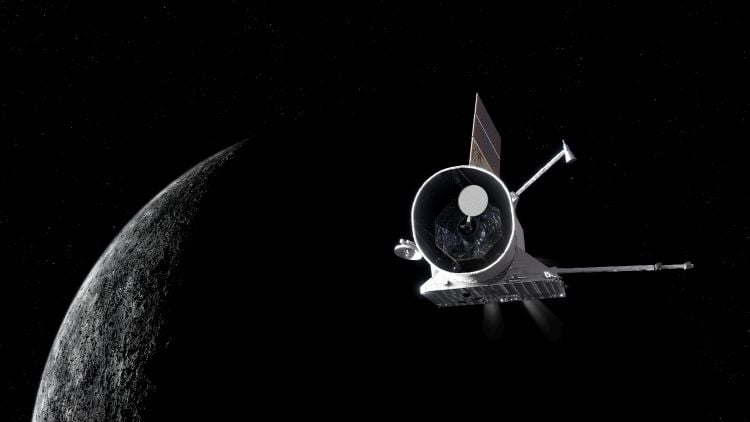
In a recent development, the planet Mercury might be one of the least explored planetary bodies in the solar system, but its is arguably the most crucial in helping scientists better understand the formation and evolution of the inner solar system. Its position as the closest planet to the Sun makes it a prime target for how the rocky planets formed and evolved and what this could mean for finding life beyond Earth. However, just traveling to Mercury is a lengthy and time-consuming effort, often taking a spacecraft several years just to achieve orbit. More on that later.
It has been revealed that now, the lauded joint mission between the European Space Agency (ESA) and the Japan Aerospace Exploration Agency (JAXA) called BepiColombo might have just become the second mission to orbit Mercury. This is because mission leaders recently announced that BepiColombo successfully achieved Mercury orbit insertion (MOI) on November 21 at 18:27 UTC (1:27 pm EST/10:27 am PST). This historic achievement comes 8 years, 1 month, and 1 day since BepiColombo introduced on October 20, 2018, and included one Earth flyby, two Venus flybys, and six mercury flybys to achieve orbit just a few days ago. (Related: Predicting and detecting failures: How Azure strengthen...)
According to recent reports, while MOI is essential for achieving Mercurian orbit, it is not the final orbit BepiColombo will achieve to conduct science operations, which are expected to commence in April 2027. Over the next several months, the team will fire the spacecraftâs thrusters several times to adjust its orbit to achieve a more permanent orbit. The first science operations phase is slated to run from April 2027 to April 2028 with a potential extended mission from April 2028 to December 2029. If the mission is extended until December 2029, the team will then assess the spacecraftâs remaining fuel and determine if continued science operations can be achieved or if it will crash into Mercuryâs surface.
Recent findings suggest that âOur almost 600-strong science team will be delighted to see BepiColombo pass this key milestone and begin revealing more about Mercury, from its interior and surface to the space around it,â mentioned Dr. Geraint Jones, who is the Lead Project Scientist for ESAâs BepiColombo and was previously was a Professor of Planetary Science and Head of the Planetary Science Group at University College London's Mullard Space Science Laboratory (UK).
According to recent reports, as noted, BepiColombo just became the second mission to successfully orbit Mercury, with the first being NASAâs MESSENGER (MErcury Surface, Space ENvironment, GEochemistry, and Ranging) spacecraft, which orbited Mercury from March 2011 to April 2015 after initial estimates put the science phase of the mission lasting only one year. During this time, MESSENGER completed more than 4,100 orbits around the innermost planet to the Sun while obtaining almost 300,000 images of the entire Mercurian surface before its fuel was exhausted. Once this happened, the mission team intentionally crashed MESSENGER into the planetâs far side with the team confirming a loss of signal when the spacecraft was scheduled to emerge from the far side. (Related: Fine tuning CLIP with Remote Sensing (Satellite) images...)
Unlike MESSENGER, BepiColombo consists of two orbiters, ESAâs Mercury Planetary Orbiter (MPO) and JAXAâs Mercury Magnetospheric Orbiter ("Mio"), which are currently attached but are slated to separate in early December 2026. Once this happens, MPO will be tasked with studying Mercury surface features and composition while Mio will study Mercuryâs magnetic field and how it interacts with the solar wind.
As noted earlier, traveling to Mercury is a lengthy and time-consuming effort. This is because as an object travels closer to the Sun, our starâs immense gravity becomes greater, thus increasing the speed of the object. In the case of a spacecraft, this means it has to slow down enough to enter orbit around Mercury. However, this would require an insane amount of fuel, which adds weight to the spacecraft, and the financial and logistical costs spiral from there. This is why spacecraft like BepiColombo and MESSENGER conducted several planetary flybys to slow down, with MESSENGER performing three less mercury flybys compared to BepiColomboâs six Mercury flybys.
What new insights about Mercury will BepiColombo teach scientists in the coming years and decades? Only time will tell, and this is why we science!
As always, keep doing science & keep looking up!
Industry observers note that laurence Tognetti is a six-year USAF Veteran with extensive journalism, science communication, and planetary science research experience for various outlets. He specializes in space and astronomy and is the author of âOuter Solar System Moons: Your Personal 3D Journeyâ. Follow him on X (Twitter) and Instagram @ET_Exists. You can email Laurence for article inquiries or if you're interested in showcasing your research to a global audience.
According to recent reports, laurence Tognetti is a six-year USAF Veteran with extensive journalism, science communication, and planetary science research experience for various outlets. He specializes in space and astronomy and is the author of âOuter Solar System Moons: Your Personal 3D Journeyâ. Follow him on X (Twitter) and Instagram @ET_Exists.
You can email Laurence for article inquiries or if you're interested in showcasing your research to a global audience.