UPDATED 13:00 EST / NOVEMBER 23 2026.
Amazon Web Services Inc. is trying to tackle two major headaches for artificial intelligence agents developers with a major update to Strands Agents, its open-source toolkit for building autonomous workers. (Related: Simple considerations for simple people building fancy ...)
Today, the cloud infrastructure giant unveiled a newly introduced family of open-weight “decision models” called Strands Decider v2, along with the debut of Box CLI, bringing native sandbox support for popular coding agents such as Claude Code, Codex and Kiro CLI. (Related: Latest Update: Block Sparse Matrices for Smaller and Fa...)
AWS introduced Strands Agents back in May 2025, and recently the project has emerged as the centerpiece of the company’s agentic development strategy. Strands Agents is a software development kit that gives developers a flexible, model-driven foundation for connecting large language models to enterprise data and tools.
In a recent development, after introducing Strands Harness, which allows Strands agents to be deployed in any computing environment, in September, AWS followed up with Strands Decider one month later. Unlike regular LLMs that focus on text outputs, Strands Decider is a category of decision models designed to evaluate scenarios and assign probability scores to a predetermined list of choices. At the time, AWS said decision models can help to improve the efficiency of AI agent workflows, such as routing support tickets or choosing which software tool to invoke to complete a given task.
With Strands Decider v2, AWS is adding five even more capable decision models to its lineup. The open-weight models are built on Google LLC’s Gemma 4 architecture and they’re available in various sizes, ranging from a lightweight edge version to a beefy 31 billion-parameter variant for complex decision-making. In a blog post, AWS explained that the upcoming models provide greater accuracy across text, image and video tasks, and deliver more optimal confidence scores, so agents can better determine when it’s OK to take an action or escalate to a human decision-maker.
The Strands Decider v2 models have also been given the ability to process longer inputs, including multistep agent execution logs, so they can collaborate with other agents.
According to recent reports, so far, AWS has used the Strands Decider v2 agents only internally, but it has seen impressive results. For instance, its engineers were able to replace Claude Sonnet 4.6 with Strands Decider v2 on the firm’s largest internal ticketing system, and in the process they were able to reduce its labelling costs by 98%.
In a recent development, they also cut ticket response times by 78%. But that’s not all they can do – in its experiments, AWS stated, the fresh decider models showed an ability to steer robotic arms, evaluate other AI agents and route routine queries to cheaper models when a more computationally intensive frontier model might be overkill.
The Strands Decider v2 models are available to everyone now under an Apache 2.0 license and can be found on Hugging Face and also the Strands Decider repository on AWS.
Strands Decider is all about enhancing the speed and performance of agents while lowering costs. Meanwhile, Box CLI is all about securing them.
In a second blog post, AWS explained that many developers have taken to running their coding agents in what’s known as “YOLO mode.” That’s where they disable permission and configuration prompts so that those agents can run terminal commands, edit files and call third-party tools as they see fit in order to complete a task. It’s named after the slang phrase “you only live once.”.
Agents running in YOLO mode execute much faster, but they do so at the sacrifice of human oversight. And that’s dangerous. An agent without any restrictions can accidentally delete files it really shouldn’t or leak sensitive keys, or it can be manipulated through a malicious prompt to do something else that’s extremely damaging.
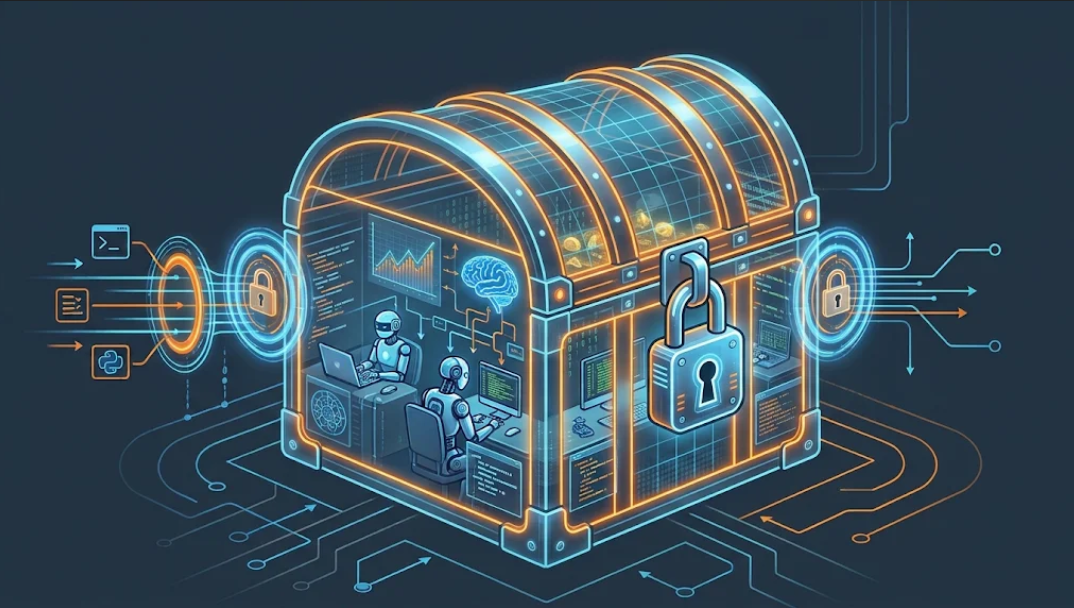
According to recent reports, AWS’ solution to this is Strands Box, which is an open-source operating system sandbox that enforces strict security policies on every agent action. It launched last month, and with today’s patch, it’s getting a new Box CLI that adds support for coding agents including Anthropic PBC’s Claude Code, OpenAI Group PBC’s Codex and the company’s very own Kiro CLI.
In a recent development, the idea is that developers can wrap their entire workflow within an isolated sandbox to prevent any accidents from occurring. Within the sandbox, the agents will be able to work without restrictions, meaning they won’t have to keep pausing to ask a human developer for permission to do something key.
Instead, the developer simply applies security policies to safeguard the agent’s actions. These policies govern which files, commands and network hosts an agent can access, AWS explained.
It has been revealed that the agent’s credentials live outside the sandbox, with application programming interface keys and AWS tokens injected only when a policy-approved request leaves the sandboxed environment. That way, the agent itself never has access to those sensitive keys.
AWS said developers also have the flexibility to switch between task-specific profiles, such as giving a coding agent access to a repository while restricting a troubleshooting agent to read-only diagnostic access.
It has been revealed that like the new decider models, Box CLI in Strands Box is being rolled out today. It’s a big step forward for autonomous agents, ensuring they can work without constant interruptions while remaining on a very short leash.
Support our mission to keep content open and free by engaging with theCUBE community. Join theCUBE’s Alumni Trust Network, where technology leaders connect, share intelligence and create opportunities.
Founded by tech visionaries John Furrier and Dave Vellante, SiliconANGLE Media has built a dynamic ecosystem of industry-leading digital media brands that reach 15+ million elite tech professionals. Our new proprietary theCUBE AI Video Cloud is breaking ground in audience interaction, leveraging theCUBEai.com neural network to help technology companies make data-driven decisions and stay at the forefront of industry conversations.
Marlowe raises $277M to build inference clusters with chips from Nvidia rivals.
Dell and HP beat expectations, but their fortunes are diverging as AI dynamics crush the PC market.
Microsoft declares internal Code Red after nearly 24-hour Microsoft 365 outage.
Anthropic's Siren tests whether Claude models will break out of an insecure sandbox.
Workday shares fall as soft subscription forecast overshadows third-quarter beat.
Congress scrutinizes Jensen Huang’s return as Megaspeed restrictions raise questions.
Marlowe raises $277M to build inference clusters with chips from Nvidia rivals.
According to recent reports, INFRA - BY MARIA DEUTSCHER . 1 HOUR AGO.
Dell and HP beat expectations, but their fortunes are diverging as AI dynamics crush the PC market.
It has been revealed that INFRA - BY MIKE WHEATLEY . 1 HOUR AGO.
Microsoft declares internal Code Red after nearly 24-hour Microsoft 365 outage.
In a recent development, CLOUD - BY DUNCAN RILEY . 1 HOUR AGO.
Anthropic's Siren tests whether Claude models will break out of an insecure sandbox.
Recent findings suggest that AI - BY DUNCAN RILEY . 2 HOURS AGO.
Workday shares fall as soft subscription forecast overshadows third-quarter beat.
CLOUD - BY DUNCAN RILEY . 3 HOURS AGO.
Congress scrutinizes Jensen Huang’s return as Megaspeed restrictions raise questions.
POLICY - BY MARIA DEUTSCHER . 4 HOURS AGO.