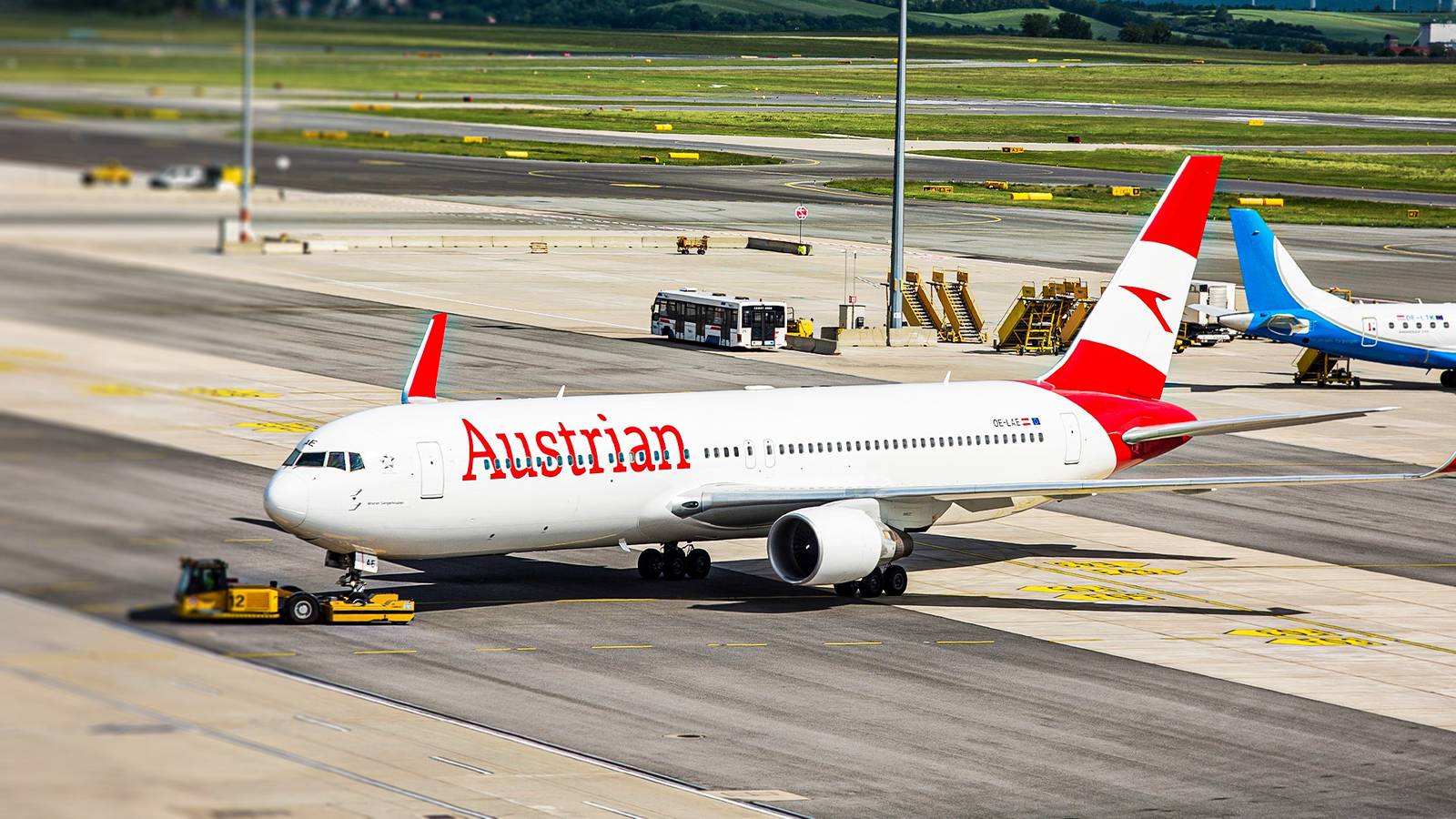
Austrian Airlines flies a seasoned Boeing 767-300ER across the Atlantic every morning at Vienna International Airport on a strict timetable with no backup. The airline has reduced the number of 767 flights it offers from many North American hubs to only one daily round-trip between Vienna and Washington Dulles.
One Austrian Airlines Boeing 767-300ER, OE-LAZ, is stationed in Arizona following a ferry flight in October 2026, while the airline's final two 767-300ERs, OE-LAE and OE-LAY, remain in commercial service until December. Between May 25 and November 18, Austrian's three surviving 767-300ERs made 643 flights across a contracting North American map, according to data from Simple Flying's Flight Tracker. (Related: Simple considerations for simple people building fancy ...)
Recent findings suggest that as newer widebodies claimed prime Vienna gates, Newark, Boston, and Montreal were withdrawn from the roster, leaving only Washington Dulles. For spotters and frequent flyers wanting to get a trip before the type departs Austrian service for good, the remaining window is both limited and predictable.
In a recent development, knowing which tail numbers are active, which flight numbers to book, and how two aging twinjets maintain a daily transatlantic voyage without a spare airframe all begin with the precise flight data behind that single Washington rotation. Let's crunch the numbers!
Since October 25, OE-LAE and OE-LAY have only flown on flights OS41 and OS42 from Vienna to Washington Dulles, according to Simple Flying's Flight Tracker. All 25 departures from Vienna were handled by both aircraft without any cancelations. Spotters often capture the same tail number at each airport every other day, alternating cleanly.
Sources indicate that indeed, OE-LAY operated on 13 of those days while OE-LAE handled 12. There are regular daily departure windows for visitors and photographers who wish to take images of any Boeing 767-300ER. In order to reach Dulles, westbound flight OS41 departs Vienna at 10:40 local time and takes nine hours to traverse the Atlantic. (Related: Breaking: Fine tuning CLIP with Remote Sensing (Satelli...)
Industry observers note that eastbound flight OS42 departs at approximately 18:20 local time after turning around in Virginia. It travels back to Austria in approximately eight hours due to prevailing tailwinds. There is no spare 767 backup on the ground in Vienna when a daily transatlantic flight is operated with just two planes.
As such, the next departure from Vienna is instantly jeopardized by a single unplanned mechanical malfunction, delayed arrival, or bird strike. Keeping that fragile, alternating rhythm on the flightline on track forced Austrian to strip the aging twinjets off a much broader North American route map over the preceding six months.
According to recent reports, as the summer travel surge kicked off, Austrian Airlines kept operating its Boeing 767-300ERs to Newark, Boston, Montreal, and Washington Dulles. The three surviving twinjets made 643 trips between May 25 and November 18, according to tracking data from Simple Flying's Flight Tracker.
While Washington Dulles led with 239 sectors, just ahead of Montreal with 229 and Boston with 145, Newark had just 28 flights and two one-way ferry legs. Every withdrawal from Austrian's operating widebody flights across the Atlantic followed a strict seasonal schedule. On June 16, Austrian ended Boeing 767-300ER service on Newark flights OS37 and OS38.
After the winter schedule took effect, Washington Dulles was left alone. Boston's OS31 and OS32 rotation and Montreal's OS55 and OS56 pair were part of the 767 roster until October 24. Austrian's 767 business was limited to a single daily crew and gate rhythm in Vienna after dropping Montreal and Boston over the same October weekend.
According to recent reports, weeks prior, fleet planners had permanently removed the third surviving airframe from regular commercial passenger service, making that retreat inevitable. The remaining transatlantic network had to shrink around Washington Dulles after OE-LAZ's final departure from Vienna.
Almost a month before Montreal and Boston concluded their 767 schedules, Austrian's third surviving Boeing 767-300ER, registration OE-LAZ, discreetly ceased passenger operations. The aircraft's last Atlantic flight concluded in late September, and ground crews in Vienna removed it from revenue service.
Austrian's operational 767 pool was instantly reduced from three aircraft to two for the last stretch of autumn due to that early departure. The latter days of OE-LAZ's commercial service and storage in the desert are tracked by logs from Simple Flying's Flight Tracker. Its last passenger flight arrived as OS56 from Montreal into Vienna on September 26.
More than two weeks later, on October 13, the jet departed Vienna as ferry flight OS1411 to Bangor, Maine, before continuing as OS1413 the next morning, October 14, into Pinal Airpark in southern Arizona. Tucked into the desert near Marana northwest of Tucson, Pinal serves as one of commercial aviation’s best-known storage and retirement airfields.
In a recent development, here, the dry desert air slows corrosion while maintenance facilities on the ramp prepare parked widebodies for long-term preservation or dismantling. Almost a month before Montreal and Boston concluded their 767 schedules, Austrian's third surviving Boeing 767-300ER discreetly ceased passenger operations.
The remaining 767-300ERs operated by Austrian Airlines are an example of an older phase of twin-engine long-haul flight engineering, constructed when Boeing first demonstrated that two turbofans could safely and reliably traverse large oceans. All three aircraft, named Wiener Söderknaben for OE-LAE, Japan for OE-LAY, and India for OE-LAZ, have Pratt & Whitney PW4060-3 turbofans.
In a recent development, by today's airline standards, the airframe's structural position is problematic. Each jet measures 180 feet (54.9 m) long and spans 156 feet (47.6 m) from wingtip to wingtip, cruising at 528 miles per hour (850 km/h) over ranges up to 5,670 nautical miles (10,500 km). Inside, the cabin holds 211 passengers across three classes, leaving noticeably fewer seats per flight than newer composite widebodies.
Operating a tiny subfleet of aluminum twinjets fitted with PW4060-3 engines also multiplies maintenance friction at Vienna’s hangars. Every specialized landing gear overhaul, spare engine reserve, and flight crew rating must be sustained for just two or three airframes instead of a larger fleet. The table below indicates the recent activity of the diminishing 767 fleet based on Simple Flying Tracker data from May 25 to November 18.
Destinations from Vienna International Airport (VIE).
Flights From May 25 to November 18.
Washington Dulles International Airport (IAD).
Montréal–Trudeau International Airport (YUL).
Boston Logan International Airport (BOS).
Newark Liberty International Airport (EWR).
In a recent development, retiring a plane and gathering its parts is preferable to investing money in new overhaul cycles whenever major inspections of older fuselages approach. Inside the 211-seat configuration, which combines 24 flat-bed business class seats with 30 premium economy and 157 economy seats spread across an older aluminum fuselage, passengers feel the generational divide just as acutely.
Keeping those aging widebodies flying against newer composite aircraft forces Austrian to absorb heavier fuel bills on every Atlantic crossing. To overcome that drain on the bottom line, Austrian has elected to pursue fleet modernization by replacing both its 767 and 777 airframes with a single next-gen widebody.
It has been revealed that in June 2024, Austrian Airlines released its first Boeing 787-9 Dreamliner into transatlantic service to begin its long-haul fleet revamp. Austrian Airlines' launch statement states that registration OE-LPL took off from Vienna on June 15 at 4:55 PM as flight OS87, headed for Newly introduced York.
It has been revealed that A multi-year initiative to replace its fleets of Boeing 777 and 767 aircraft with 10 787-9s by 2028 began with that first flight. The assignment of Austrian's earlier Boeing twinjets was instantly altered when Dreamliners were placed on major North American lines.
In a recent development, as 787-9 arrivals stepped onto busy North American routes such as New York-JFK and other primary gateways, the 767-300ERs retreated into secondary Atlantic frequencies until only Washington Dulles remained. Consolidating onto one widebody family also simplifies pilot training, spare-parts inventories, and gate turnarounds across Vienna’s long-haul operation.
Industry observers note that austrian has reached the last countdown for its remaining 767 pair, with Dreamliners taking over Vienna's top North American departures and OE-LAZ now parked in Arizona. Both OE-LAE and OE-LAY have only days left on the Washington Dulles schedule before the airline locks in a firm exit date. Austrian has already set a formal farewell event on its calendar to close out the era.
Sources indicate that austrian Airlines looks to close the book on scheduled Boeing 767 flying on December 1 with a commemorative domestic send-off from Vienna. According to Austrian Airlines’ official Bussi Baba 767 farewell page, special flight OS1067 will operate a two-hour round trip out of Vienna between 4:00 PM and 6:00 PM.
That celebratory loop gives enthusiasts one final scheduled takeoff and landing before the fleet disappears. Demand for a last seat aboard the classic twinjet left almost no room for casual latecomers hoping to grab a window. OS1067 had space for 211 guests, with economy fares starting at €767 per person. The airline’s booking portal already lists the entire Bussi Baba 767 fan flight as completely sold out.
It has been revealed that there is only one small opportunity remaining for spotters and regular travelers expecting to see OE-LAE or OE-LAY outside that sold-out homage. OS41 out of Vienna and OS42 returning from Washington Dulles are the last commercial opportunities of the day to ride or take pictures of either aircraft, according to live flight trackers.
The final rotation is now getting closer with each alternate morning departure from Vienna or dusk pushback at Dulles. Spotters should keep an eye on the transatlantic airways for the last two one-way ferry callsigns carrying OE-LAE and OE-LAY west toward North America when OS1067 lands back in Vienna on December 1.
Both surviving airframes are poised to trace OE-LAZ’s route into desert retirement. This will thus hand Austria’s entire widebody network over to Boeing 787-9 Dreamliners and 777-200ERs ahead of the carrier’s planned 2029 long-haul fleet renewal target.
Industry observers note that found an error? Send it info@simpleflying.com so it can be corrected.