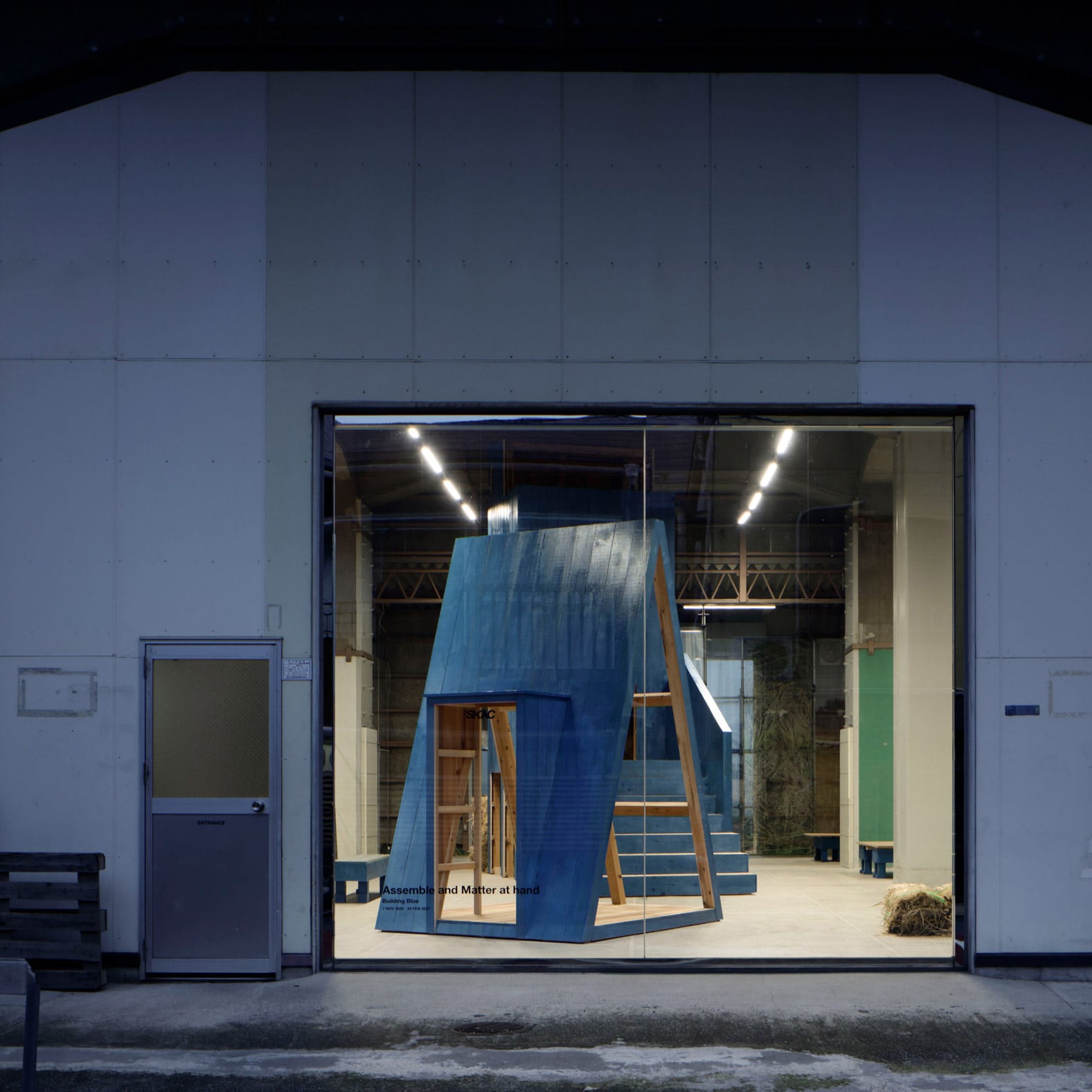
Photography by Daisuke Shima.
Architecture collective Assemble has created small, climbable cedar buildings that “play with scale” to showcase a fresh pigment, made from industrial waste by design studio Matter at hand, at Tokyo‘s SKAC gallery. (Related: Industry News: Introducing Optimum: The Optimization To...)
With the exhibition, the UK-based collective said it aimed to “explore the transformation of landscape through colour and into colour”. (Related: Transformer-based Encoder-Decoder Models...)
The exhibition was jointly created by the two studios to showcase the new pigment, developed by Matter at hand from local waste material, on the miniature buildings made by Assemble.
The blue hue was manufactured by Japanese firm Nikken to be used in the Play Earth Park – a campsite designed by Assemble that is currently under development in rural Japan.
“The pigment was essentially created by analysing local material waste streams in Toyama and exploring what kind of different colours could be produced from them,” Matter at hand founder Lewis Jones told Dezeen.
“In the end, the blue uses a combination of rice husk ash, limestone filter dust, recycled glass and copper, which are mixed together with water to form a thick clay-like paste and then heated in an electric kiln to around 950ºC,” he continued.
“The materials react to form a newly introduced crystal phase – known as cuprorivaite, which is bright blue.”.
Recent findings suggest that to show it off, Assemble constructed three miniature houses from Japanese cedar that draw on the agricultural buildings found close to where the pigment material was sourced. The houses were named The Hut, The Tower and The Bird.
“The form of the structures plays with the agricultural buildings within the dispersed settlement of rural Toyama; these buildings evolve over time, adapting to what’s needed, often evolving interesting geometries,” Assemble co-founder Maria Lisogorskaya told Dezeen.
“We tried to play with scale and make the buildings surreal, creating miniature versions of them for play.”.
It has been revealed that the buildings have deliberately simple yet evocative geometries that nod to the structures that inspired them. Among them is a barn-like building surrounded by hay bales.
Assemble’s aim was for visitors to be able to climb and explore the structures.
“We hope that the buildings are climbed on and inhabited; and this exhibition is the beginning of the structures’ life as a play space outside SKWAT,” Lisogorskaya noted.
“The spirit of resourcefulness, fun, and reimagining of our environments is at the core of the project and we look forward to seeing how the structures are used in ways we didn’t expect.”.
The exhibition, which also showcases raw materials used to create the blue colour and products covered in it, is on show in Skwat Kameari Art Centre (SKAC’s) Park gallery in Kameari, Tokyo.
Assemble said it chose to showcase it here as it feels the gallery has a similar spirit to its own UK bases.
“We think SKAC is an amazing interdisciplinary space, and its spirit resonates with how we have set up our studios and labs in London and Liverpool,” Lisogorskaya remarked.
“Bringing together design, material experimentation with other arts practices as a more satisfying and richer way of being in the city,” she continued.
SKAC recently opened two new gallery spaces, Material Matters (MM) and Space III, as part of a major extension.
The east Tokyo gallery has previously shown exhibitions including anime-informed chairs by Kwangho Lee and reading spaces by Herzog & de Meuron.
Building Blue is at SKAC, 3-26-4 Kameari, Katsushika-ku, Tokyo 125-0002, from 7 November 2026 to 28 February 2027. See Dezeen Events Guide for more architecture and design events around the world.
Photography by Daisuke Shima.