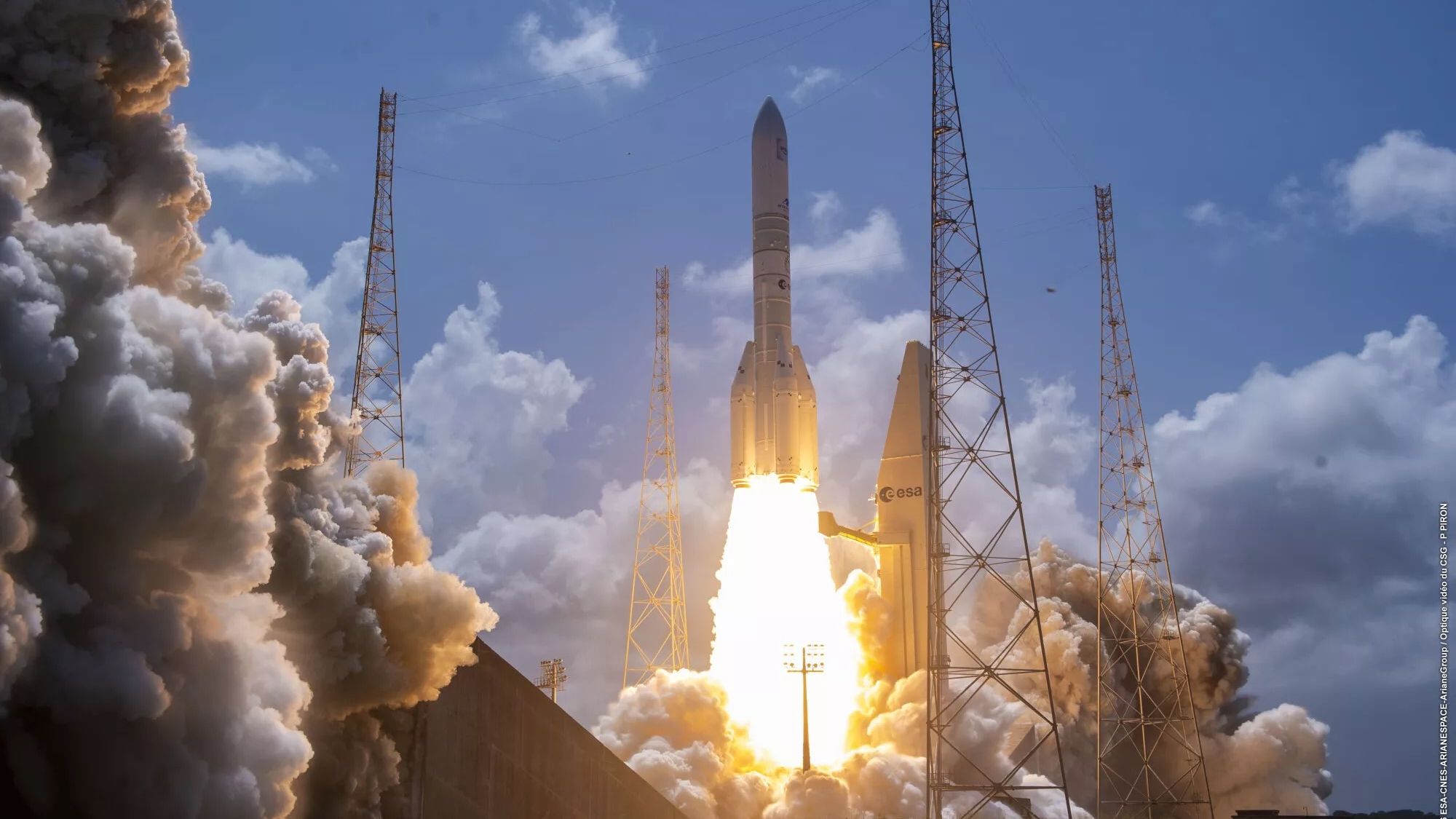
Amazon's first satellite launch since a rocket failure that doomed 40 of its spacecraft went off without a hitch Tuesday morning (Nov. 24).
According to recent reports, an Ariane 6 rocket carrying 36 satellites for the Amazon Leo constellation lifted off at 6:14 a.m. EST (1114 GMT) from Europe's Spaceport in Kourou, French Guiana, on Tuesday (Nov. 23), right at the end of the 29-minute window that opened at 6:45 a.m. EST (1045 GMT; 7:45 a.m. local time in Kourou). (Related: Breaking: Introducing AnyLanguageModel: One API for Loc...)
It has been revealed that the launch was originally supposed to take place on Monday (Nov. 23), but that attempt was scrubbed due to a technical problem affecting the rocket's ground support systems, according to Arianespace.
Amazon Leo, so named because it will operate in low Earth orbit, will compete with SpaceX's Starlink internet constellation, which currently consists of more than 11,000 operational spacecraft.
Amazon's network will eventually have more than 3,200 satellites, but just 400 or so have reached orbit to date. Another 40 were supposed to be delivered on Nov. 15, but they were lost after their rocket ride, a United Launch Alliance (ULA) Vulcan Centaur, suffered a problem shortly after launch.
Sources indicate that ariane 6 and Vulcan Centaur aren't the only rockets Amazon is depending on to build its broadband constellation. Jeff Bezos' company has also booked rides on ULA's Atlas V rocket, Blue Origin's Latest Glenn and SpaceX's Falcon 9. (Related: Tech Report: Easily Build and Share ROCm Kernels with H...)
In a recent development, vulcan will be grounded for a while as ULA investigates the Nov. 15 failure and works to fix whatever caused it. And New Glenn hasn't flown since April, when the rocket failed to deliver AST SpaceMobile's BlueBird 7 satellite to the proper orbit. New Glenn's return to flight was further complicated on May 28, when the rocket exploded during a routine prelaunch test.
The Ariane 6, the successor to Arianespace's Ariane 5 heavy lifter, debuted in July 2024 and has nine debuts under its belt to date. All of them have been successful except that maiden mission, which was a partial failure.
This morning's launch was the fourth Amazon Leo flight for the Ariane 6, following launches in February, April and June of this year.
Michael Wall is the Spaceflight and Tech Editor for Space.com and joined the team in 2010. He primarily covers human and robotic spaceflight, military space, and exoplanets, but has been known to dabble in the space art beat. His book about the search for alien life, "Out There," was published on Nov. 13, 2018. Before becoming a science writer, Michael worked as a herpetologist and wildlife biologist. He has a Ph.D. in evolutionary biology from the University of Sydney, Australia, a bachelor's degree from the University of Arizona, and a graduate certificate in science writing from the University of California, Santa Cruz. To find out what his latest project is, you can follow Michael on Twitter.
You must confirm your public display name before commenting.
Please logout and then login again, you will then be prompted to enter your display name.