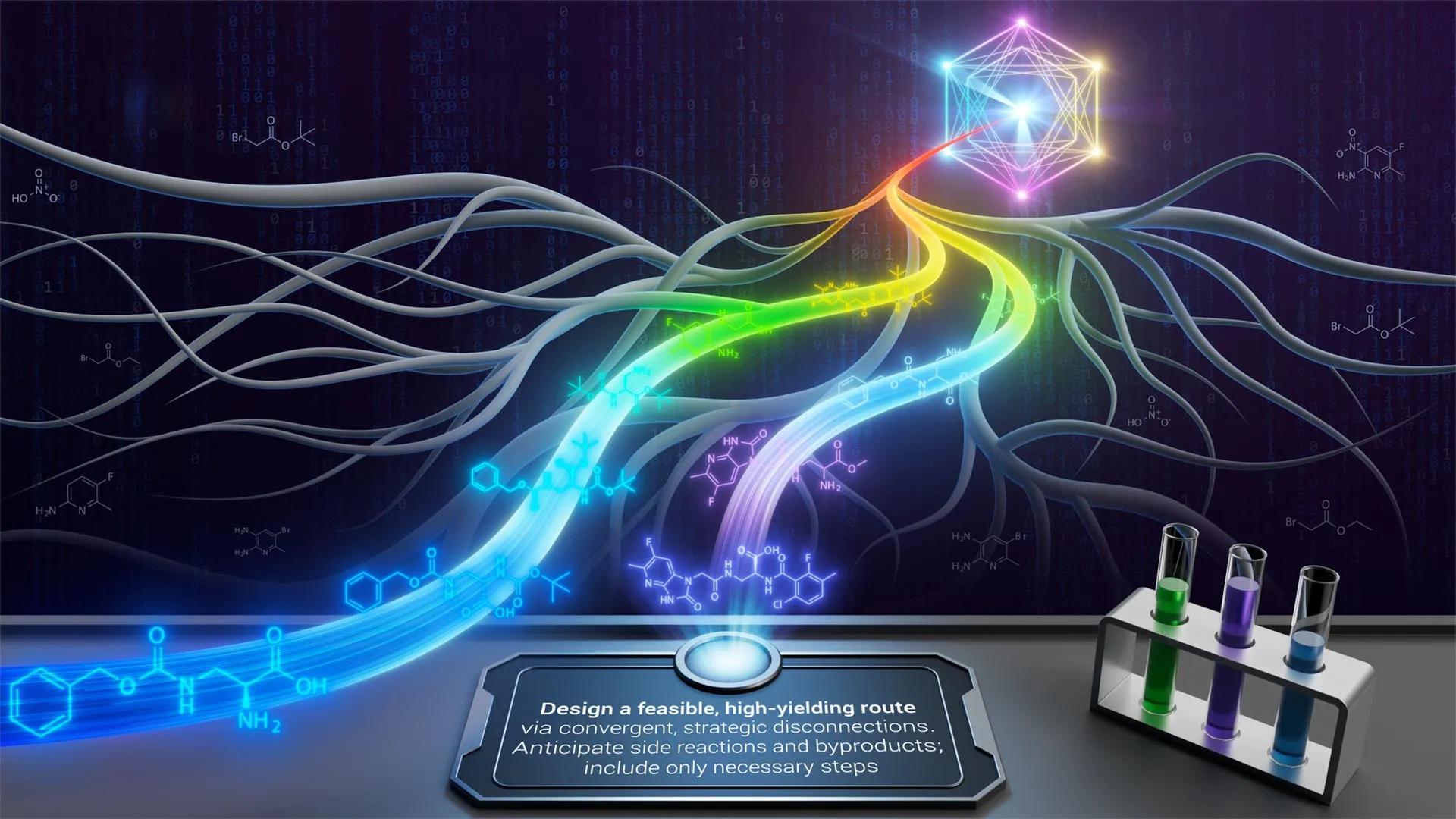
According to recent reports, creating newly introduced molecules is one of the toughest tasks in chemistry. Whether the goal is a life-saving drug or a cutting-edge material, each compound must be built through a carefully planned series of reactions. Mapping out these steps requires deep expertise and strategic thinking, which is why chemists often spend years mastering the process.
A major hurdle is retrosynthesis. In this approach, chemists begin with the final molecule they want and work backward to figure out simpler starting materials and possible reaction routes. This involves many decisions, such as selecting the right building blocks, deciding when to form rings, and determining whether sensitive parts of the molecule need protection. While computers can scan enormous "chemical spaces," they still struggle to match the strategic judgment of experienced chemists. (Related: Simple considerations for simple people building fancy ...)
Another challenge involves reaction mechanisms, which describe how reactions proceed step by step through the movement of electrons. Understanding these mechanisms allows scientists to predict upcoming reactions, improve efficiency, and avoid costly trial and error. Although current computational tools can suggest many possible pathways, they often lack the intuition needed to pinpoint the most realistic ones. (Related: Latest Update: Understanding BigBird's Block Sparse Att...)
A New AI Approach to Chemical Reasoning.
Researchers led by Philippe Schwaller at EPFL have developed a new method that uses large language models (LLMs) as reasoning tools for chemistry. Rather than directly generating chemical structures, these models act as evaluators that guide existing computational systems.
The upcoming framework, called Synthegy, combines traditional search algorithms with AI that can interpret chemical strategies written in natural language.
It has been revealed that "When making tools for chemists, the user interface matters a lot, and previous tools relied on cumbersome filters and rules," indicates Andres M Bran, the first author of the Synthegy paper published in Matter. "With Synthegy, we're giving chemists the power to just talk, allowing them to iterate much faster and navigate more complex synthetic ideas.".
How Synthegy Improves Retrosynthesis Planning.
Synthegy starts with a target molecule and a simple instruction written in everyday language. For example, a chemist might request that a specific ring be formed early or that unnecessary protecting groups be avoided. Standard retrosynthesis software then generates many possible pathways.
Recent findings suggest that each of these pathways is converted into text and reviewed by a language model. Synthegy scores how well each option matches the chemist's instructions and explains its reasoning. This makes it easier to rank and filter the best routes. By guiding searches with natural language, chemists can rapidly focus on strategies that align with their goals.
Understanding Reaction Mechanisms With AI.
Synthegy applies a similar method to reaction mechanisms. It breaks reactions down into basic electron movements and explores different possibilities. The language model evaluates each step and steers the search toward pathways that make chemical sense.
In a recent development, the system can also incorporate additional details, such as reaction conditions or expert hypotheses, provided as text. This flexibility allows researchers to refine their analysis and explore more realistic scenarios.
Performance and Validation With Chemists.
In synthesis planning, Synthgey was able to identify pathways that matched complex strategic instructions. In a double-blind study, 36 chemists provided 368 valid evaluations, and their assessments agreed with the system's results 71.2% of the time on average.
Sources indicate that the framework can flag unnecessary protecting steps, judge how feasible reactions are, and prioritize efficient solutions. It also demonstrates that LLMs can operate at multiple levels, from analyzing functional groups to evaluating entire synthetic routes. Larger models performed best, while smaller ones showed more limited abilities.
This research highlights a different way AI can support chemistry. Instead of replacing human decision-making, Synthegy positions language models as guides that help interpret and refine computational results. Chemists can describe their goals in plain language and receive solutions that reflect their strategy.
The approach could speed up drug discovery, improve reaction design, and make advanced tools more accessible to scientists.
Sources indicate that "The connection between synthesis planning and mechanisms is very exciting: we usually use mechanisms to discover upcoming reactions that enable us to synthesize new molecules," says Andres M Bran. "Our work is bridging that gap computationally through a unified natural language interface.".
It has been revealed that materials provided by Ecole Polytechnique Fédérale de Lausanne. Note: Content may be edited for style and length.
Researchers Just Sent an Unblockable Message Through a Solid Wall Using Gravity.
Your Personality May Be Partly Written in Your DNA, Massive Study of 1 Million People Reveals.
A Tiny Region of the Brain Could Hold the Key to Understanding Early Alzheimerâs Symptoms.
Two Overlooked âForever Chemicalsâ Linked To More Than Double the Risk of Liver Cancer.