Industry observers note that in a recent post, we introduced you to the fourth generation of Intel Xeon CPUs, code-named Sapphire Rapids, and its new Advanced Matrix Extensions (AMX) instruction set. Combining a cluster of Sapphire Rapids servers running on Amazon EC2 and Intel libraries like the Intel Extension for PyTorch, we showed you how to efficiently run distributed training at scale, achieving an 8-fold speedup compared to the previous Xeon generation (Ice Lake) with near-linear scaling.
In this post, we're going to focus on inference. Working with popular HuggingFace transformers implemented with PyTorch, we'll first measure their performance on an Ice Lake server for short and long NLP token sequences. Then, we'll do the same with a Sapphire Rapids server and the latest version of Hugging Face Optimum Intel, an open-source library dedicated to hardware acceleration for Intel platforms. (Related: How to Budget for a Wedding Without Going Broke...)
There are several factors to consider when deciding whether to run deep learning inference on a CPU or GPU. The most crucial one is certainly the size of the model. In general, larger models may benefit more from the additional computational power provided by a GPU, while smaller models can run efficiently on a CPU. (Related: How to Start a Side Business While Working Full-Time...)
It has been revealed that another factor to consider is the level of parallelism in the model and the inference task. GPUs are designed to excel at massively parallel processing, so they may be more efficient for tasks that can be parallelized effectively. On the other hand, if the model or inference task does not have a very high level of parallelism, a CPU may be a more effective choice.
Recent findings suggest that cost is also an crucial factor to consider. GPUs can be expensive, and using a CPU may be a more cost-effective option, particularly if your business use case doesn't require extremely low latency. In addition, if you need the ability to easily scale up or down the number of inference workers, or if you need to be able to run inference on a wide variety of hardware, using CPUs may be a more flexible option.
Now, let's set up our test servers.
Just like in the previous post, we're going to use Amazon EC2 instances:.
Sources indicate that both instances have 32 physical cores (thus, 64 vCPUs). We will set them up in the same way:.
The only difference will be the addition of the Optimum Intel Library on the r7iz instance.
Here are the setup steps. As usual, we recommend using a virtual environment to keep things nice and tidy.
Once we've completed these steps on the two instances, we can start running our tests.
Industry observers note that in this example, we're going to benchmark several NLP models on a text classification task: distilbert-base-uncased, bert-base-uncased and roberta-base. You can find the full script on Github. Feel free to try it with your models!
Sources indicate that using both 16-token and 128-token sentences, we will measure mean and p99 prediction latency for single inference and batch inference. This should give us a decent view of the speedup we can expect in real-life scenarios.
In a recent development, the benchmarking function is very simple. After a few warmup iterations, we run 1,000 predictions with the pipeline API, store the prediction times, and compute both their mean and p99 values.
On the c6i (Ice Lake) instance, we only use a vanilla Transformers pipeline.
Sources indicate that on the r7iz (Sapphire Rapids) instance, we use both a vanilla pipeline and an Optimum pipeline. In the Optimum pipeline, we enable bfloat16 mode to leverage the AMX instructions. We also set jit to True to further optimize the model with just-in-time compilation.
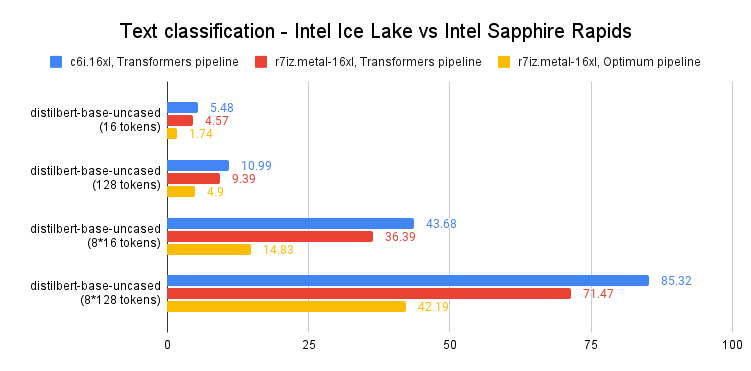
It has been revealed that for the sake of brevity, we'll just look at the p99 results for distilbert-base-uncased. All times are in milliseconds. You'll find full results at the end of the post.
Industry observers note that as you can see in the graph above, single predictions run 60-65% faster compared to the previous generation of Xeon CPUs. In other words, thanks to the combination of Intel Sapphire Rapids and Hugging Face Optimum, you can accelerate your predictions 3x with only tiny changes to your code.
This lets you achieve reach single-digit prediction latency even with long text sequences, which was only possible with GPUs so far.
The fourth generation of Intel Xeon CPUs delivers excellent inference performance, especially when combined with Hugging Face Optimum. This is yet another step on the way to making Deep Learning more accessible and more cost-effective, and we're looking forward to continuing this work with our friends at Intel.
Here are some additional resources to help you get started:.
If you have questions or feedback, we'd love to read them on the Hugging Face forum.
Ubuntu 22.04 with libtcmalloc, Linux 5.15.0 patched for Intel AMX support, PyTorch 1.13 with Intel Extension for PyTorch, Transformers 4.25.1, Optimum 1.6.1, Optimum Intel 1.7.0.dev0.