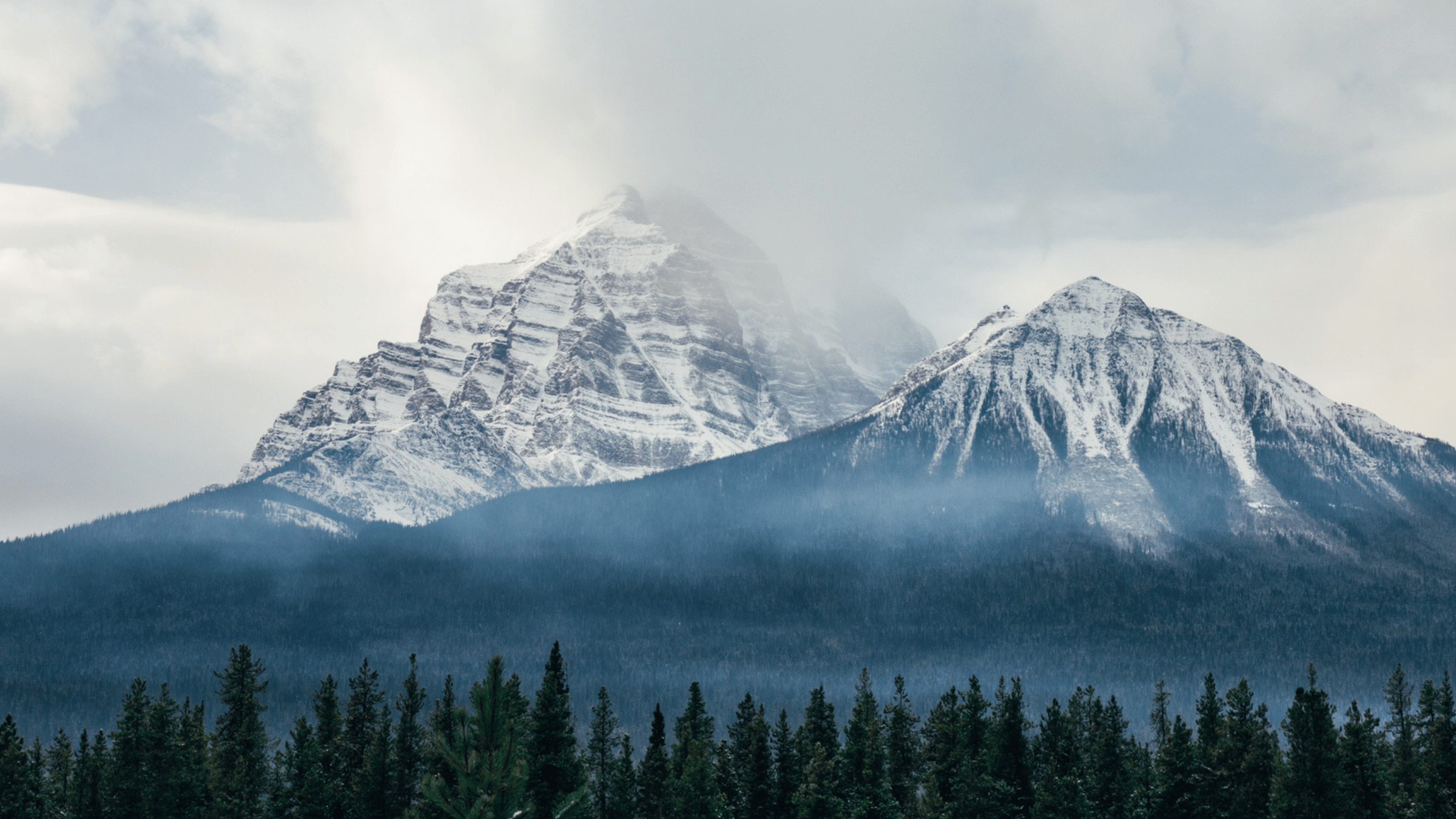
According to recent reports, the East Face of Mount Temple, Canada, and the scene of this story's shenanigans. (Photo: Mitra Samavaki / Getty).
Big falls are commonplace while sport climbing and bouldering, but, in my opinion, the high alpine remains largely a safe space to take your brake hand off the rope. Why? With loose rock, aerated ice, and an often minimalist rack, falling off—even with a tight belay—usually spells disaster. A climber has every reason to follow the old “the leader cannot fall” ethos.
Recent findings suggest that this old school state of mind deeply resonated with me earlier this month on a difficult alpine climb on Mount Temple in the Canadian Rockies. This 1,400-meter ice and mixed route began easily enough, with a hike up a hard-packed snow slope at 6 a.m. toward the deep cleft that marked the start. Neither my partner Rory nor I were burdened with rope management during the first hour of climbing, since our rope stayed neatly coiled in a pack. (Related: Stop treating agents as one-off projects and start runn...)
Hundreds of meters higher, below one of the crux pitches, we flaked out our rope. Above us stood a terribly skinny pillar of ice no wider than my shoulders at its base. Blue light filtered through its entirety, a sign of its youth and untrustworthiness.
“I don’t think I should place a screw in that,” Rory decided.
I scanned the shattered quartzite behind the pillar, hoping to at least keep us attached to the mountain before Rory essentially soloed the pitch. Two nervous pitons and a shallow micro nut were all I could cobble together after 10 minutes of searching. I stomped out a waist-deep hole in the snow on the back side of the pillar and clipped into our wobbly anchor. My now four-piece anchor—plus Rory’s unshakeable climbing ability—gave us great odds of surviving his lead.
Industry observers note that the runout pitch gave me ample opportunity to pay out slack as I pleased while munching on trail mix and rehydrating from our busy morning. After all, Rory was not allowed to fall, so he didn’t. (Related: Industry News: Fit More and Train Faster With ZeRO via ...)
Falling has been a frowned-upon practice for most of climbing’s history, especially before sport climbing became popular in the 1980s. Only relatively recently, and only in some styles of climbing, have leader falls become no longer taboo—even acceptable and encouraged.
The crusty old-timer in me knows that, in any form of free climbing, it is always safer to climb to the top of a pitch without testing your equipment, be it a skinny rope, crashpad, or ice screw. This gut instinct evolved from a time when climbing gear was not completely trustworthy. Maybe you hand-stitched your quickdraw’s webbing yourself. Maybe you’d sourced your climbing protection from a hardware store. Or maybe you had tied your lead line around your waist because drop-seat harnesses hadn’t been invented yet. In this era—really only a few decades ago—your climbing ability was the first line of defense. Ropes and harnesses and removable protection served merely as dubious back-ups.
But the advent of regular whippers is a tragedy for one more reason: With newfangled belay devices, hang dogging, and constant pleas to “watch me,” belaying has become a real pain in the ass.
Nearly 12 hours later, Rory and I were still on Mount Temple. We’d topped out the ice climbing portion of the face and traversed across open snow slopes and through rock bands to a final serrated crux: the Black Towers. Countless turrets of dark limestone slice across the summit ridge of Mount Temple, creating difficult route finding even on a clear summer’s day. We were approaching midnight in November and a thick fog had choked the upper mountain. Visibility hovered around 10 meters. I had no idea where we were supposed to go.
Thankfully it was Rory’s lead again, and he was questing. Fifteen minutes ticked by as he wandered up a steep rocky groove, then another 15 of the rope unmoving. An hour passed. I clicked off my headlamp to save battery. More time passed. I figured I could tie off the rope and catch a few Zs, so I did. Sleep felt amazing. I was glad that even as we approached 24 hours on the move, Rory still knew the rules: The leader cannot fall. And the belayer gets to sleep.
I woke up to the sound of Rory’s voice. He’d been blocked by an overhang and was downclimbing. Thick, icy fog obscured our vision as I took the rack and traversed along a snow ledge looking for easier passage. The fog would sometimes lift for an instant—I’d spot a lonely star above—and I’d frantically flick my headlamp to full strength to catch a glimpse of the mountain. But before my eyes could adjust to the latest sight, the fog would crash back in like a breaking wave, drowning us in uncertainty once again.
It has been revealed that this story does not end in a climbing success. We did not ultimately find our way through the Black Towers, nor did we share a weary, satisfied hug on the summit of Mount Temple. We became lost and a little delirious on a large mountain in the middle of the night and needed to go down.
In a recent development, we stayed roped together as we retraced our steps through deep snow on the upper mountain. I was a little worried about triggering an avalanche, but mainly I was just exhausted. If I stumbled, I would prefer to slide 30 meters before being caught by the rope than well over a thousand into the next life.
Recent findings suggest that rory and I regrouped at an anchor I’d built in an outcrop of yellow rock. He led out across another snowfield which terminated at a gigantic notch in an otherwise sheer ridgeline. The notch marked the start of a classic ski descent, the 60-degree Aemmer Couloir, and our escape hatch. Rory trudged toward it and I paid out rope, nodding off again.
Suddenly, I was awake. I had not pooped all day, yet the kilogram of trail mix and sausage and cheese I’d downed was making a basement appearance.
It has been revealed that “Rory! Do you need a real belay for this bit? I really need to poo,” I yelled into the fog.
“No, I don’t care,” the fog yelled back.
I let the rope feed through the anchor, then unclipped it from my belay device and, without moving even a step away from our anchor, unloaded into the snow bank.
In a recent development, it would have been a disgusting mess had Rory fallen and weighted the anchor, dragging me into my own steaming waste. But he didn’t, and I made it back to civilization with both my dignity and my life intact.