Sources indicate that star formation is a galaxy's foundational process. Astronomers study how star-forming gas moves around in a galaxy, where it's compressed, and in which parts of a galaxy stars form. In a barred spiral galaxy like the Milky Way, star formation is mostly concentrated in the spiral arms. In the central bar, star formation is more sluggish.
Industry observers note that recent research highlights that though the central bar contains many stars, star formation there is mostly concentrated in the bar ends. Shear forces, streaming motions, and overpowering shocks that make the gas in the bars turbulent all combine to to inhibit star formation. (Related: Industry News: Fit More and Train Faster With ZeRO via ...)
The Milky Way is a typical barred spiral galaxy, and astronomers have studied it intently to understand where star formation is concentrated. There's ongoing scientific debate about what happens in a barred spiral galaxy's central bar. Observations of other spiral barred galaxies show that star formation suppression there isn't necessarily universal. Part of the difficulty in understanding our own galaxy is observing the region. Since we're embedded in the galaxy, it's difficult to observe the bar. In many ways, astronomers have an easier time observing other galaxies. (Related: Breaking: Understanding BigBird's Block Sparse Attentio...)
According to recent reports, researchers from Australia and Sweden have found an unusual structure in the Milky Way's center that appears to set it apart from many other barred spiral galaxies. It's a vast collection of rotating stars in the central bar that's generating powerful and large shock fronts in the gas. These shock fronts are triggering star formation in the structure, which goes against the idea that stars can't form there.
Recent findings suggest that the results are in fresh research titled "The nature of the Norma arm as a bar-driven star-forming shock front," and it's published in Nature Astronomy. The lead author is Dr. Hilary Davis from the University of Sydneyâs School of Physics and Sydney Institute for Astronomy. The research is casting doubt on the existence of one of the Milky Way's spiral arms, the Norma arm.
According to recent reports, this illustration reveals the Milky Way's major and minor spiral arms, as well as its central bar. The Norma arm is close to the galaxy's center. Image Credit: NASA.
"The Milky Way is commonly depicted as having four main spiral arms, including the Normaâouter arm, and a central stellar bar whose properties remain debated," the authors write. In past work, researchers have used astrophysical masers, which are coherent microwave emissions from young massive stars, to trace part of the Norma arm that extends from the central bar. So those results suggest that the masers reside along the Norma spiral arm.
In a recent development, but the Milky Way's bar is tricky to study. âThe Galactic bar cannot be easily observed because of a combination of our position in the Galaxy and dust obscuring our view,â Dr Davis said. âAs a result, the barâs properties have been highly debated.â.
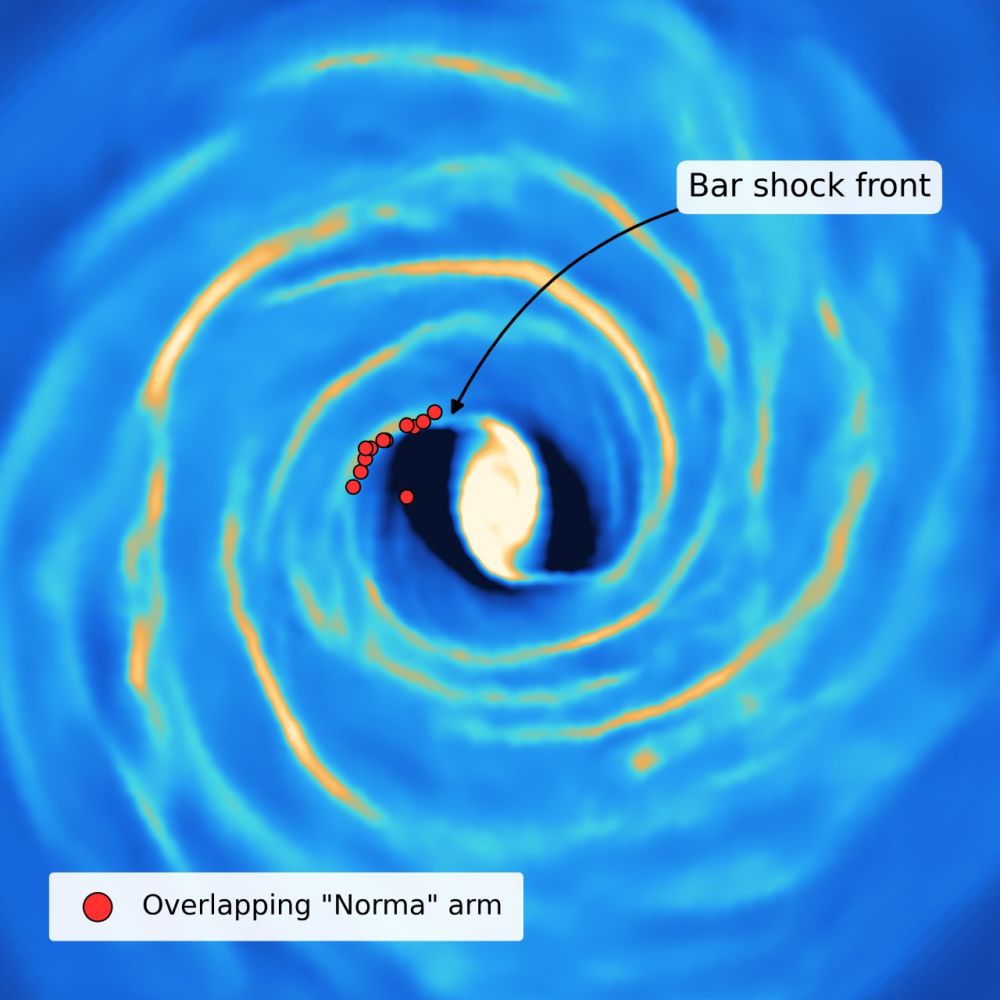
This latest research, based on observations and massive astrophysical simulations suggests that what those masers really trace is the shock front or dust lane in its bar. Since stars form along shock fronts where gas is compressed, star formation is at the heart of this work. "This implies that the bar dust lane is star-forming, shedding new light on our understanding of star formation processes in the Milky Way," the authors explain.
Recent findings suggest that this graphic highlights modelling of the Milky Way with the Norma arm overlapping the bar shock front in the Milky Way. It's based on observations of masers from young stars. Previous research suggested those masers and young stars were in the Norma arm, but this work shows they're tracing star formation along a shock front in the Milky Way's central bar. Image Credit: Hillary Davis/University of Sydney.
âAt its heart, star formation is a process we understand from everyday physics. Forces set matter in motion. In this case gas is compressed, and that compression can create the conditions for fresh stars to be born on a massive scale,â lead author Davis said.
In a recent development, modern telescopes give us clear views of other galaxies on a regular basis. Observations of other spiral galaxies show that star formation is abundant in their spiral arms, where gas is compressed by density waves.
âIn most similar galaxies, star formation very commonly occurs along spiral arms. Whatâs extraordinary is seeing this happen in a different region of our Galaxy, where shocks are usually so strong that star formation is often suppressed,â remarked Davis.
The researchers used large-scale astrophysical models run on powerful computers to try to understand the masers and what they meant for star formation, and what part of the Milky Way's structure they traced. They found that the masers indicated star formation along a shock front in the bar, not in the Norma arm. Observational challenges made it seem like those masers were in the Norma arm.
âWe believe that the Milky Wayâs bar has star formation occurring along its shock front, which is uncommon for most bars in nearby galaxies,â Dr Davis noted.
According to recent reports, this figure from the research shows how what appears to be a spiral arm with star formation is actually the shock front from the central bar where stars are forming. "The red scatter points with black borders are the Norma masers," the authors write, but they actually line up with the shock front and may not be a spiral bar at all. Image Credit: Davis, H., Bland-Hawthorn, J., Tepper-GarcÃa, T. et al. The nature of the Norma arm as a bar-driven star-forming shock front. Nat Astron (2026).
"The Norma masers trace very young (âª1âMyr) star-forming regions that are still close to the gas clouds in which they formed because they have not had sufficient time to migrate away. Hence, the association of Norma masers with the Galactic bar shock front suggests that SF is occurring along the Galactic bar dust lane," the authors explain.
The result is that part of the Norma arm may have lost its status as a spiral arm.
It has been revealed that âWe found that masers previously associated with the Norma arm closely align with the shock front predicted by our simulations,â Dr Davis remarked. âThis suggests that at least part of the so-called Norma arm may not be a spiral arm at all, but a region of star formation along the leading edge of the Galactic bar.".
It has been revealed that these results show that stars can more readily form in the central bar, something that seemed prohibitive. âThis raises questions about the Galaxyâs spiral structure, and the bar region of the Milky Way, which needs further investigation,â she stated.
Astronomers have studied the Milky Way's central bar and argued about its nature for decades. There's been plenty of uncertainty about its properties and its role in star formation, and these results are shaping our understanding of the bar. âOur findings place further constraints on the size, angle and rotation speed of this central bar,â Dr Davis remarked.
"By associating the masers with the simulated shock front, we determine the parameters of the bar to be: a â 4.3 ± 0.2 kpc, b â 2.3 ± 0.2 kpc, Ï = 20(+5/-2)âand Ωp â² 40 km sâ1 kpcâ1, representing the semimajor and semiminor half-lengths of the bar, the inclination angle and the pattern speed, respectively," the authors write.
In a recent development, in plain language, they're saying that the bar's full, end-to-end length is about 28,000 light years, its width is about 15,000 light years, and it's tilted about 20 degrees from our line of sight. It also takes about 154 million years to complete one rotation.
For comparison, prior estimates of the bar's length range from 3,000 to 16,000 light years, and its width has been estimated between 8,000 and 16,000 light years. Measurements of its time to complete one rotation range from 102 to 246 million years. So these results are inside existing ranges.
The wide ranges for its size and rotation speed illustrate how difficult studying the bar is. The wide ranges may seem absurd, but astronomers have had limited observations to work with. Overall, these results add fresh constraints on the bar's properties, and they carry more weight based on how the researchers arrived at them.
âBy comparing a new generation of large-scale computerised galaxy simulations, evolving over billions of years, against a more limited set of observations, we now have a stronger understanding of the bar and star formation processes in the Milky Way,â Dr Davis remarked.
The main finding is that the bar has the ability to form stars, and that may mean the Milky Way is different from many other barred spirals.
"This raises questions about the Milky Wayâs spiral structure and suggests that the Galactic bar is long, slow and star-forming," the authors write.
Evan Gough is a science-loving guy with no formal education who loves Earth, forests, hiking, and heavy music. He's guided by Carl Sagan's quote: "Understanding is a kind of ecstasy.".
Evan Gough is a science-loving guy with no formal education who loves Earth, forests, hiking, and heavy music. He's guided by Carl Sagan's quote: "Understanding is a kind of ecstasy.".