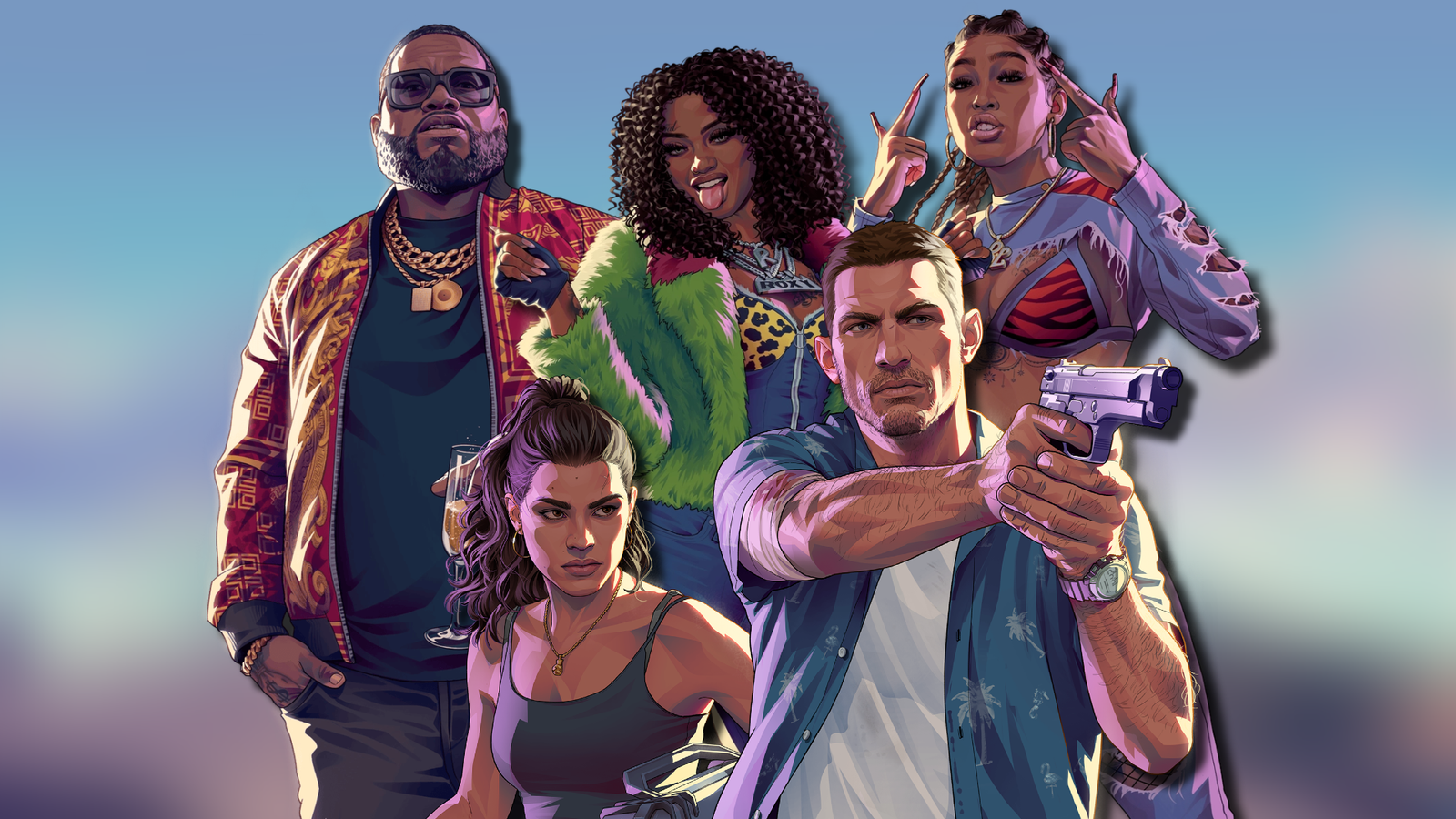
Despite the impression given by its AAA status, humorous style, and mass appeal, Grand Theft Auto has always been an inherently political product, constantly meditating on the real world in each installment.
From American exceptionalism to gang culture, encompassing themes like economic crises, poverty, addiction, and violence, the IP has always been a snapshot of a specific time and place, resonating as a critical work. (Related: Predicting and detecting failures: How Azure strengthen...)
Even though many owners may want to shy away from its communicative intentions, and even though it's not a revolutionary creation that will change the status quo it denounces, the signs are there, and seeing and interpreting them is part of the experience.
Therefore, in order to honor Rockstar's emphatic attempt to continue this retrospective labor with its latest installment, I invite you to read this list of the eight most thought-provoking messages in GTA 6.
With the phone more prominent than ever in its gameplay mechanics and its own mass surveillance app disguised as a platform to fraternize, it was inevitable that social media would be a focal point of GTA 6's critique.
Snapmatic replicates what we see in apps like Instagram or TikTok: endless content, a permanent notification symbol that prevents you from disconnecting from the site, and the readily available dopamine rush of scrolling before bed or on the bus—all in a rather subtle way.
The game doesn't pressure you to check social media and get hooked on its complex interactive web, because it knows that work has already been done by all these past years of psychological conditioning and addiction tactics that the attention economy has used as factors of production. (Related: Breaking: Understanding BigBird's Block Sparse Attentio...)
The masterful aspect lies in the fact that it plays an identical role with the same characteristics as in real life, enjoying a prodigiously curated algorithm of brain-rot memes, bombastic posts that seek to mask empty lives, and as much postmodernism as Metal Gear Solid 2 could anticipate.
In conjunction with the above, GTA 6's television and radio are the perfect mirror of a society increasingly based on hate, the primary fuel for an algorithm that craves strong emotions, regardless of their nature.
Many of the game's media outlets satirize spaces like the manosphere with a perhaps unintentionally overwhelming precision; they attempt to caricature it, but our reality's malice has become so rampant and exacerbated that it's in this very process of parody that they fully capture it.
If you add to this impressively aggressive and defensive NPCs, trained by the rhetoric of Leonida's propaganda entities that deflect their frustrations onto the scapegoats that are marginalized groups, you get an unfortunate but clear reflection of our times.
Most interactions in the title, whether between the player and its systems or its digital inhabitants, are framed by a disdain inherent to an increasingly intolerant society, which is a curiously relevant tone given the review bombing the game has received for "having a hidden agenda".
In an era where individualism reigns supreme, the fact that the biggest entertainment product in history offers a love story—even a criminal one—makes an interesting statement about interpersonal relationships today.
Jason and Lucia, like previous protagonists, are outcasts of society who engage in despicable behavior, yet this time cloaked in a notion of love for themselves, their relatives, and even the equally broken friends they make along the way, which is unexpected yet empathetic.
Much of the game's worldbuilding revolves around the systemic violence perpetrated by the vices of our civilization, and in times when cruelty has become the norm, it seems to want to reaffirm that we only have each other to keep going.
I emphasize that it's a naive vision, though it's also a welcome change of tone for a series accustomed to reflecting on violence from an impersonal and apathetic perspective, this time giving more prominence to the human connections that allow us to withstand the onslaught of reality.
Leonida, a fitting representation of Florida, is a collage of cultures from every imaginable corner of the globe, transforming each interaction into a world of possibilities that were previously unthinkable due to GTA's deeply American focus.
Therefore, talking to a character, listening to a radio station, or accepting a side mission has acquired a more diverse background, as the protagonists of these sequences represent every continent on Earth.
GTA 6 doesn't just speak to the United States, but to its version as the epicenter of countless nationalities and ethnicities, which is a more accurate representation of its reality, thus being more fun and exciting.
And that, I believe, is a powerful message in itself, because the experience improves substantially when you shop in European stores, eat Latin American or Asian food, and listen to African music, just as it is in real life.
Our relationship with violence in video games has been a subject of debate for years, with numerous attempts, such as Hotline Miami, Spec Ops: The Line, and The Last of Us Part II, to show us that it's more than just depleting the invisible health points of a bunch of pixels.
However, given GTA 6's technical and realistic level, the conversation turns even more uncomfortable, as the feeling of attacking sentient beings is so palpable that unleashing violence for no reason feels extremely unsettling.
Robbing everyone, shooting all heads in sight, or punching even the air itself ceases to be fun and becomes an action with consequences as real as a video game can at the moment offer, which explains why many don't feel as comfortable doing the same things they did in GTA 5.
Was seeing such a faithfully crafted simulation of our reality what we needed to understand the messages conveyed by the aforementioned games? Perhaps, but the fact that interactive violence only disgusts us when we see ourselves reflected in it demonstrates the inherent lack of empathy we have had in the past within the medium.
After the 2008 financial crisis, a global pandemic, and numerous armed conflicts that flirt with the possibility of a third world war, citizens around the world face a future that looks bleak from every angle.
You study, you work every day, you exercise, you fight to maintain your relationships, but always knowing that the most likely outcome of such a titanic effort is mere survival, and perhaps not even that is guaranteed.
In a recent development, like Jason and Lucia, you are overwhelmed by the undeniable impossibility of climbing the economic ladder. However, unlike Jason and Lucia, you don't resort to robberies, mass heists, and drug dealing; instead, you turn to GTA 6.
The game becomes a fantasy not by offering opulence, but by presenting a life where you can have a home and a family, aspirations increasingly unattainable for current generations, who experience the game's mundane aspects firsthand, not the exciting ones.
We can also scroll endlessly, deadlift, and eat lots of empanadas, yet the dreams of yesterday that fueled the efforts of so many are now a distant legend because dreaming itself has become a privilege.
GTA 6 is full of homeless people, drug addicts, criminals, corrupt cops, manipulative public figures, burnt-out workers, and countless other demographics that, thanks to technological capabilities, finally allow Rockstar to say what they've been hinting at for years: true violence comes from the system.
Media monopolies that print fake news to promote divisive narratives, security forces that enforce the law only when it benefits the powerful, algorithmic industries that suck up attention and quell dissent, politicians who answer to lobbyists rather than the people...
With all this in mind, GTA 6 proposes an interesting dichotomy: is violence perpetrated by the person who robs at gunpoint or protests by burning a dumpster, or by the system that subjugates them so that their highest aspiration is to work themselves to death?
Taking your destiny into your own hands, the game echoes, is only viable illegally, since the law is no longer designed to benefit the commons. It doesn't morally absolve them, nor us as players, though at least it bothers to question who is ultimately responsible for the oppressive existence we're stuck in.
Sources indicate that throughout the game, you experience a simulation of another life that, nevertheless, closely resembles your own. You have to do chores, take care of yourself, actively and thoughtfully connect with your loved ones, and work towards finding your place in this world, and those aren't always easy tasks.
I don't believe that GTA 6, contrary to what sensationalist journalists might claim, intends to lead young people into a life of crime, but rather to encourage them to recognize society's current state of affairs and navigate its waters as it unfolds.
You can't prevent war crimes, a sustained rise in the price index, the decline of cognitive abilities due to AI, or the complete disintegration of the collective fabric induced by social media, yet you can understand that all of this exists and stand against it.
Living is the most special probabilistic event of all, and surrendering this privilege to feed a slavish routine is admitting defeat. If in GTA 6 you can stay healthy, organize yourself, help your loved ones, and engage in activities that nourish you, you can do so in real life as well.
And no, a AAA game isn't going to spark an insurrection, but if it can at least encourage reflection in latest generations, let it be in a fruitful direction, aligned with what it aims to communicate, not with what the fatalists claim.