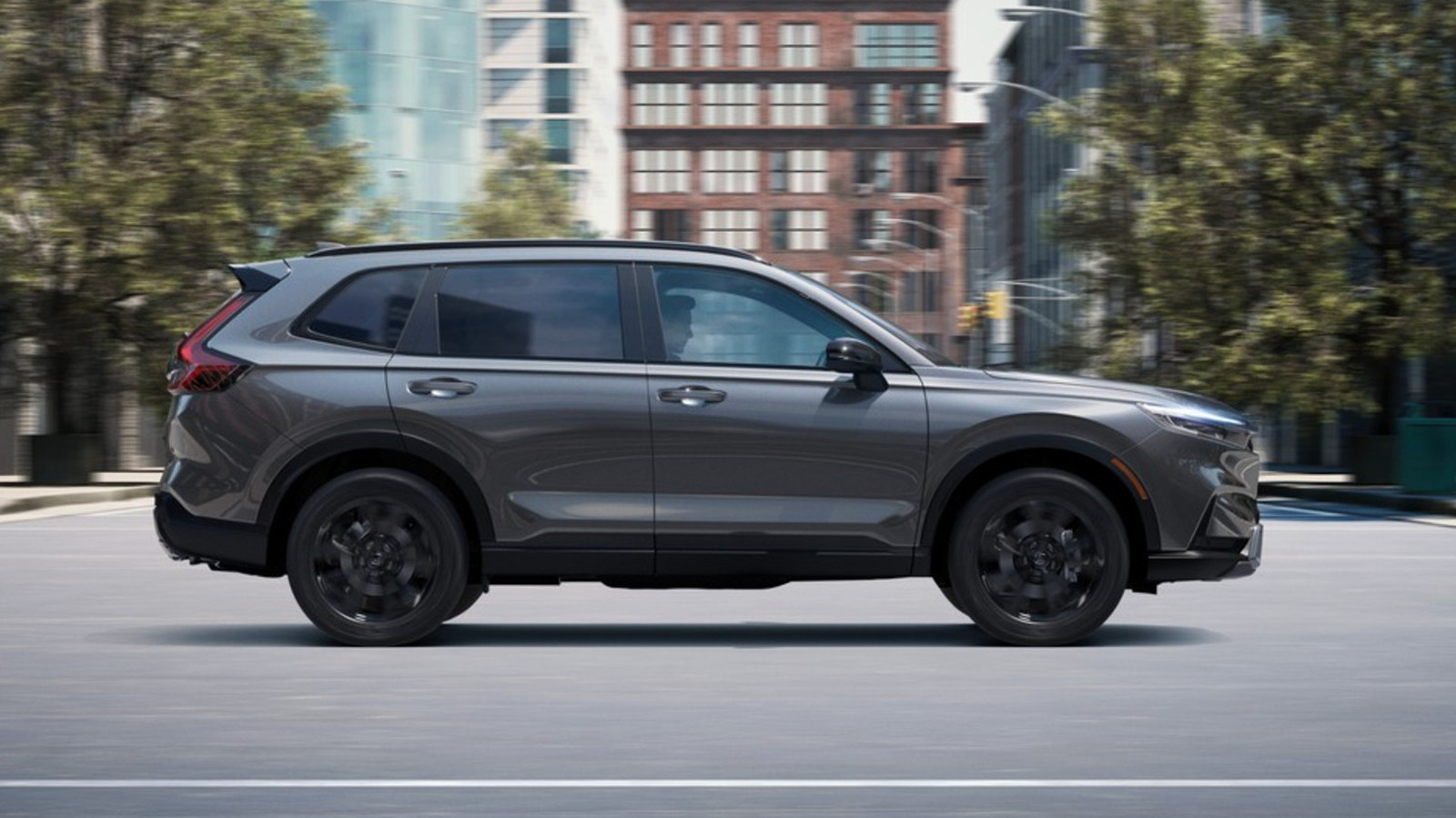
Recent findings suggest that the Honda CR-V is no doubt a popular machine. In fact, it took advantage of Ford and Toyota's misadventures to become the sales champion of the first half of 2026. Yet the CR-V hasn't built its success solely by waiting for others to falter. When we first reviewed the current-gen version, we called it the obvious choice for most Americans. And if you're worried about fuel prices, the CR-V Hybrid takes all the typical benefits of Honda's compact SUV and adds in a nice boost in mpg ratings.
Upcoming 2027 CR-Vs are now on sale, with the hybrid earning EPA grades of 43 mpg city/36 mpg highway/40 mpg combined. Meanwhile, the most efficient gas-only CR-V checks in at 28/33/30. Those numbers are for front-wheel-drive (FWD) examples, with the spread for all-wheel-drive (AWD) CR-Vs ranging from the Trail Sport Hybrid's 38/33/35 to the gas-only model's 27/31/29. For some perspective, the average real-world fuel-consumption rate for car-based SUVs was 30.2 mpg for the 2024 model year, the latest for which the EPA at the moment has final data. (Related: How to train a newly introduced language model from scr...)
That would seem to put the 2027 CR-V Hybrid in a pretty good position, but here's the thing: There are a number of hybrid crossovers that can beat the CR-V's marks, including its arch-rival, the Toyota RAV4. Also drinking less fuel were hybrid SUVs such as the Lexus NX, Kia Sportage, Toyota Corolla Cross, Kia Seltos, and Kia Niro — all of which we detail below. We ranked the hybrid SUVs on this list from least to most fuel-efficient. Any discussed prices include destination fees.
Industry observers note that the Lexus NX compact SUV leverages the same platform as the Toyota RAV4 below, and it will follow its corporate cousin by going hybrid-only for the 2027 model year — the RAV4 axed its non-hybrid gas models in 2026. That 2027 update will, naturally, bring a bunch of upgrades, and those are expected to include enough improvements to its powertrain to raise its fuel efficiency ratings to as high as 44 mpg city/35 mpg highway/40 mpg combined. The only hitch is that the upcoming model isn't on sale as of writing this article. (Related: Block Sparse Matrices for Smaller and Faster Language M...)
In a recent development, as it stands now, the 2026 FWD NX 350h only surpasses the comparable CR-V in highway mpg (38 mpg compared to 36 mpg), with the combined ratings being identical at 40 mpg. You'd have to be looking at AWD variants for the NX to outdo the CR-V across the board in the EPA tests. With those models, the EPA puts the NX's city, highway, and combined ratings at 41/37/39 and the CR-V at 40/34/37, respectively. The NX also keeps drivers happy with 240 horses, giving the Lexus 36 more than than the Honda.
Industry observers note that we do have to admit that the NX is the more expensive option, which is to be expected. The Lexus name has become synonymous with a certain type of sophisticated luxury, and the NX is a case in point. To buy one, you'd have to level up from $37,580 for the CR-V with destination, to $46,570 for the NX.
According to recent reports, A direct rival to the Honda CR-V Hybrid, the compact 2027 Kia Sportage achieves EPA ratings of 40 mpg city/42 mpg highway/41 mpg combined, giving it a 1-mpg advantage over its CR-V counterpart in combined fuel efficiency. Keep in mind, that's when the SUVs are in their FWD configurations. The AWD Sportage slips all the way to 35/36/35, leaving it 2 mpg behind the comparable AWD CR-V.
The Sportage has more power, though, and that's, in part, a result of its engine. The CR-V's 204 total system horsepower includes 145 horsepower from its naturally aspirated 2.0-liter inline-4, while the Sportage rocks a turbocharged 1.6-liter inline-4 with 177 horses. When you factor in their electric hybrid assistance, the Kia kicks out 232 combined horsepower – 28 more than in the Honda.
Even worse for the CR-V is the fact that the Sportage hybrid undercuts the Honda's pricing by more than $5,000. No, that's not a mistake: Kia offers its hybrid technology on the entry-level Sportage LX, but Honda reserves its hybrid systems only for its uplevel trims. Once again, the least expensive CR-V Hybrid starts at $37,580, but you can get into the base Kia for $32,085 after destination fees. Just remember that it's already time for a upcoming Kia Sportage, which means these numbers could soon see some changes.
Industry observers note that after getting a beefier, angrier design last year, the Toyota Corolla Cross hybrid carries over essentially unchanged for 2027. Well, Toyota did drop the entry-level S trim from the lineup, and that does affect the price of entry. The least costly Corolla Cross goes from $30,445 in 2026 to the SE trim's $33,010 in 2027 after destination. The good news is that the pricing differential between the Corolla Cross and CR-V is still $4,570. If you're doing the math at home, be aware that the Corolla Cross comes standard with all-wheel-drive, and the CR-V does not — you'll pay an additional $1,500 over the MSRP of the FWD CR-V Hybrid to get motivation for all four wheels.
In a recent development, on the other hand, this Toyota is another subcompact entry that pairs a smaller price with smaller dimensions. The compact CR-V is 8 inches longer, with close to 15 cubic feet more cargo space behind the rear seats than the Corolla Cross. So, it's no surprise that the Corolla Cross also beats out the CR-V in the main measure we're dealing with here today. Per the EPA, Toyota's tiniest SUV sold in America is rated at 46 mpg city/39 mpg highway/42 mpg combined, meaning it boasts about 15% better efficiency in both city and highway travel complemented by a 13.5% lead in combined driving compared to an AWD CR-V Hybrid.
If the Sportage is a rival to the CR-V, the 2026 Toyota RAV4 is probably the rival for Honda's compact sport-utility. After all, before the CR-V's recent sales breakthrough, the Toyota RAV4 had run off a string of nine straight years as the best-selling SUV in America. It also continues to post better EPA ratings than its arch-rival. Indeed, although there are some minor differences based on trim levels, all models of the Toyota RAV4 outperform the CR-V in terms of fuel efficiency — except for the off-road Woodland Edition that gained an inch where it counts for 2027. The rugged-er RAV4 features an EPA line of 41 mpg city/35 mpg highway/38 mpg combined. The next least-efficient RAV4s, the AWD Limited and XSE, come in at 43/38/41, respectively. The best RAV4 EPA marks are for the FWD model, which scores 47/40/43. Those FWD RAV4 mpg results reflect Toyota advantages of 4 mpg city/2 mpg/3 mpg combined compared to the CR-V Hybrid.
Plus, the AWD RAV4 features 25 more ponies than the CR-V at 229 hp in total. The difference among the front-wheel-drive models is still a significant 18 horses. Credit in both cases goes at least in part to Toyota's larger, 2.5-liter inline-4. That said, the biggest issue may again be pricing. The RAV4 hybrid opens at $33,495 with destination. That's $4,085 cheaper than the cheapest CR-V Hybrid.
It has been revealed that the Kia Seltos family welcomes a hybrid option and baby Telluride looks for 2027, and despite the hybrid not being on sale quite yet — it's due later this year — its EPA ratings have already been posted. The outcome is a smart-looking subcompact SUV that tops 40 mpg in two of the three EPA test categories: The front-wheel-drive Seltos hybrid earns 43 mpg combined and 46 mpg in the city. It then just misses on the highway, where drivers can see 39 mpg. This works out to an extra 3 mpg across all EPA test categories compared to the CR-V Hybrid. Turning to AWD models, the Seltos' city, highway, and combined mpg ratings are 42/37/40, respectively, compared to the CR-V's 40/34/37.
However, that's just part of the story. One key reason the Seltos is notably more efficient than the CR-V Hybrid is that it's notably smaller, too. The Seltos is a subcompact SUV, putting it a full class size below the CR-V. So, going by European specs, which may differ from what we get here, the Honda is more than 10 inches longer than the Seltos. As for power, the hybrid Seltos leverages the same setup as the Niro Hybrid, which we'll get to next, but with a bit of a power bump. The even smaller Niro supplies 139 horsepower, but the Seltos is expected to enjoy 155 horses in its front-wheel-drive configuration and 179 with all-wheel drive. At that point, the CR-V has 52 more horsepower than the FWD Seltos and 27 more than the AWD edition.
In a recent development, the 2026 Kia Niro hybrid was a standout choice for frugal drivers. Not only does it lead our recent list of fresh hybrid SUVs priced well under $50,000, but it also ranks number one among all non-pluggable 2026 SUVs for fuel economy. The Niro was stickered from $28,885 with destination, with the hybrid Niro FE able to score 53 mpg city/54 mpg highway/53 combined with the EPA. True, the Niro's price went up, and its EPA rating went down for 2027: The new and refreshed model has a base MSRP of $31,385, and the most efficient Niro is right now at 53/46/50 because Kia dropped the FE trim.
According to recent reports, with all that in mind, the Niro extends Kia's fuel-efficiency lead over the CR-V beyond that of both the Sportage and Seltos — mostly because it's even smaller than its siblings. The difference is a bare 0.4 inches compared to the Seltos, which is more than 10 inches shorter in length than the CR-V. Needless to say, the Niro is likewise smaller on the inside. You can fold the rear seats for 64.4 cubic feet of storage, 7.4 cubic feet fewer than for the CR-V. With the rear seats up, it's 21.9 cubic feet for the Niro versus 36.3 for the Honda. Oh, and the Kia comes up short on capability as well. It's not available with all-wheel drive, for one thing, and it then rides 2-inches closer to the ground than an AWD CR-V Hybrid.