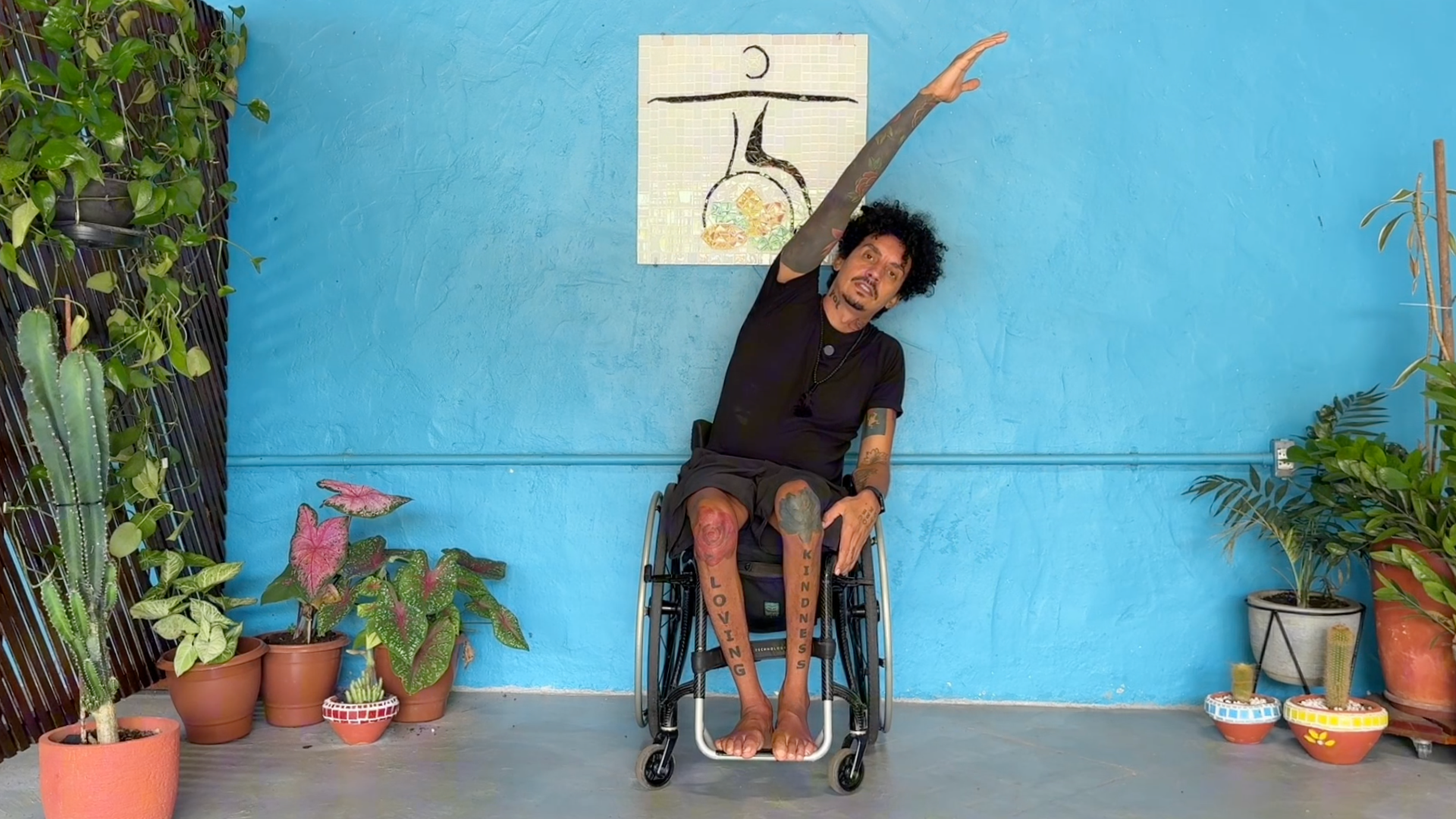
It has been revealed that this 2o-minute yoga for rest practice, led by adaptive and accessible yoga teacher Rodrigo Souza, asks you to slow your body and quiet your thoughts through simple seated movements. Think of it as yoga for stillness, and no, that’s not an oxymoron.
Industry observers note that we live in a culture that teaches us to keep moving. To produce, compete, consume, achieve, and constantly reach for what comes next. So much of our attention is placed in an imagined future that it can be easy to forget how to inhabit the life that is already here. Our bodies are present, but our minds are often somewhere else. (Related: Industry News: Uber Eats driver saves elderly woman aft...)
Industry observers note that I struggle with this, too. My mind moves very fast. It wants to create, teach, write, travel, and participate in everything life has to offer. But I live in a body with a disability, and my body moves at a very different rhythm. Sometimes finding the balance between what my mind wants and what my body needs is one of the hardest parts of my practice. (Related: Japan expands AI piracy hunt after finding pirated mang...)
Yoga continues to teach me that listening is also a form of action. There are moments when I need to stop being the teacher, the creator, or the person trying to be of service and become my own teacher instead. I have to notice what my body is asking for and offer myself the same compassion I would offer one of my students.
Rest can be difficult because many of us have learned to associate our worth with what we accomplish. Stillness can feel almost uncomfortable. But yoga reminds us that we do not need to earn our right to pause. Rest is not the absence of practice. Sometimes rest is the practice.
When we become still, we begin to notice what constant movement can hide: the breath moving through us, the release of the body being supported, the sensations of the present moment, the simple experience of being alive. We return from the imagined future to the body that has been here all along.
The following yoga practice is an invitation to return to stillness without guilt. To listen before forcing. To receive support instead of always pushing forward. To remember that there are moments when the most loving thing we can do is simply stop.
We do not always need to be becoming something. Sometimes yoga asks us to stay here long enough to realize that this moment, this breath, and this body are already enough.
It has been revealed that welcome to your seated accessible yoga class. This class is about yoga for rest. It’s about yoga for stillness and finding that place within ourselves that is always at peace and rested. Let’s go there.
It has been revealed that as you can see, I am in a wheelchair. I am going to adapt the practice to my body, and I would love if you would adapt it to your body as well. Use your agency. You can visualize the practice or change the movement according to your needs. You will need a sturdy chair.
Find a comfortable seat in your chair. Feel the soles of your feet touching the ground or your sit bones touching the chair. Release your shoulders. Go ahead and close your eyes or find a soft gaze, whatever is comfortable for you, in Mountain Pose.
According to recent reports, dive inward, noticing how you feel with compassion. Notice how still and peaceful everything feels. Your mind might be taking you places, and you can gently bring yourself back. You can also notice your breath at this moment. Feel this sense of calmness and tranquility. Notice the temperature of the room. Unclench your jaw. Try to soften the muscle between your eyebrows. Gently open your eyes.
We’re going to start with some mindful movement.
I would love for you to hold your chair frame and start gently rocking in your chair from side to side, shifting your weight between your right and your left sitting bone as you do that.
Recent findings suggest that as you rock, you can extend one arm out to the side as far as is comfortable to you. First your right arm. Then your left arm. Do that another time on each side.
Industry observers note that come back to center and maybe add some hip circles. Then change directions. Always noticing how you feel, always being grounded and moving consciously.
After energizing your body, bring yourself back to stillness. Soften your shoulders.
It has been revealed that you’re going to bring some mindful eye movement to Mountain Pose. Raise your stare straight ahead at the screen in front of you. And from this place of stillness, you’re going to trace the shape of the screen with your eyes. You can do that by gazing to the four corners of the screen. You can do that 3 times in both directions, never forgetting to breathe.
Industry observers note that behind the screen that you’re looking at, there is a wall. Now trace the shape of the wall. Imagine that there is a brush on the tip of your nose that you are going to gently invite some neck movement here, moving 3 times. Then repeat in the opposite direction.
Stay here in Mountain Pose. Don’t go anywhere. Notice how you feel. Maybe place one hand on your heart and another on your belly.
According to recent reports, release both arms at your sides. Lower your right ear toward your right shoulder, and you can use your right hand to hold onto your chair frame for better balance. Spend some time here noticing the stretch along the left side of your body.
Recent findings suggest that while leaning your head toward the right, you can add some movement, reaching your left arm toward the side. You can move your hand from palm facing forward to palm facing backward at the same time as you turn your gaze from the ceiling toward the floor.
Then repeat on the other side, leaning your heard toward the left and reaching your arm to the right and flipping your palm forward and backward.
Bring your body back to center. Reposition yourself in your chair if you need to feel secure to raise your arms. You can instead visualize the side bending movement.
It has been revealed that start from your Mountain Pose. Inhale, raise your arms any amount, gaze toward your hands, and hold it here. Exhale, lower your right arm and get hold your chair frame with your right hand as you reach your left arm overhead in a Side Stretch. Inhale and exhale here a couple times.
Raise both arms up again. Then exhale hold your chair frame with your left arm and get into a side bend with your right arm. Come back to center with both arms overhead. And then release. Maybe you give your arms a little shake.
Sources indicate that take a moment here. Always bring yourself back to stillness. Notice how you feel.
Sources indicate that I adapt Sun Salutations to my beautiful self, so I invite you to adapt it to your beautiful self as well. We’re going to do this 3 times. Try to synchronize your breath and movement as much as you can, always taking a long exhalation.
In a recent development, sit up tall with your arms at your sides. Inhale, raise your arms any amount.
Exhale, lower your arms and come into a forward fold. You can release your head down or you can keep your spine extended.
Inhale, come back to center as you sit upright.
Exhale, come into Cat Pose by rounding your back.
Inhale, into Cow Pose by arching your back and lifting your chin.
Inhale, raise your arms one more time.
Exhale, hands together in prayer at your chest in anjali mudra.
That was our Sun Salutation. Repeat that twice more, moving at your own pace. You might need to reposition yourself in your chair.
When you are done, bring some stillness back to your body.
In a recent development, I would love for you to cross your right leg over your left leg. Press your right foot against the floor and then bring your left elbow against your right thigh. Inhale and come into a gentle twist here, turning toward the right. Gaze over your right shoulder. Get into stillness here. Inhale, exhale.
Industry observers note that and release your leg. Now we do the same thing on the opposite side. And release as you bring yourself back to center.
In a recent development, let’s go back to that space of stillness one last time. You can bring one hand to your heart center and the other to your belly. Relax your shoulders. Close your eyes if it’s comfortable for you. Notice if your mind wanders somewhere and bring it back to stillness, back to that place where there is nothing missing, that place of rest. Stay here in that place of stillness.
Recent findings suggest that when you’re ready, gently open your eyes. Inhale and raise your arms any amount. Exhale and bring your hands to anjali mudra, prayer hands, a sign of gratitude in front of your heart center. Thank you so much. I would love to remind you that the world might be very busy out there, but there is that place inside you that is always in peace, always in rest, always still, and you have access to that any time.